
Water-Cooled vs. Air-Cooled Industrial Chillers
A Professional Selection Guide for Engineering Process Applications
In the field of industrial cooling, selecting the appropriate chiller architecture is a fundamental decision that impacts energy efficiency, operational stability, and long-term ROI. At APT Group, we evaluate every project based on specific engineering requirements, particularly for demanding environments like T3 high-ambient conditions.
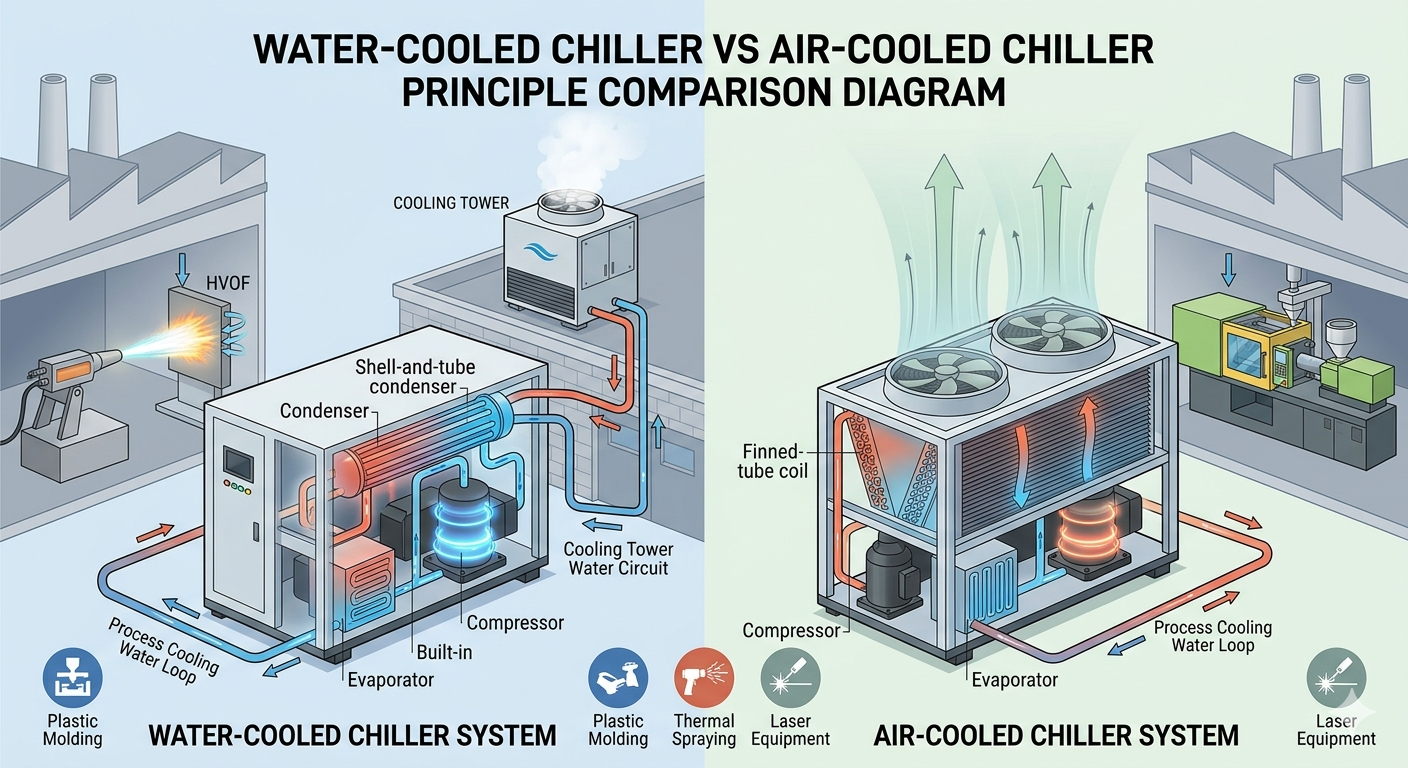
Technical Comparison Analysis
| Engineering Factors | Air-Cooled System | Water-Cooled System |
|---|---|---|
| Heat Dissipation | Ambient air via finned-tube coils | Water circulation via cooling tower |
| Energy Efficiency (COP) | Standard Performance | High Efficiency (20-25% Savings) |
| Installation Footprint | Compact & Self-contained | Requires external tower & pumps |
| Ambient Temp Sensitivity | High (capacity drops in heat) | Low (Stable in T3 conditions) |
| Target Applications | Plastic Molding, Mobile Units | HVOF Thermal Spray, Large Plants |
Expert Selection Insights
While Air-Cooled Chillers offer unmatched flexibility and “plug-and-play” convenience for smaller facilities or water-scarce regions, Water-Cooled Chillers remain the industry standard for high-capacity engineering process applications. For processes like HVOF thermal spraying, where heat loads are massive and constant, the water-cooled system provides the necessary thermal stability to protect expensive spray guns and ensure coating consistency.
Ready to Optimize Your Cooling Process?
Speak with our technical engineers for a customized cooling load calculation and T3-certified equipment specifications.
Get a Technical Quote