
Industrial Chiller Applications for Process Cooling
APT Chiller supports industrial process cooling applications where stable temperature control, reliable flow, and application-based engineering are required.
How should I choose a chiller by application?
Start from the heat source and cooling object: spray gun, laser source, mold, die, plating bath, reactor, tank, spindle, or production loop. Then confirm cooling capacity, target water temperature, flow rate, pump pressure, water quality, ambient temperature, voltage, and site conditions. APT can match the application to an air-cooled, water-cooled, or custom industrial chiller configuration.
Core Industrial Chiller Applications
Focus on the main industrial process cooling applications where stable temperature, flow, and engineering review matter most.
Thermal Spray Cooling
Closed-loop cooling for HVOF spray guns, plasma spray torches, coating systems, and power supplies.
View Thermal Spray CoolingLaser Cooling
Stable chilled-water cooling for laser sources, optics, power supplies, and industrial laser systems.
View Laser CoolingInjection Molding Cooling
Mold cooling, hydraulic oil cooling, feed throat cooling, and process temperature control.
View Injection Molding CoolingDie Casting Cooling
Cooling for die casting machines, molds, quench loops, and high-temperature production equipment.
View Die Casting CoolingElectroplating Cooling
Process bath cooling for plating tanks, anodizing lines, rectifiers, and surface treatment systems.
View Electroplating CoolingChemical Process Cooling
Temperature control for reactors, tanks, condensers, heat exchangers, and process loops.
View Chemical CoolingApplication Selection Matrix
Compare process objects, cooling requirements, recommended chiller types, and engineering options before selecting an application path.
By Cooling Object
- Spray guns / torches
- Laser sources / optics
- Molds / dies
- Baths / tanks
- Reactors / condensers
By Cooling Requirement
- Stable temperature
- High flow / pump pressure
- Closed-loop circulation
- Corrosion resistance
- High ambient operation
Recommended Chiller Type
- Air-cooled for simple installation
- Water-cooled for large capacity
- Custom for special conditions
- Parts / heat exchangers for service
Engineering Options
- T3 high ambient
- Stainless steel / titanium
- Explosion-proof review
- Special voltage
- PLC / communication
Find Chiller Solutions by Cooling Requirement
Start from your cooling condition and identify the process cooling solution that best matches your application requirements.
Closed-Loop Equipment Cooling
For spray guns, plasma torches, lasers, test equipment, CNC spindles, and precision systems.
Mold & Tool Cooling
For injection molds, die casting molds, forming tools, and production equipment.
Process Bath Cooling
For electroplating, anodizing, chemical tanks, extraction systems, and surface treatment lines.
High-Capacity Production Cooling
For production lines, centralized chilled-water systems, and continuous industrial operation.
Corrosion-Resistant Cooling
For plating, chemical fluids, seawater risk, stainless steel, or titanium heat exchanger needs.
High-Ambient Cooling
For T3 high ambient, outdoor installation, hot workshops, and Middle East project conditions.
Recommended Chiller Types by Application
Match your application requirements with the most suitable APT chiller product category for further technical review.
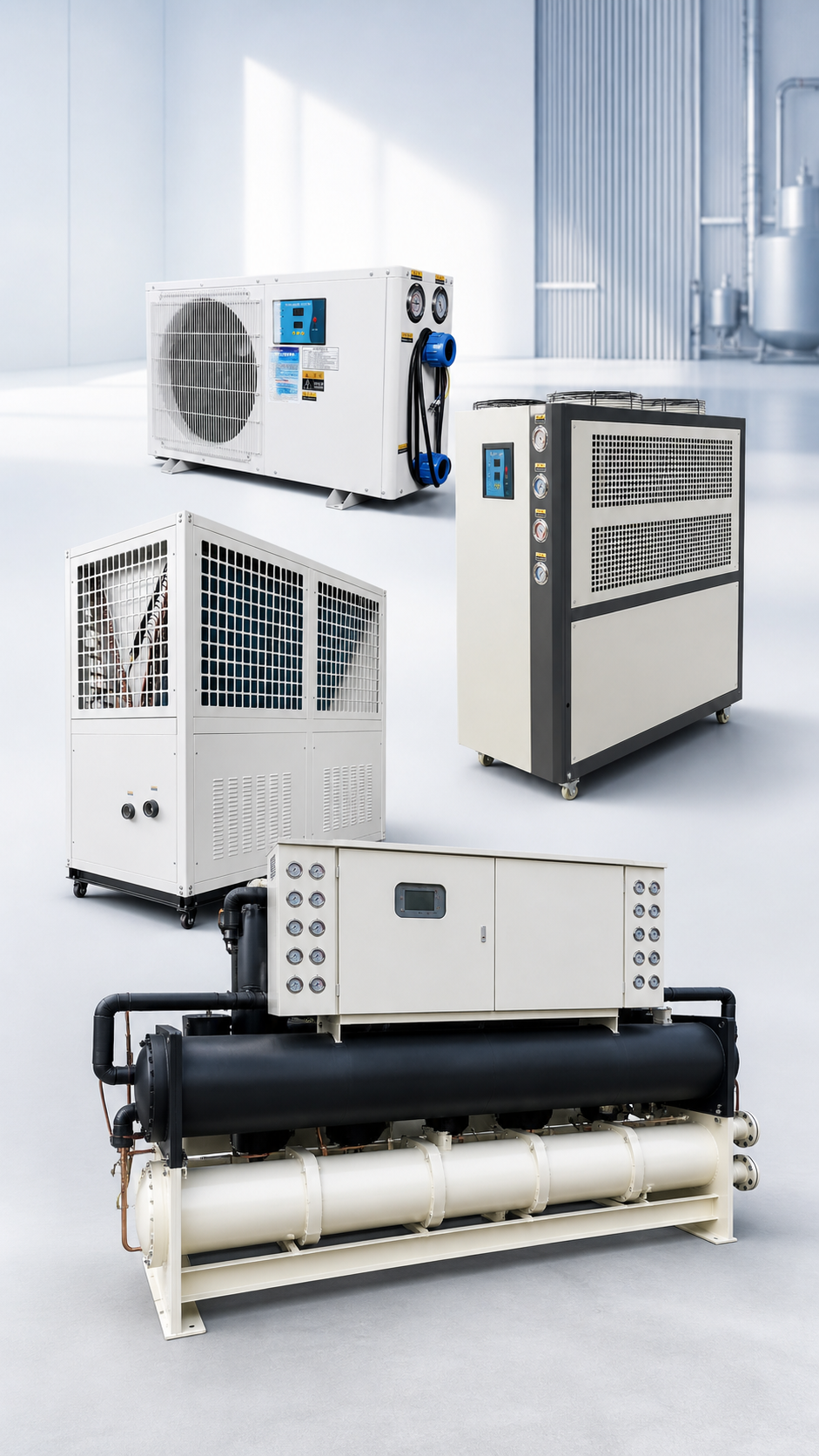
Air-Cooled Chillers
For standalone machines, workshops, and applications without cooling towers.
View Air-CooledWater-Cooled Chillers
For high-capacity, indoor, centralized, or cooling tower-based process cooling.
View Water-CooledCustom Industrial Chillers
For high ambient, corrosion, special voltage, compact layout, OEM, or process-specific control needs.
View CustomParts & Heat Exchangers
For replacement parts, evaporators, condensers, coils, and heat exchanger support.
View PartsHow APT Selects a Chiller for Your Application
Follow this six-step path to prepare the core process data needed for preliminary application review and chiller selection.
Confirm Process
Application, equipment, heat source.
Estimate Load
Cooling capacity and operating hours.
Set Temperature
Target water temperature and stability.
Check Flow
Flow rate, pump pressure, piping loss.
Review Site
Ambient, space, water quality, voltage.
Configure Chiller
Air-cooled, water-cooled, or custom.
Quote Information Checklist
Providing complete project information helps APT engineers recommend the right chiller type, capacity, pump, heat exchanger, electrical configuration, and engineering options.
Application Data
Industry, equipment type, cooling object, working hours, heat source.
Cooling Data
Cooling capacity, target temperature, flow rate, pump pressure, coolant type.
Site Conditions
Ambient temperature, indoor or outdoor location, installation space, ventilation, dust, corrosion, or hazardous-area conditions.
Engineering Requirements
Voltage, frequency, control logic, heat exchanger material, T3 design, explosion-proof needs, documentation, and export requirements.
Additional Process Cooling Applications
APT also supports additional process cooling scenarios where compact chillers, glycol systems, laboratory cooling, or OEM cooling configurations may be required.
CNC Machine Tool Cooling
Spindle, cutting fluid, grinder, and precision machine cooling.
View CNC CoolingLaboratory & Testing Cooling
Compact chillers for instruments, test benches, and small process loops.
View Lab CoolingFood & Beverage / Glycol Cooling
Fermentation, tanks, beverage process cooling, and glycol systems.
View Glycol CoolingIce Bath & Wellness Cooling
Compact chillers for cold plunge and OEM cold therapy systems.
View Ice Bath CoolingRelated Resources
Continue your review with products, selection tools, case studies, and technical downloads for industrial cooling projects.
Industrial Chiller Applications FAQ
Answers to common application-based chiller selection questions from industrial buyers, equipment engineers, and process cooling project teams.
What are industrial chiller applications?
Industrial chiller applications are process cooling uses where chilled water or process fluid removes heat from equipment, molds, tanks, lasers, spray guns, machine tools, production lines, or chemical systems.
How do I choose a chiller for my application?
Start by confirming the cooling object, cooling capacity, target temperature, flow rate, pump pressure, ambient temperature, fluid type, voltage, and installation conditions. APT can then recommend an air-cooled, water-cooled, or custom industrial chiller configuration.
Which applications usually use air-cooled chillers?
Air-cooled chillers are commonly used for standalone machines, workshops, injection molding machines, laser systems, thermal spray equipment, CNC machines, plating tanks, and applications where a cooling tower is not available.
Which applications usually use water-cooled chillers?
Water-cooled chillers are often selected for larger cooling capacity, high-efficiency operation, centralized chilled-water systems, indoor factories, chemical processes, production lines, or projects where cooling tower water is available.
Can one chiller cool multiple machines?
Yes. One centralized chiller can cool multiple machines when the total heat load, flow rate, pump pressure, piping layout, temperature control method, and safety margin are properly designed.
Can APT customize chillers for special applications?
Yes. APT can customize cooling capacity, compressor type, pump, tank, evaporator, heat exchanger material, voltage, control system, enclosure, alarm output, and protection logic based on application requirements.
Does APT support corrosive or special fluid applications?
Yes. For corrosive fluids, electroplating, chemical processing, seawater-related conditions, or special process liquids, APT can provide stainless steel, titanium, anti-corrosion, or customized heat exchanger options.
What information should I provide for application-based chiller selection?
Please provide your application, equipment type, required cooling capacity, target temperature, flow rate, pump pressure, voltage and frequency, ambient temperature, fluid type, installation conditions, and any special requirements such as high ambient, corrosion resistance, explosion-proof design, or PLC control.
Need a Chiller for Your Process Cooling Application?
Share your application, cooling load, target water temperature, flow rate, pump pressure, voltage, and installation environment. APT engineers will help recommend a suitable air-cooled, water-cooled, or custom industrial chiller solution.