
Injection Molding Chiller for Mold Cooling and Plastic Processing
APT injection molding chillers provide closed-loop chilled water cooling for plastic injection molds, hydraulic oil cooling, feed throat cooling, process water loops, and centralized injection molding cooling systems. Each chiller can be configured according to injection molding machine tonnage, mold heat load, plastic material, shot weight, cycle time, target mold temperature, flow rate, pump pressure, water quality, voltage, and factory installation conditions.
What Matters Most in Injection Molding Cooling?
An injection molding chiller should be selected around machine tonnage, mold heat load, plastic material, shot weight, cycle time, target mold temperature, cooling water flow rate, pump pressure, number of machines, water quality, ambient temperature, and whether the system is standalone or centralized. Stable chilled-water cooling helps reduce temperature fluctuation and support repeatable molding cycles.
The correct injection molding cooling system is not selected by horsepower alone. APT reviews mold cooling channels, hydraulic oil cooling demand, process water loop, pipe length, filter pressure loss, factory layout, voltage, and whether an air-cooled, water-cooled, or custom centralized system is more suitable.
Key Injection Molding Chiller Parameters
Injection molds, hydraulic oil circuit, feed throat, process water loop, centralized machine group.
Closed-loop chilled water cooling; open-loop or centralized support by project review.
1HP to 100+ HP customizable according to machine size and total heat load.
Common 5–35°C, set according to plastic material and mold temperature requirement.
Configured according to mold channels, pipe length, filters, and pressure loss.
Filter, bypass, anti-scaling, stainless tank, and maintenance review.
Air-cooled, water-cooled, pump-and-tank integrated, or centralized cooling.
Digital controller, PLC, alarm output, flow switch, remote signal optional.
What Is an Injection Molding Chiller?
An injection molding chiller is an industrial process cooling system used to supply chilled water to plastic injection molds, hydraulic oil cooling circuits, feed throat sections, and process water loops. By maintaining stable cooling water temperature, flow rate, and water quality, the chiller helps support mold temperature control, production cycle stability, and reliable equipment operation.
Mold Temperature Control
Removes heat from injection molds to support stable forming and shorter cycle time.
Hydraulic Oil Heat Removal
Helps control heat generated by the injection molding machine hydraulic system.
Closed-Loop Water Circulation
Provides cleaner and more stable cooling compared with uncontrolled open water circulation.
Continuous Production Stability
Supports stable molding operation during continuous factory production.
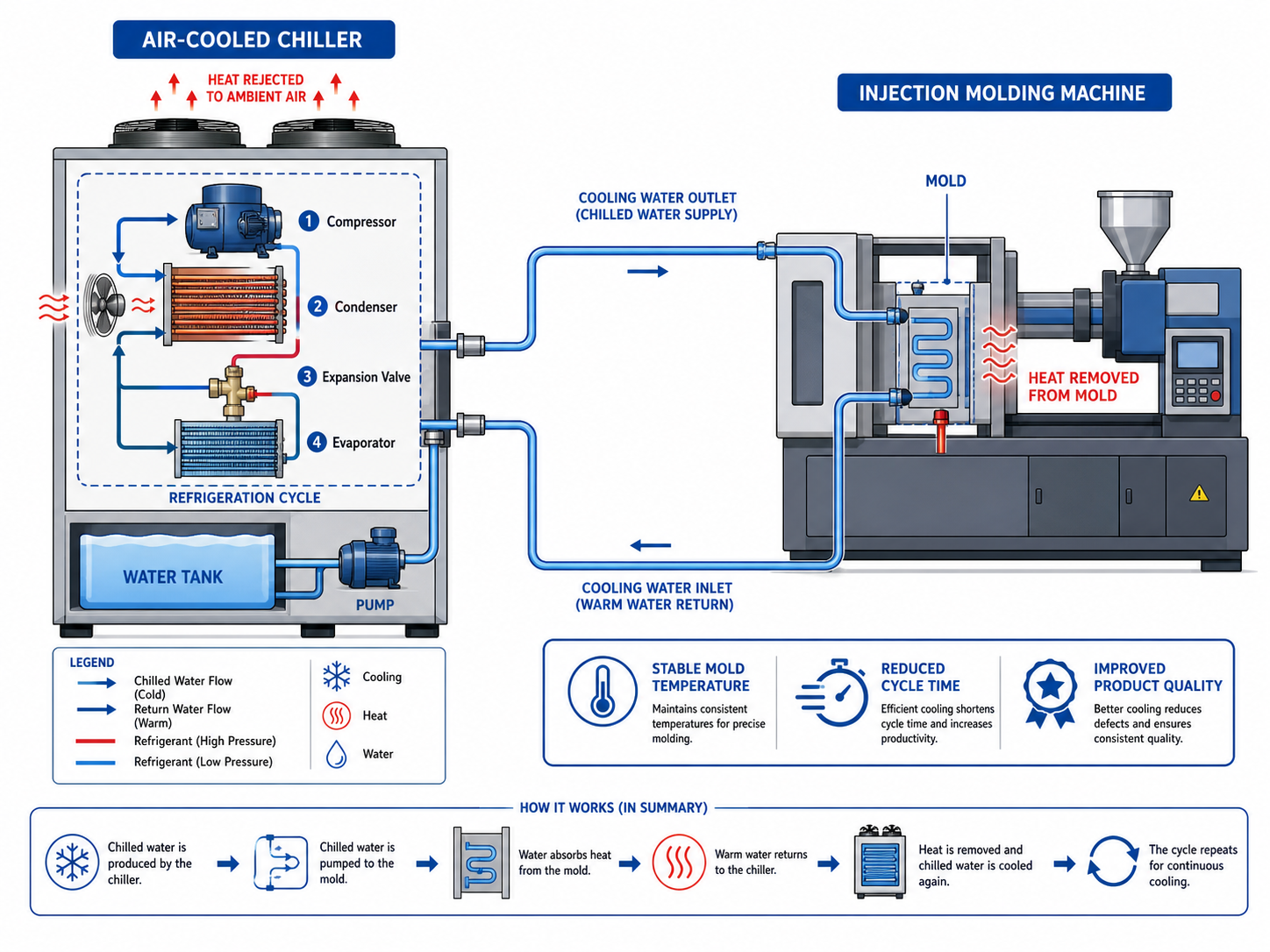
Injection Molding Cooling Requirements
Injection molding production can be affected by mold temperature, cooling time, water flow, water quality, hydraulic oil temperature, and factory cooling layout. The chiller should be selected according to real process load and production conditions.
Mold Temperature Stability
Stable mold temperature supports dimensional consistency, surface quality, and repeatable molding results.
Cooling Cycle Control
Efficient heat removal can help reduce cooling time and improve production efficiency.
Flow and Pressure Matching
Pump flow and pressure should match mold channels, pipe length, filters, and pressure loss.
Hydraulic Oil Temperature Control
Cooling helps control heat generated by hydraulic systems during continuous molding operation.
Water Quality and Scaling Prevention
Filters, anti-scaling review, and maintenance planning help protect mold channels and heat exchangers.
Single-Machine or Centralized Cooling
Cooling configuration should match the number of machines, factory layout, and piping distribution.
Cooling Points in Injection Molding Systems
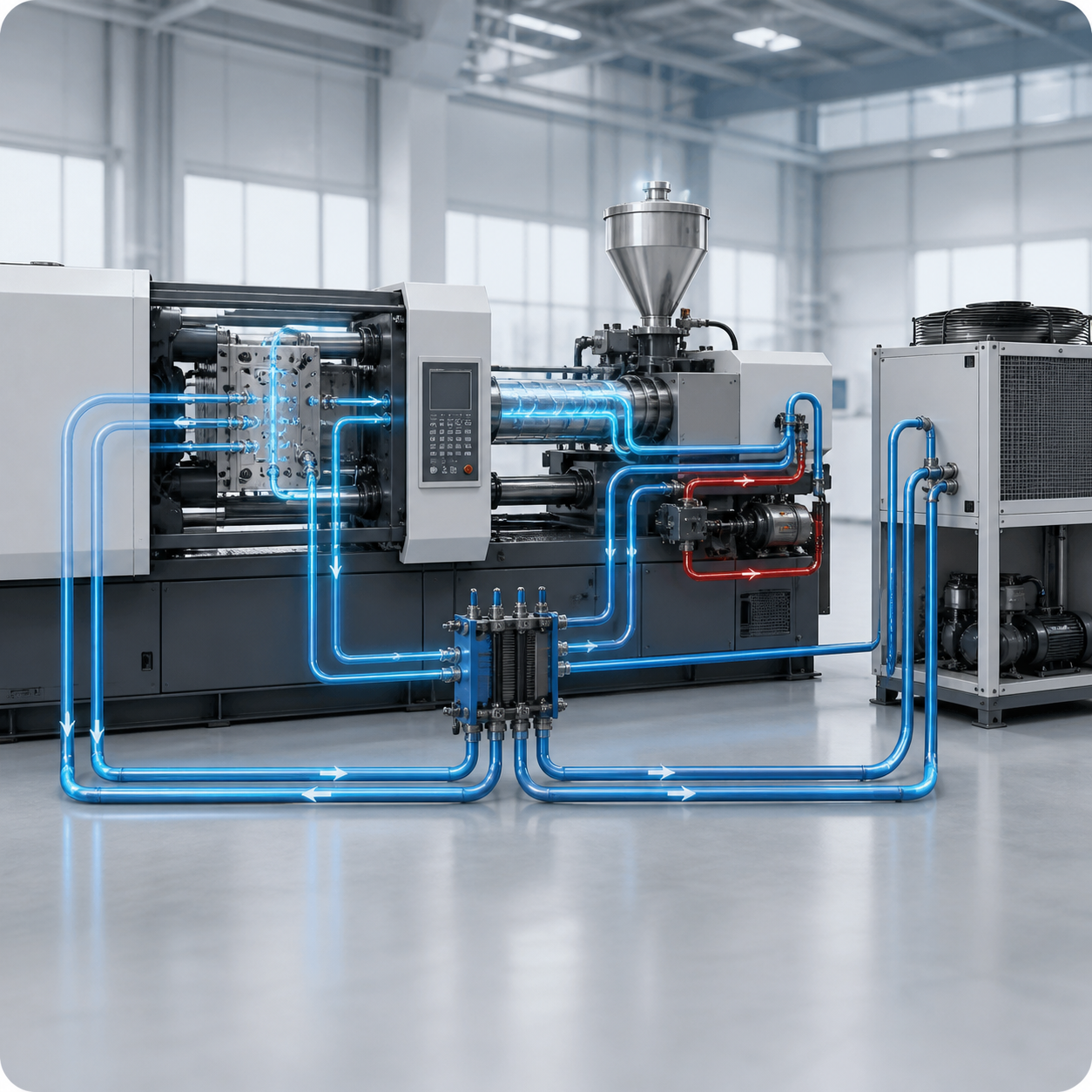
Injection molding cooling may involve several circuits. The final chiller configuration should be reviewed according to mold channels, hydraulic circuit, feed throat, process water loop, and number of connected machines.
Injection Mold Cooling
Chilled water circulates through mold cooling channels to remove heat from molded parts and mold steel.
Hydraulic Oil Cooling
Cooling helps control oil temperature and supports stable hydraulic system operation.
Feed Throat Cooling
Feed throat cooling helps reduce heat transfer to raw material and supports stable plastic feeding.
Process Water Loop
Closed-loop process water provides controlled cooling for machines and process equipment.
Centralized Multi-Machine Cooling
Centralized cooling can supply chilled water to multiple injection molding machines or production lines.
Recommended Chiller Selection Matrix for Injection Molding Cooling
Use this matrix as a preliminary guide before confirming machine tonnage, mold heat load, water temperature, flow rate, pump pressure, number of machines, and installation conditions.
| Injection Molding Requirement | Recommended Chiller Direction | Best For | Engineering Review | Next Step |
|---|---|---|---|---|
| Small injection machine or test mold | Compact air-cooled process chiller | Small machines, test molds, laboratory molding, independent cooling loop | Heat load, mold temperature, pump flow, compact layout | View Air-Cooled Chillers → |
| Standard injection molding machine | Industrial air-cooled chiller | Single machine mold cooling, hydraulic oil cooling, no cooling tower | Machine tonnage, shot weight, cycle time, flow, pressure | View Air-Cooled Chillers → |
| Medium to large injection molding line | Large air-cooled chiller direction | Multiple molds, high heat load, production line cooling | Total heat load, ambient temperature, pump pressure, pipe length | View Air-Cooled Chillers → |
| Factory with cooling tower or central utilities | Water-cooled industrial chiller | Continuous production, indoor plant room, higher efficiency | Condenser water, cooling tower, water quality, working hours | View Water-Cooled Chillers → |
| Multiple machines or special process layout | Custom centralized cooling system | Multi-machine cooling, custom pump/tank, PLC, special voltage | Machine count, total heat load, piping layout, control logic | Request Custom Design → |
Mold Cooling, Hydraulic Oil Cooling, Feed Throat Cooling, and Centralized Cooling Comparison
Different cooling areas in injection molding systems may require different flow, pressure, temperature, and system layout. APT reviews the real cooling circuit before final chiller selection.
| Cooling Area | Typical Cooling Purpose | Chiller Selection Focus | Common Options |
|---|---|---|---|
| Injection Mold Cooling | Remove heat from molded parts and mold steel | Stable mold temperature, cooling water flow, channel pressure loss, cycle time | Air-cooled chiller, custom pump, filter, bypass, flow switch |
| Hydraulic Oil Cooling | Control hydraulic oil temperature during continuous machine operation | Oil heat load, heat exchanger interface, operating hours, machine duty | Process chiller with heat exchanger, pump and tank review |
| Feed Throat Cooling | Reduce heat transfer near hopper and material feeding area | Stable low-flow cooling, clean water, compact connection | Compact chiller or shared process water loop |
| Single-Machine Cooling | Supply one injection molding machine or mold set | Compact layout, simple installation, stable chilled-water temperature | Air-cooled chiller, built-in tank and pump |
| Centralized Process Cooling | Supply several machines or production lines | Total heat load, pipe length, pressure loss, water distribution, redundancy | Water-cooled or custom centralized chiller system |
Typical Injection Molding Chiller Specification Range
Final specifications should be confirmed according to injection machine size, mold heat load, cooling water flow, pump pressure, ambient temperature, water quality, voltage, and production schedule.
| Cooling Capacity | 1HP to 100+ HP customizable according to machine size, mold heat load, and number of machines |
| Cooling Medium | Water, glycol water, or special process fluid by review |
| Outlet Water Temperature | Common 5–35°C, set according to plastic material and mold temperature requirement |
| Temperature Stability | ±1°C common option, tighter stability by engineering review |
| Pump Flow | Configured according to mold channels, machine count, pipe length, and cooling circuit |
| Pump Pressure | Standard or customized according to pressure loss, filters, mold channels, and layout |
| Chiller Type | Air-cooled, water-cooled, compact, pump-and-tank integrated, or centralized injection molding cooling system |
| Tank | Built-in tank, stainless tank, buffer tank, external tank, or centralized tank system |
| Water Quality | Filter, bypass, anti-scaling review, stainless tank, and maintenance planning |
| Evaporator | Tank coil, plate heat exchanger, shell-and-tube, stainless, or custom options |
| Control | Digital controller, PLC, alarm output, flow switch, remote start/stop optional |
| Voltage | 220V / 380V / 400V / 415V / 460V, 50Hz / 60Hz, custom export voltage |
| Protection | High/low pressure, overload, phase protection, anti-freeze, water level, flow alarm, pump protection |
| Installation | Indoor workshop, outdoor option, centralized system, high ambient or limited space by review |
Custom Engineering Options for Injection Molding Cooling
APT can configure injection molding chillers according to mold heat load, water circuit pressure drop, pump pressure, water quality, factory layout, voltage, communication requirements, and number of connected machines.
Pump Flow and Pressure Configuration
Custom pump selection according to mold channel pressure loss, pipe length, filters, machine count, and flow requirement.
Tank, Filter, and Bypass Options
Built-in tank, external tank, buffer tank, filter, bypass, dual pump, and stainless tank options.
Air-Cooled / Water-Cooled Layout
Air-cooled design for standalone machines or water-cooled design for plant rooms and cooling tower systems.
Centralized Multi-Machine Cooling
Centralized cooling for multiple injection machines, production lines, pump station, and distribution loop.
Heat Exchanger and Water Quality Options
Tank coil, plate heat exchanger, shell-and-tube, stainless options, filtration, and anti-scaling review.
Control, Voltage, and Export Configuration
Digital controller, PLC, alarm output, remote signal, custom voltage, 50Hz/60Hz, documentation, and export support.
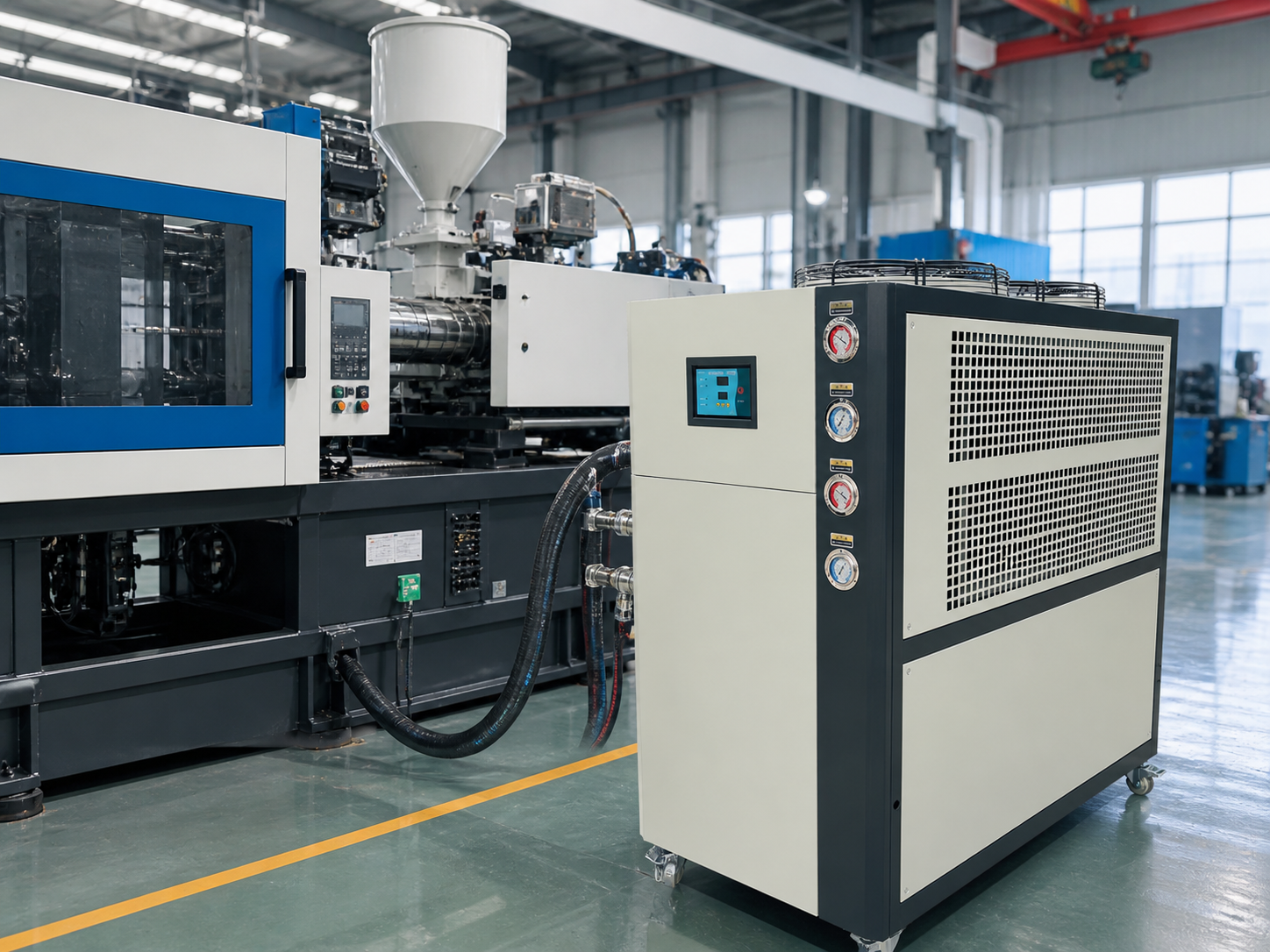
10HP Chiller for Injection Molding Machine Cooling
This 10HP industrial chiller is configured for injection molding machine cooling where stable mold cooling, process water temperature control, and reliable continuous operation are required. The final configuration can be customized according to mold heat load, flow rate, pump pressure, water temperature, voltage, tank volume, and installation environment.
Quote Information Checklist for Injection Molding Chillers
To recommend a suitable injection molding chiller, APT engineers need machine data, mold cooling conditions, water flow and pressure requirements, production schedule, and installation information. If exact data is not available, machine tonnage, mold photos, nameplate, or production information can be used for preliminary review.
- Injection molding machine tonnage and model
- Number of machines connected to the cooling system
- Plastic material and product type
- Shot weight and cycle time if available
- Required cooling capacity or estimated heat load
- Target mold temperature or chilled water temperature
- Cooling water inlet and outlet temperature if available
- Required flow rate
- Required pump pressure
- Mold cooling channel condition and pipe length
- Hydraulic oil cooling requirement
- Feed throat or auxiliary process cooling requirement
- Water quality, filter, scaling, or maintenance requirement
- Installation space, airflow direction, and ambient temperature
- Voltage, phase, and frequency
- Control requirements: alarm output, PLC, HMI, Modbus, remote signal, interlock
Manufacturing, Testing, and Export Support
APT supports injection molding chiller manufacturing, refrigeration system testing, pump and water circuit checking, temperature control inspection, packaging, documentation, and export shipment preparation.
As an industrial chiller manufacturer for injection molding cooling applications, APT supports custom cooling capacity, pump flow, pump pressure, water temperature stability, mold cooling review, air-cooled or water-cooled configuration, centralized cooling design, voltage options, factory testing, and export documentation.
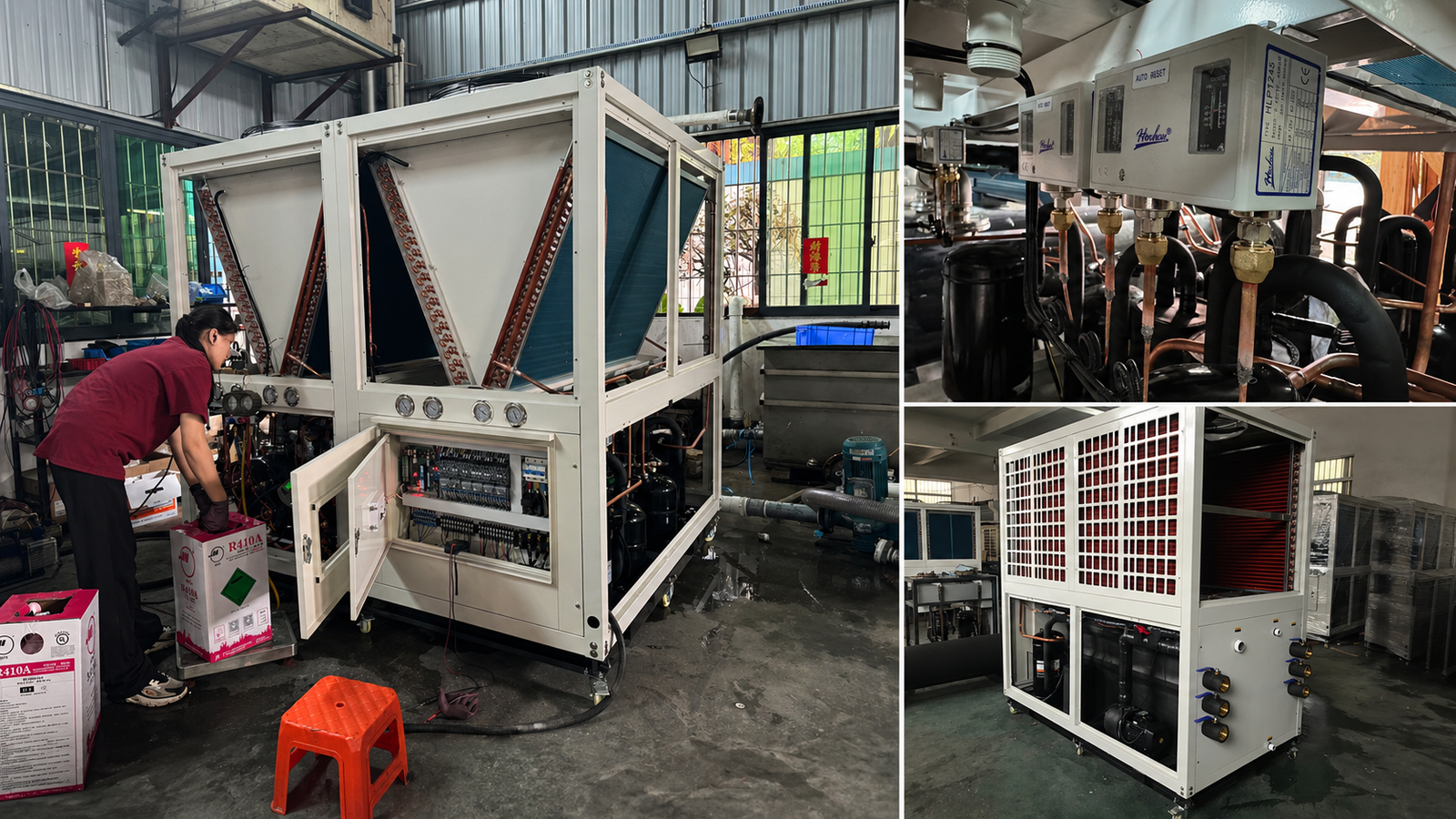
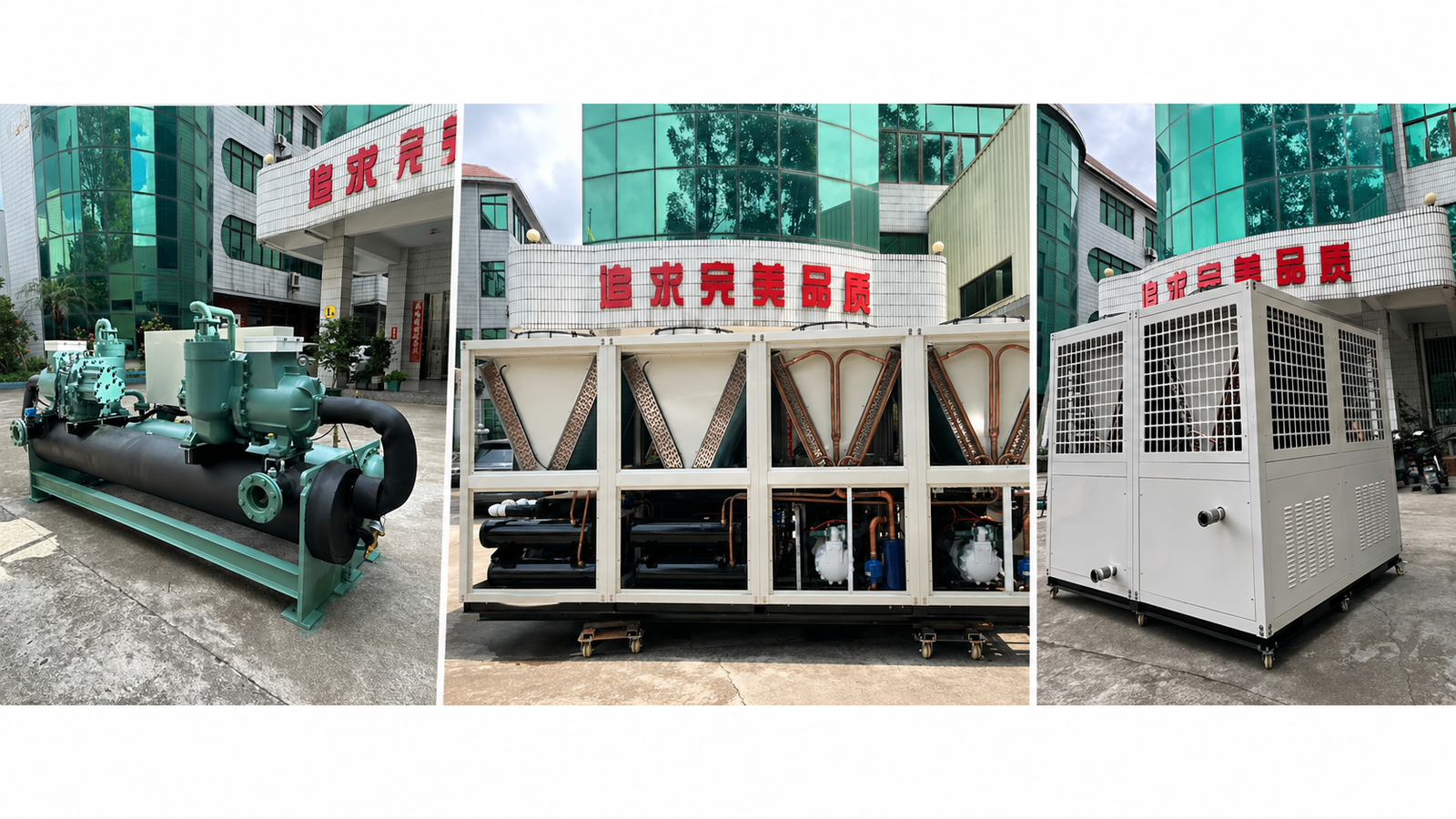
Workshop Production
Manufacturing with compressor, condenser, evaporator, pump, tank, electrical cabinet, and project-specific assembly.
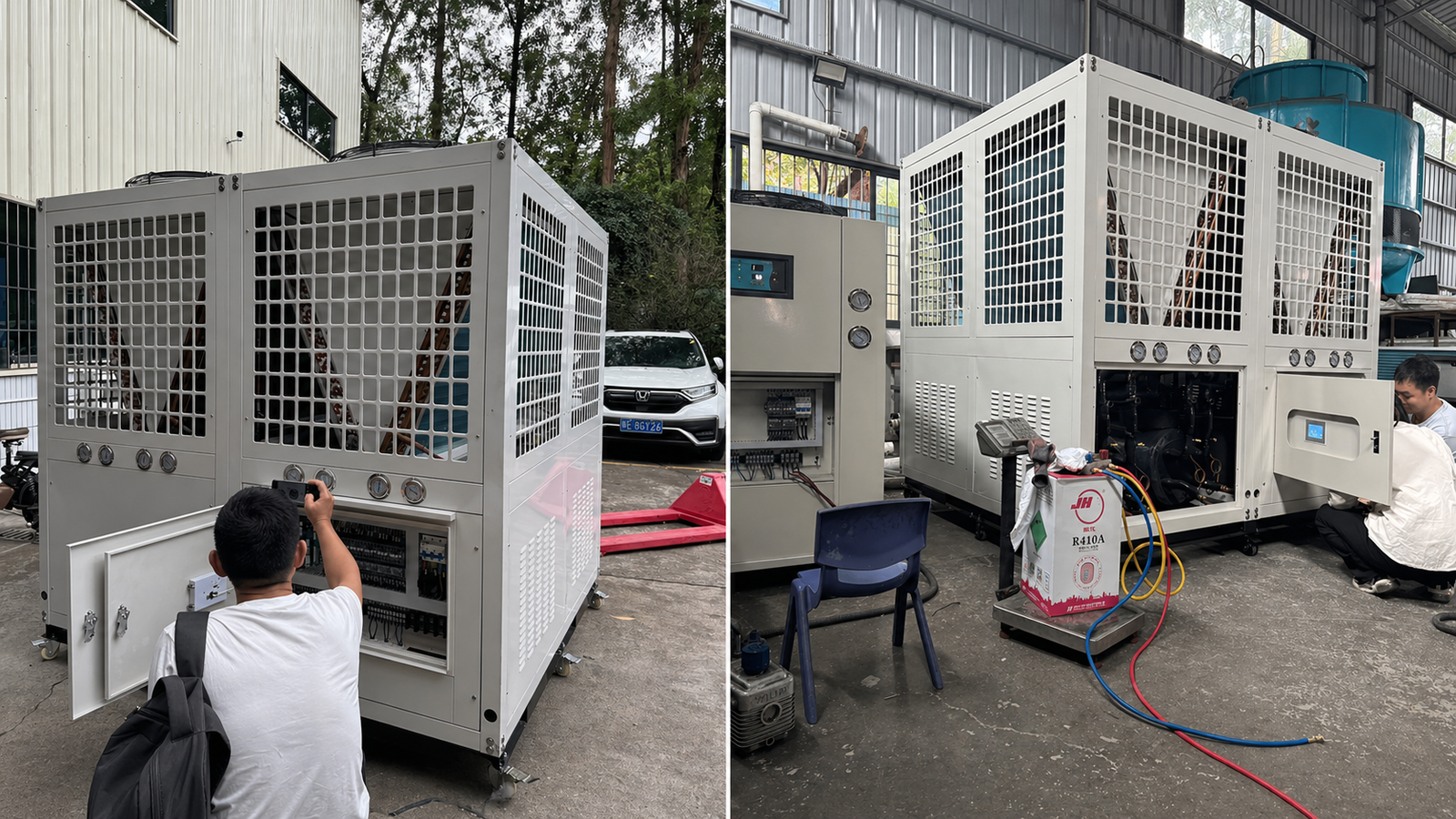
Performance Testing
Cooling performance, water circulation, pump pressure, temperature control, alarm logic, and pre-shipment inspection.
Export Documentation
Support for datasheets, manuals, packing details, voltage confirmation, and quotation documents.
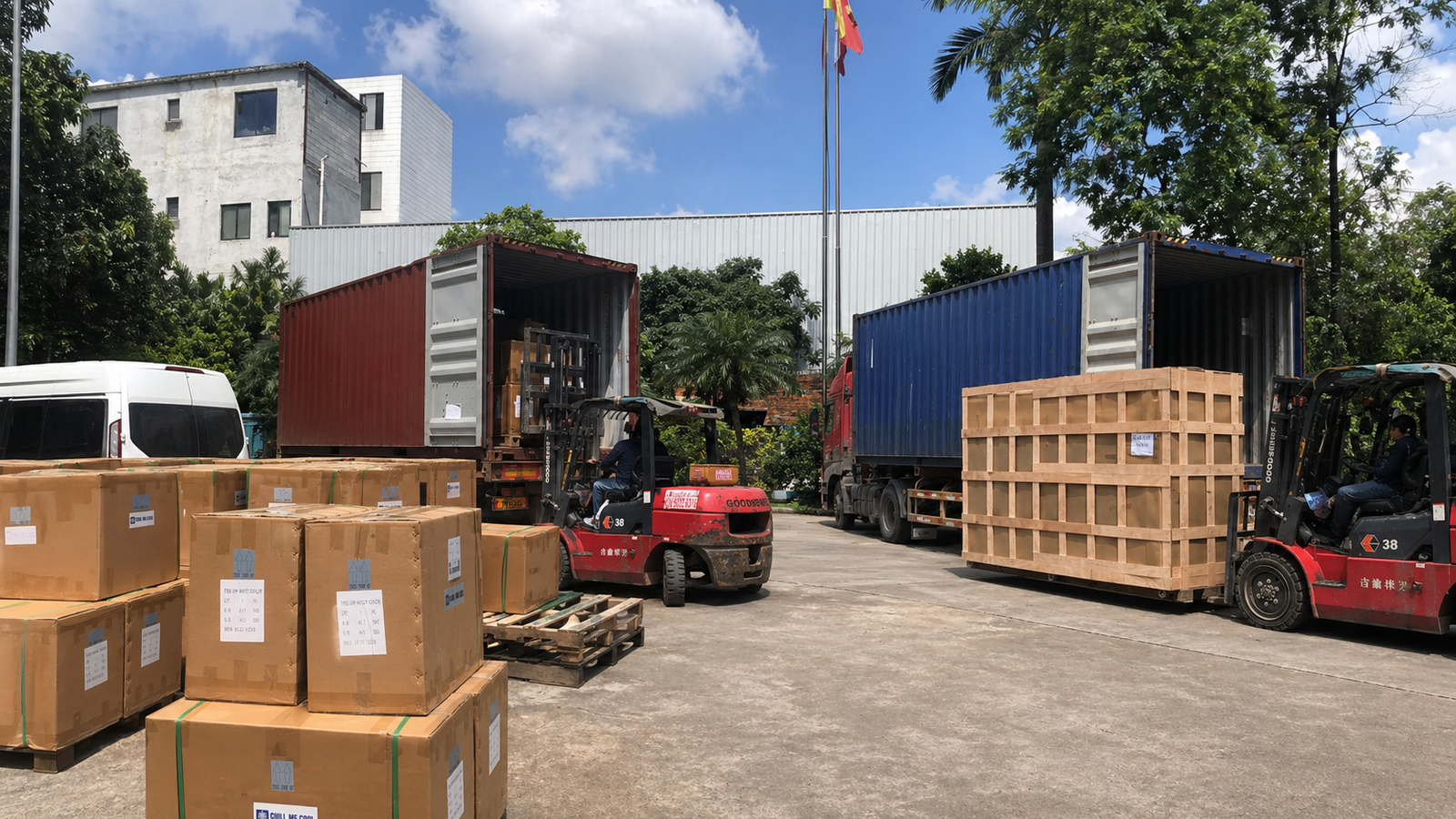
Packaging & Shipment
Export packaging, inspection photos, shipment coordination, and container loading support.
Related Product and Engineering Pages
Compare standard and custom APT chiller directions for injection molding cooling requirements.
Related Industrial Cooling Applications
APT also supports other industrial process cooling applications that require stable chilled-water temperature and reliable equipment protection.
Thermal Spray Cooling
Cooling for HVOF spray gun and plasma spray torch cooling circuits.
ApplicationLaser Cooling
Cooling for laser sources, optics, cutting heads, welding heads, and OEM laser equipment.
ApplicationDie Casting Cooling
Cooling for die casting machines, molds, hydraulic systems, and high-temperature production.
ApplicationElectroplating Cooling
Tank cooling and process temperature control for plating and anodizing lines.
ApplicationChemical Process Cooling
Temperature control for reactors, tanks, heat exchangers, and industrial process loops.
Injection Molding Chiller FAQ
These questions help engineers and buyers prepare injection molding cooling data before requesting a formal quotation.
What is an injection molding chiller?
An injection molding chiller is an industrial process cooling system that supplies chilled water to injection molds, hydraulic oil cooling circuits, feed throat sections, or process water loops to remove heat and support stable plastic molding production.
Why does injection molding need a chiller?
Injection molding may require a chiller when stable mold temperature, shorter cooling time, continuous production, hydraulic oil temperature control, or centralized process cooling is needed. Stable cooling helps support repeatable cycle time and product consistency.
What size chiller do I need for an injection molding machine?
Chiller size depends on injection machine tonnage, mold heat load, plastic material, shot weight, cycle time, target water temperature, flow rate, pump pressure, number of machines, and working hours.
Should I choose an air-cooled or water-cooled chiller for injection molding?
Air-cooled chillers are suitable for standalone machines and factories without cooling tower water. Water-cooled chillers may be preferred for larger heat loads, centralized cooling, indoor plant rooms, or continuous high-duty production.
Can one chiller cool multiple injection molding machines?
Yes. A centralized injection molding cooling system can serve multiple machines if the total heat load, pump flow, pump pressure, pipe length, water distribution, and control logic are properly designed.
What water temperature is used for injection mold cooling?
Mold cooling water temperature depends on plastic material, mold design, product quality requirements, cycle time, and process conditions. Common chiller outlet temperature may be 5–35°C, but the final setting should follow the molding process requirement.
Can a chiller reduce injection molding cycle time?
A properly selected chiller can improve heat removal from the mold and may help reduce cooling time. Actual cycle improvement depends on mold design, cooling channel layout, water flow, plastic material, and process settings.
What pump flow and pressure are needed?
Pump flow and pressure depend on mold channels, pipe length, filters, machine count, pressure loss, and centralized cooling layout. APT can review flow and pressure requirements before recommending pump configuration.
How does water quality affect injection mold cooling?
Poor water quality can cause scaling, blocked mold channels, reduced heat transfer, unstable cooling, and higher maintenance frequency. Filters, bypass, anti-scaling review, and regular maintenance should be considered.
Can APT customize pump and tank configurations?
Yes. APT can customize pump pressure, water flow, built-in or external tank, buffer tank, filter, bypass, dual pump, stainless steel water circuit, voltage, and control system according to injection molding cooling requirements.
What information should I provide for an injection molding chiller quotation?
Please provide injection machine tonnage, number of machines, plastic material, shot weight, cycle time, target mold temperature, flow rate, pump pressure, cooling water temperature, voltage, ambient temperature, and installation conditions.
Can APT provide centralized injection molding cooling systems?
Yes. APT can provide centralized cooling systems for multiple injection molding machines, including air-cooled or water-cooled chillers, pump and tank modules, piping layout review, PLC control, alarm output, filtration, and custom voltage options.
Need a Chiller for Your Injection Molding Machine?
Share your injection molding machine tonnage, number of machines, plastic material, mold temperature requirement, cooling capacity, water flow, pump pressure, voltage, ambient temperature, installation space, and centralized cooling requirements. APT engineers will help recommend a suitable injection molding chiller, mold cooling chiller, water-cooled chiller, air-cooled chiller, or custom process cooling system.