
Stainless Steel and Corrosion-Resistant Industrial Chillers
APT stainless steel and corrosion-resistant industrial chillers are custom process cooling systems designed for clean water, DI water, chemical processes, electroplating, anodizing, food, pharmaceutical, and corrosive-fluid applications. The water tank, pump, piping, evaporator, heat exchanger, condenser, cabinet, control system, and fluid-contact materials can be configured according to process fluid type, pH value, concentration, temperature, chloride content, water quality, and material compatibility review.
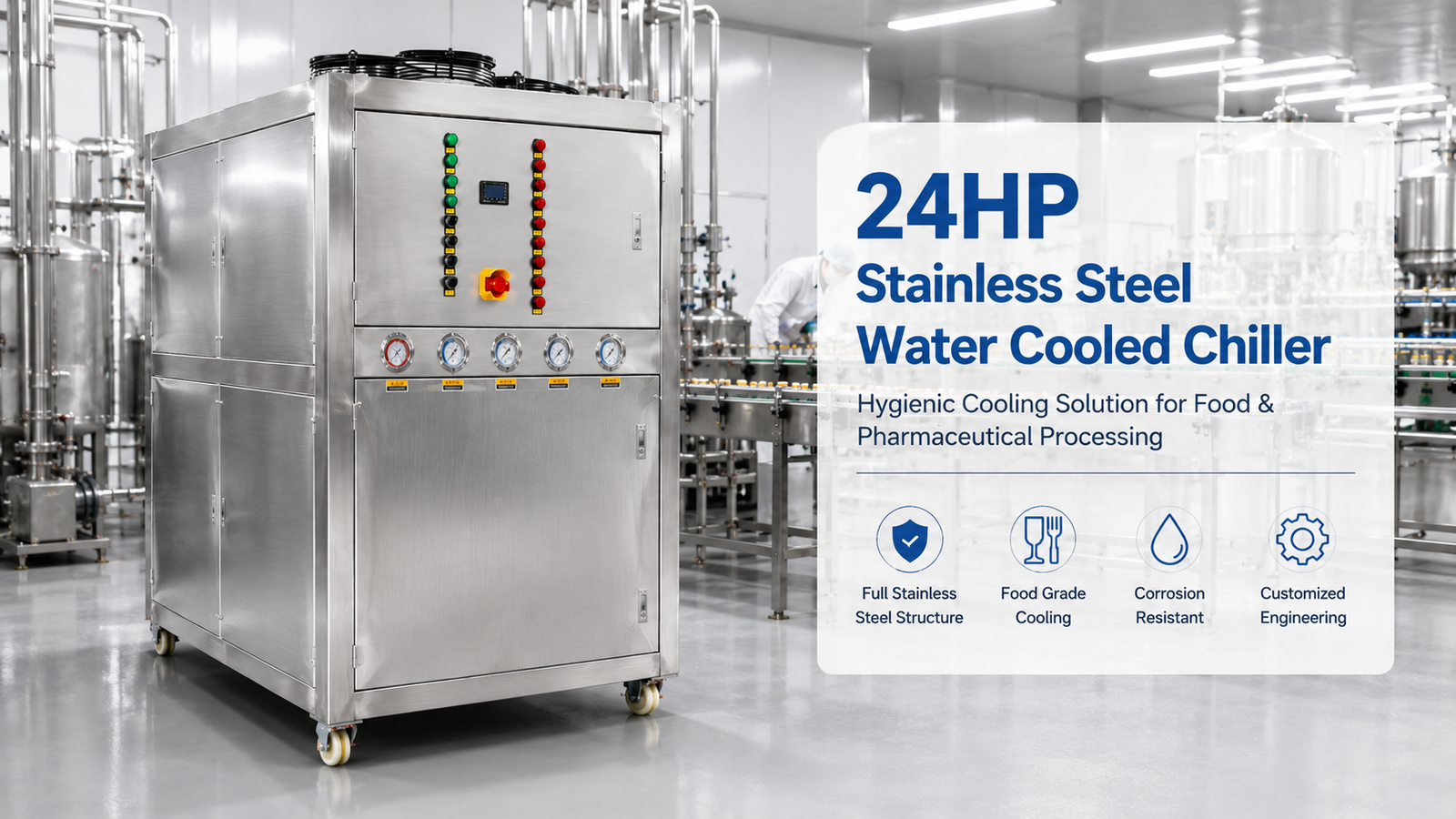
When Should You Choose a Stainless Steel or Corrosion-Resistant Chiller?
A stainless steel or corrosion-resistant industrial chiller should be reviewed when the cooling circuit handles clean water, DI water, corrosive liquid, chemical process fluid, plating solution, food-grade process water, pharmaceutical process water, or a workshop environment with corrosion risk. Standard chillers may not be suitable when the fluid or ambient environment can corrode ordinary tanks, pumps, piping, evaporators, condensers, or heat exchanger materials.
Final material selection should be confirmed according to fluid type, pH value, concentration, chloride content, temperature, conductivity, water quality, and process compatibility.
When Do You Need This Custom Direction?
Clean Water or DI Water Process
Clean water, DI water, and low-conductivity process loops may require stainless steel or special water circuit materials to reduce contamination and compatibility risks.
Chemical or Corrosive Fluid
Chemical fluids should be reviewed for pH value, concentration, temperature, chloride content, and material compatibility before selecting the heat exchanger and fluid path.
Electroplating and Anodizing Lines
Plating tanks, anodizing lines, acid or alkaline solutions often require titanium, stainless steel, or isolated heat exchange instead of standard copper or carbon steel components.
Food and Pharmaceutical Cooling
Food and pharmaceutical process cooling may require stainless steel tank, stainless pump, clean water circuit, and documentation according to process requirements.
Material Selection Matrix
| Process Fluid / Water Condition | Recommended Material Direction | Typical Applications | Key Engineering Review | Next Step |
|---|---|---|---|---|
| Clean water | Stainless steel tank / stainless piping by review | Food, pharmaceutical, laboratory, clean process water | Water quality, hygiene requirement, temperature stability, pump and tank material | Request Clean Water Review |
| DI water / deionized water | Stainless or special water circuit | Laser, laboratory, electronics, precision process cooling | Conductivity, ion contamination, pump material, piping compatibility | Submit DI Water Data |
| Electroplating solution | Titanium heat exchanger or isolated heat exchange | Electroplating tanks, anodizing lines, surface treatment | Acid/alkali type, concentration, chloride content, temperature, tank layout | Request Plating Cooling Review |
| Chemical process fluid | Stainless, titanium, coated, or isolated exchanger by review | Chemical reactors, tanks, condensers, process loops | pH, concentration, fluid compatibility, safety, maintenance access | Request Chemical Cooling Review |
| Corrosive workshop air | Cabinet coating / condenser protection / material review | Chemical workshop, plating plant, coastal or humid site | Ambient corrosion, ventilation, condenser exposure, cabinet protection | Submit Site Conditions |
Application Selection Matrix
| Application | Fit Level | Typical Cooling Need | Engineering Review | Related Page |
|---|---|---|---|---|
| Electroplating Cooling | High | Tank temperature control, plating bath cooling, anodizing line cooling | Fluid chemistry, acid/alkali concentration, titanium exchanger, pump material | View Page |
| Chemical Process Cooling | High | Reactor cooling, process tank cooling, condenser cooling | Fluid compatibility, pH, concentration, safety, heat exchanger material | View Page |
| Food & Beverage Cooling | High | Clean process water cooling, hygienic process support | Stainless tank, stainless pump, water quality, clean operation | View Page |
| Pharmaceutical Process Cooling | High | Clean water process cooling, solvent or production process support | Material compatibility, documentation, stainless circuit, safety | View Page |
| DI Water / Laser Cooling | Medium to High | Low-contamination cooling loop, stable chilled water | Conductivity, ion contamination, stainless or special loop material | View Page |
| Laboratory Cooling | Medium to High | Small process cooling, clean water or special fluid loop | Water quality, temperature stability, pump material | View Page |
Stainless / Titanium / Anti-Corrosion Options
Stainless Steel Water Tank
Tank material can be reviewed according to water quality, hygiene sensitivity, cleaning method, and process fluid exposure.
Stainless Steel Pump and Piping
Pump and piping material should be selected according to fluid compatibility, conductivity, and long-term process maintenance requirements.
Stainless Steel Plate Heat Exchanger
Stainless plate heat exchangers may be suitable for some clean water and mild process fluids after material compatibility review.
Titanium Heat Exchanger
Titanium is often reviewed for electroplating, chloride-related, or more corrosive process fluids when standard exchanger materials may not be suitable.
Shell-and-Tube / Isolated Heat Exchange
An isolated loop or shell-and-tube direction may be preferred when the process fluid should be separated from the main refrigeration water circuit.
Anti-Corrosion Cabinet and Condenser Protection
Cabinet coating, condenser protection, and exposed component review may be needed in humid, coastal, or corrosive workshop environments.
Technical Specification Direction
| Parameter | Typical Direction / Options | Engineering Notes |
|---|---|---|
| Cooling Capacity | Project-specific / compact to large-capacity custom systems | Capacity should be matched to actual heat load and process duty. |
| Chiller Type | Air-cooled / water-cooled / custom process chiller | Cooling method should be selected according to site utility and process layout. |
| Cooling Medium | Clean water / DI water / glycol / chemical-compatible fluid by review | Fluid type affects material direction and water circuit design. |
| Fluid Contact Material | SUS304 / SUS316 / titanium / coated / special material by review | Material selection should follow fluid compatibility review rather than fixed default values. |
| Water Tank | Stainless steel tank / external tank / buffer tank | Tank style should be reviewed according to loop volume, cleanliness, and process requirement. |
| Pump | Standard / stainless steel / chemical-compatible / high-flow / high-pressure | Pump selection depends on flow, pressure drop, conductivity, and fluid compatibility. |
| Evaporator | Plate / shell-and-tube / tank coil / titanium / stainless options | Evaporator type should be reviewed according to fluid condition and maintenance requirement. |
| Heat Exchanger | Stainless steel / titanium / isolated heat exchanger by review | Heat exchanger direction depends on pH, chloride content, and process contamination risk. |
| Condenser | Air-cooled / water-cooled / coated fin / anti-corrosion option | Ambient condition and workshop corrosion risk may affect condenser protection strategy. |
| Temperature Range | Project-specific based on process requirement | Temperature targets should follow the actual process cooling need. |
| Control | Digital / PLC / HMI / remote alarm / Modbus | Control logic can be adjusted according to process integration requirements. |
| Voltage | 380V / 400V / 415V / 460V / 50Hz / 60Hz / custom | Final electrical configuration should match plant power supply and destination country. |
| Protection | High/low pressure, overload, phase, flow, anti-freeze, high temperature alarm | Protection scope should be confirmed according to the system design and process condition. |
| Documentation | Datasheet, layout drawing, wiring diagram, material notes, inspection photos | Documentation can be adjusted according to project and export needs. |
Example Case: 24HP Stainless Steel Water-Cooled Chiller
24HP Stainless Steel Water-Cooled Chiller for Food and Pharmaceutical Process Cooling
APT configured a stainless steel water-cooled chiller for clean process cooling where water circuit material, hygiene-sensitive operation, stable temperature control, pump and tank configuration, and project-specific process requirements needed engineering review. The stainless steel design direction can be adjusted according to water quality, process requirements, and site conditions.
Suitable vs Not Recommended Conditions
Suitable For
- Clean water process cooling
- DI water cooling
- Food and beverage cooling
- Pharmaceutical process cooling
- Electroplating and anodizing tanks
- Chemical process cooling
- Corrosive process fluids
- Titanium heat exchanger requirements
- Stainless steel tank and pump requirements
- Projects requiring material compatibility review
Not Recommended For
- Projects without clear fluid information
- Unknown chemical composition
- Highly corrosive fluids without material compatibility review
- Applications where standard water circuits are sufficient
- Processes requiring certified hygienic compliance without clear documentation requirements
- Seawater or chloride-rich fluids without titanium or special review
- Strong acid / alkali without isolated heat exchanger review
- Hazardous areas without explosion-proof safety review
Quote Information Checklist for Stainless Steel and Corrosion-Resistant Chillers
What APT Needs to Review
Corrosion-resistant chiller projects depend on process fluid review as much as cooling capacity. Sharing water quality, chemistry, and material expectations early helps confirm whether stainless steel, titanium, isolated heat exchange, or another custom circuit direction is more suitable.
- Application or process type
- Required cooling capacity or heat load
- Cooling medium or process fluid
- pH value
- Concentration
- Temperature range
- Chloride content if available
- Conductivity if DI water or clean water is used
- Fluid compatibility requirement
- Clean water / food / pharmaceutical requirement
- Electroplating or chemical bath information
- Tank material requirement
- Pump material requirement
- Heat exchanger material requirement
- Flow rate and pump pressure
- Voltage / phase / frequency
- Ambient temperature and installation location
- Control requirements: PLC, HMI, alarm, Modbus
- Photos, layout drawings, existing equipment data
- Destination country
Related Custom Chiller Pages
Stainless Steel and Corrosion-Resistant Chiller FAQ
What is a corrosion-resistant industrial chiller?
A corrosion-resistant industrial chiller is a custom process cooling system reviewed for clean water, DI water, chemical fluids, plating solutions, or corrosive workshop conditions where standard tank, pump, piping, or heat exchanger materials may not be suitable.
When do I need a stainless steel industrial chiller?
You should review a stainless steel industrial chiller when the process requires cleaner water-contact materials, corrosion resistance, hygiene-sensitive cooling, or better compatibility with the water quality and operating environment.
What fluid information is required before selecting materials?
APT should review the fluid type, pH value, concentration, temperature, chloride content, conductivity, water quality, contamination sensitivity, and any process-specific compatibility concerns before confirming material direction.
Can APT provide stainless steel water tanks and stainless pumps?
Yes. Stainless steel tanks, stainless pumps, and related water circuit components can be reviewed according to fluid condition, cleanliness requirement, and project layout.
When should I choose a titanium heat exchanger?
Titanium heat exchangers are commonly reviewed when chloride content, electroplating chemistry, corrosive fluid condition, or process compatibility makes standard exchanger materials less suitable.
Is this type of chiller suitable for electroplating cooling?
Yes, this custom chiller direction is commonly reviewed for electroplating and anodizing cooling, but the final heat exchanger and water circuit material should be selected according to bath chemistry and operating conditions.
Can it be used for chemical process cooling?
It can be suitable for chemical process cooling when the fluid compatibility, pH, concentration, maintenance access, and circuit material selection are reviewed for the actual process.
Can APT design chillers for DI water or clean water cooling?
Yes. APT can review stainless steel, special water circuit, or isolated loop directions for DI water and clean water cooling according to conductivity, contamination sensitivity, and temperature stability requirements.
Is stainless steel suitable for all corrosive fluids?
No. Stainless steel is not automatically suitable for all corrosive fluids. Material selection should still be confirmed according to fluid type, pH, concentration, chloride content, temperature, and compatibility review.
When should an isolated heat exchanger loop be used?
An isolated heat exchanger loop should be reviewed when the process fluid should not directly contact the standard cooling circuit, or when chemistry, contamination risk, or maintenance requirements make fluid separation more suitable.
Need a Stainless Steel or Corrosion-Resistant Chiller for Your Process?
Share your process fluid, pH value, concentration, temperature, chloride content, water quality, cooling capacity, flow rate, pump pressure, voltage, installation layout, and material requirements. APT engineers can review whether a stainless steel, titanium, isolated heat exchanger, or other corrosion-resistant chiller direction is more suitable for your project.