
Explosion-Proof Industrial Chillers for Hazardous Area Process Cooling
APT explosion-proof industrial chillers are custom process cooling systems designed for hazardous industrial environments where flammable gas, vapor, solvent, or chemical risk may require project-specific electrical protection and safety review. The refrigeration system, electrical cabinet, Ex-rated components, control logic, pump, tank, heat exchanger, voltage, cabinet layout, and protection functions can be configured according to hazardous area classification, process cooling load, site conditions, and local safety requirements.
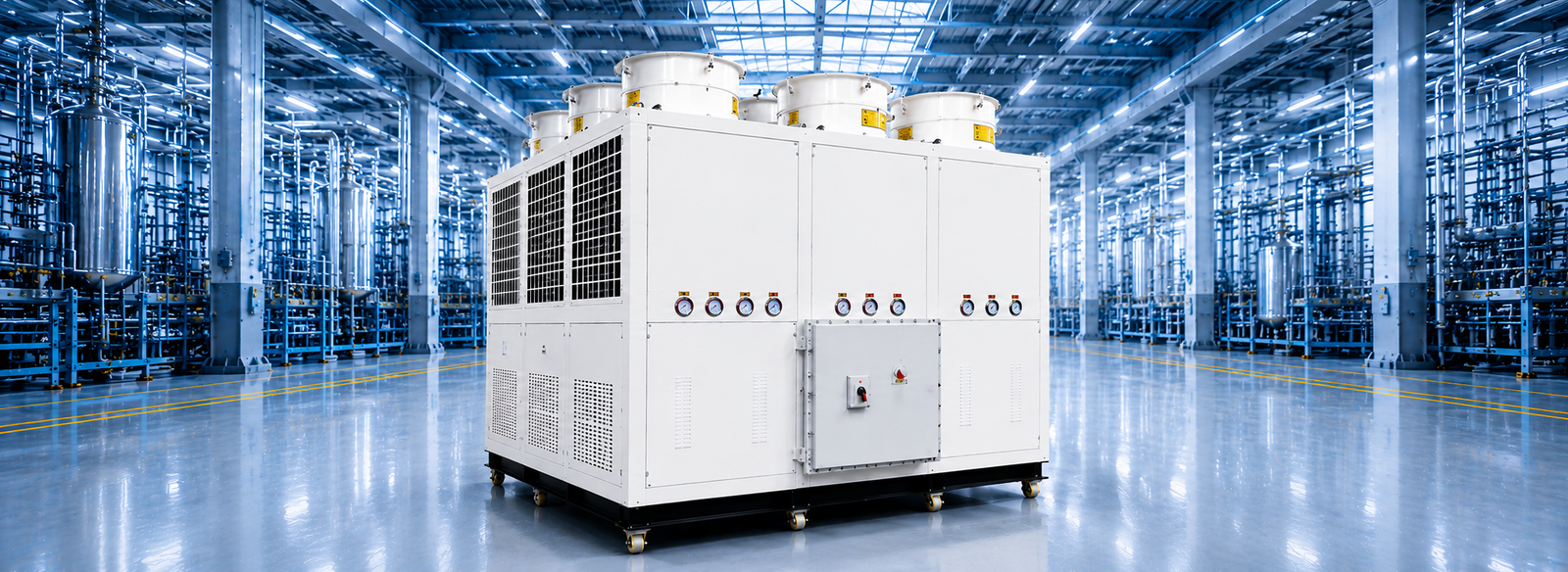
When Should You Choose an Explosion-Proof Industrial Chiller?
An explosion-proof industrial chiller should be reviewed when the cooling system is installed in or near a hazardous area where flammable gas, vapor, solvent, dust, or chemical risk may be present. It is commonly reviewed for chemical processing, solvent extraction, petrochemical production, pharmaceutical manufacturing, hazardous workshops, and industrial process cooling systems that require explosion-proof electrical configuration, safety interlocks, and project-based protection design.
The final explosion-proof configuration should be confirmed according to hazardous area classification, local standards, process conditions, and customer safety requirements.
When Do You Need This Custom Direction?
Hazardous Area Installation
When the chiller or electrical control system may be installed in a classified area, electrical components and cabinet protection must be reviewed.
Flammable Gas or Solvent Risk
Solvent extraction, chemical processing, and petrochemical applications may require Ex-rated electrical components and safety interlock review.
Chemical Process Cooling
Chemical reactors, process tanks, condensers, and solvent loops may need both process cooling and explosion-proof electrical protection.
Project-Specific Safety Requirements
Explosion-proof chillers should be configured according to hazardous area classification, local standards, ventilation, installation layout, and safety documentation needs.
Explosion-Proof Chiller Selection Matrix
| Project Condition | Recommended Design Direction | Typical Use Cases | Key Engineering Review | Next Step |
|---|---|---|---|---|
| Hazardous area installation | Explosion-proof industrial chiller | Chemical plant, solvent room, hazardous workshop | Hazardous area classification, electrical cabinet, Ex-rated components, local standards | Request Explosion-Proof Review |
| Solvent extraction system | Explosion-proof process cooling system | Solvent extraction, flammable vapor environment, process room cooling | Solvent type, vapor risk, ventilation, control cabinet location, safety interlock | Submit Solvent Cooling Data |
| Chemical process cooling | Custom chemical process chiller with Ex protection | Reactors, process tanks, condensers, chemical loops | Process fluid, cooling load, corrosion risk, electrical protection, heat exchanger material | Request Chemical Cooling Review |
| Petrochemical production | Heavy-duty explosion-proof industrial chiller | Petrochemical process cooling, refinery auxiliary cooling, continuous process loop | Operating hours, hazardous area, redundancy, ambient temperature, voltage, protection logic | Request Project Review |
| Pharmaceutical / clean process | Explosion-proof + clean process cooling configuration | Pharmaceutical production, solvent process, clean process area | Clean water circuit, stainless tank, safety protection, temperature stability, documentation | Submit Process Requirements |
Explosion-Proof Engineering Design Points
Hazardous Area Classification Review
The hazardous area level, project layout, and local standard should be reviewed before confirming any explosion-proof electrical direction.
Explosion-Proof Electrical Cabinet
The cabinet structure, location, separation strategy, and component arrangement should be selected according to project safety requirements rather than treated as one fixed layout.
Ex-Rated Electrical Components
Motors, switches, sensors, wiring, and control parts may need project-specific Ex-rated review based on the actual installation condition.
Safety Interlocks and Alarm Logic
Emergency stop, alarm logic, permissive control, and trip conditions should be matched to the process risk, operating sequence, and site protection philosophy.
Chemical-Resistant Water Circuit Options
Process fluid exposure, corrosion risk, and circuit compatibility may require stainless steel, titanium, coated, or isolated water circuit review.
Pump, Tank, and Heat Exchanger Matching
Pump pressure, tank style, evaporator type, and heat exchanger material should be selected according to process cooling load and installation conditions.
Technical Specification Direction
| Parameter | Typical Direction / Options | Engineering Notes |
|---|---|---|
| Cooling Capacity | Project-specific / example 90 HP direction | Cooling capacity should be confirmed according to actual process heat load and duty condition. |
| Chiller Type | Custom explosion-proof industrial chiller | The final structure depends on hazardous area review and process layout. |
| Cooling Method | Air-cooled / water-cooled / project-specific | Cooling method should be selected according to installation condition and utility availability. |
| Hazardous Area Review | Zone / class / division / local standard by project | Area classification and local compliance direction should be confirmed before final design. |
| Explosion-Proof Components | Electrical cabinet, motors, switches, sensors, wiring, control parts by review | Component scope may vary according to cabinet location and site safety requirement. |
| Cooling Medium | Water / glycol / process fluid / chemical-compatible fluid by review | Fluid compatibility affects material selection and circuit design. |
| Leaving Water Temperature | Project-specific, commonly reviewed by process requirement | Temperature range should follow the process cooling target rather than a fixed default. |
| Compressor | Scroll / semi-hermetic / screw / project-specific | Compressor selection depends on capacity, operating hours, and refrigeration condition. |
| Condenser | Air-cooled condenser / water-cooled condenser / project-specific | Heat rejection method should match the site layout and utility condition. |
| Evaporator | Plate / shell-and-tube / tank coil / stainless / titanium / anti-corrosion options | Evaporator type should match process fluid compatibility and water circuit design. |
| Pump | Standard / high-flow / high-pressure / stainless / explosion-proof motor options | Pump direction depends on flow rate, pressure drop, and process loop resistance. |
| Water Tank | Built-in / external / stainless tank / buffer tank | Tank type should follow the loop volume, fluid condition, and installation layout. |
| Control | Digital / PLC / HMI / remote alarm / safety interlock / Modbus | Control logic should be defined by the process interface and safety review. |
| Voltage | 380V / 400V / 415V / 460V / 50Hz / 60Hz / custom | Final voltage and frequency should be confirmed by destination country and project power supply. |
| Protection | High/low pressure, overload, phase, flow, anti-freeze, emergency stop, safety alarm | Protection scope should be matched to process risks and system design. |
| Installation | Hazardous area / safe-area installation with remote control cabinet / project-specific layout | Cabinet location and wiring route should be reviewed together with area classification. |
| Documentation | Datasheet, wiring diagram, layout drawing, inspection photos, safety configuration notes | Documentation scope depends on project review and delivery requirement. |
Example Case: 90HP Explosion-Proof Industrial Chiller
90HP Explosion-Proof Industrial Chiller for Hazardous Process Cooling
APT configured a 90HP explosion-proof industrial chiller for a hazardous industrial process cooling project. The project required large cooling capacity, customized explosion-proof electrical configuration, industrial safety protection, continuous operation, process water circulation, and project-specific engineering review for hazardous-area cooling.
Suitable vs Not Recommended Conditions
Suitable For
- Chemical processing plants
- Solvent extraction systems
- Petrochemical process cooling
- Pharmaceutical solvent process cooling
- Hazardous workshops
- Flammable gas or vapor risk areas
- Large process cooling systems
- Continuous industrial operation
- Projects requiring Ex-rated electrical review
- Projects requiring custom safety interlocks
Not Recommended For
- Projects without clear hazardous area classification
- Applications where standard industrial chillers are sufficient
- Sites where electrical cabinet must be isolated outside the hazardous area but layout is not confirmed
- Corrosive environments without material review
- Outdoor high ambient projects without condenser review
- Low-temperature applications without special refrigeration review
- Projects requiring certified local compliance without clear standard confirmation
Application Fit Matrix
| Application | Fit Level | Typical Cooling Need | Engineering Review |
|---|---|---|---|
| Chemical Reactor Cooling | High | Reactor jacket, tank loop, condenser support, process temperature control | Process fluid, corrosion risk, area classification, heat exchanger material, protection logic |
| Solvent Extraction Cooling | High | Closed-loop cooling for solvent extraction and vapor-risk process rooms | Solvent type, ventilation, cabinet location, hazardous area review, safety interlocks |
| Petrochemical Process Cooling | High | Continuous process cooling for petrochemical auxiliary systems | Duty cycle, ambient condition, redundancy review, voltage, protection strategy |
| Pharmaceutical Process Cooling | Medium to High | Clean process cooling with solvent-related electrical review | Temperature stability, documentation, clean water circuit, cabinet location |
| Hazardous Area Process Cooling | High | Custom process cooling near classified production areas | Hazardous area classification, local standard, Ex-rated components, installation layout |
| Explosion-Proof Manufacturing Systems | Medium to High | Cooling support for factory systems requiring project-specific electrical protection | Control interface, utility layout, process load, protection logic |
| Paint / Coating / Solvent Workshop Cooling | Medium to High | Cooling for solvent-related workshops and process support loops | Vapor risk, ventilation, cabinet location, local safety review |
| Industrial Utility Cooling for Classified Areas | Medium | Utility-side chilled water support for classified industrial areas | Area separation, remote cabinet strategy, water loop routing, safety documentation |
Quote Information Checklist for Explosion-Proof Industrial Chillers
What APT Needs to Review
Explosion-proof chiller projects require both standard process cooling data and hazardous-area engineering review. Sharing safety, layout, and utility information early helps confirm whether an explosion-proof industrial chiller or another custom direction is more suitable.
- Application or process type
- Required cooling capacity or process heat load
- Hazardous area classification
- Applicable safety standard or local requirement
- Gas, vapor, solvent, dust, or chemical risk description
- Installation location: hazardous area or safe area
- Control cabinet location
- Indoor or outdoor installation
- Ambient temperature and ventilation condition
- Chilled-water inlet and outlet temperature
- Flow rate and pump pressure
- Coolant type and chemical compatibility
- Process fluid and heat exchanger material requirement
- Voltage / phase / frequency
- Control requirements: PLC, HMI, alarm, remote start/stop, Modbus
- Required protection: emergency stop, safety interlock, flow switch, pressure alarm
- Photos, layout drawings, P&ID, existing equipment data
- Destination country and documentation needs
Related Custom Chiller Pages
Explosion-Proof Industrial Chiller FAQ
What is an explosion-proof industrial chiller?
An explosion-proof industrial chiller is a custom process cooling system reviewed for hazardous industrial environments where flammable gas, vapor, solvent, dust, or similar risk may require project-specific electrical protection and safety configuration.
When do I need an explosion-proof chiller?
You should review an explosion-proof chiller when the cooling system or its electrical parts may be installed in or near a classified area, or when the process involves solvent, vapor, chemical, or hazardous workshop risk that requires special electrical review.
What information is required before designing an explosion-proof chiller?
APT should review the hazardous area classification, process type, cooling load, chilled-water temperature, flow rate, pump pressure, installation layout, cabinet location, utility condition, applicable safety standard, and any solvent, gas, dust, or chemical risk information.
Can APT provide explosion-proof electrical cabinets and Ex-rated components?
Yes. APT can review explosion-proof electrical cabinet direction and Ex-rated component selection according to project conditions, hazardous area classification, and customer safety requirements.
Is this chiller suitable for chemical processing plants?
It can be suitable for chemical processing plants when the cooling load, process fluid condition, hazardous area review, material compatibility, and electrical protection direction are confirmed for the project.
Can explosion-proof chillers be used for solvent extraction systems?
Yes, explosion-proof chillers are commonly reviewed for solvent extraction systems, but the final configuration should be confirmed according to solvent type, vapor risk, ventilation condition, cabinet location, and local safety requirements.
Can APT customize the pump, tank, and heat exchanger for chemical fluids?
Yes. Pump pressure, tank type, evaporator structure, and heat exchanger material can be reviewed for chemical compatibility, corrosion risk, and process water circuit requirements.
Can APT customize PLC, HMI, alarm, and safety interlock logic?
Yes. APT can review PLC, HMI, alarm output, remote start/stop, safety interlock logic, communication options, and control interface requirements according to the project control philosophy.
Is a 90HP explosion-proof chiller a fixed standard model?
No. A 90HP explosion-proof chiller is better understood as an example project direction. The final chiller capacity, component selection, and protection scope should still be confirmed according to the actual hazardous-area cooling requirement.
When should the control cabinet be installed outside the hazardous area?
The control cabinet may need to be installed outside the hazardous area when project layout, area classification, local standard, or maintenance strategy makes remote cabinet placement more suitable, but this should be confirmed during engineering review.
Need an Explosion-Proof Chiller for Hazardous Area Process Cooling?
Share your hazardous area classification, process type, cooling capacity, chilled-water temperature, flow rate, pump pressure, process fluid, installation layout, voltage, control cabinet location, safety requirements, and destination country. APT engineers can review whether an explosion-proof industrial chiller or another custom chiller direction is more suitable for your project.