
Condenser Cleaning and Heat Rejection Guide for Industrial Chillers
Condenser heat rejection is a core part of industrial chiller performance. Whether the chiller is air-cooled or water-cooled, poor condenser maintenance can reduce cooling capacity, increase compressor load, and trigger high-pressure alarms.
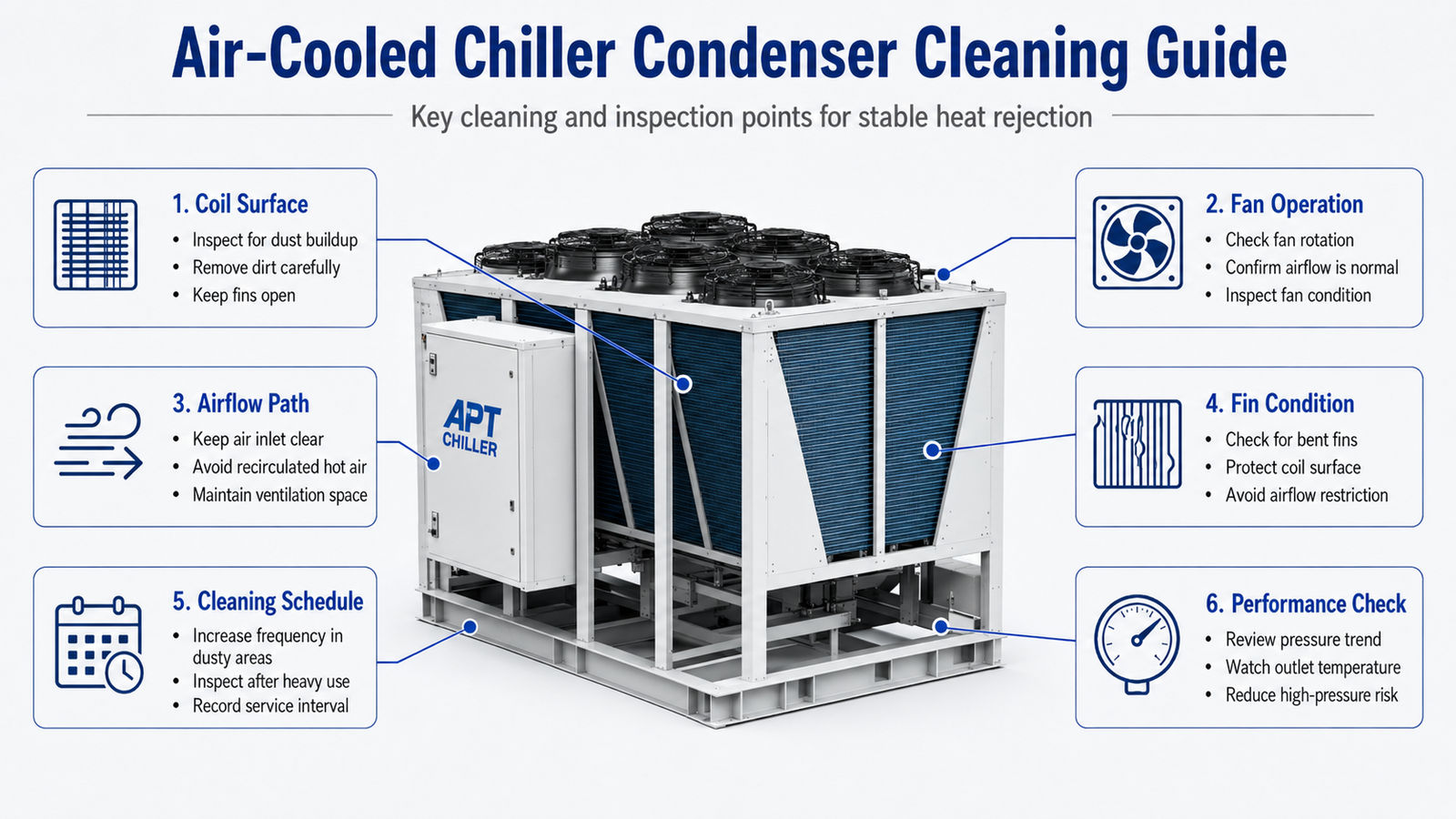
Quick Summary
Main problem
Dirty or poorly ventilated condensers cannot reject heat effectively, especially in hot or dusty workshops.
What to inspect
Airflow path, condenser fins, fan operation, cooling water condition, tube fouling, cooling tower operation, and ambient temperature.
Recommended action
Clean condensers regularly, maintain ventilation space, monitor pressure readings, and adjust maintenance frequency to the site environment.
When to contact support
Contact APT when high-pressure alarms repeat, condenser fouling is severe, or high-ambient operation requires design review.
Article Overview
For industrial users, chiller maintenance is not a minor background task. It directly affects stable process cooling, equipment protection, product consistency, energy use, and production availability. APT Chiller views maintenance and troubleshooting as part of the complete engineering support cycle, from chiller selection to long-term operation.
This guide is written for engineers, maintenance teams, overseas buyers, OEM equipment manufacturers, plant operators, and project managers who need practical information before contacting technical support or planning preventive chiller maintenance.
The guidance below is general and does not replace qualified electrical or refrigeration service procedures. When the issue involves electrical cabinets, refrigerant circuits, pressure protection, or safety devices, use trained personnel and follow site safety requirements.
Why Condenser Heat Rejection Matters
An industrial chiller removes heat from process water and rejects that heat through the condenser. In an air-cooled chiller, heat is rejected to ambient air through condenser fins and fans. In a water-cooled chiller, heat is rejected through a water-cooled condenser and usually transferred to a cooling tower or cooling water system.
If heat rejection is restricted, refrigerant pressure rises and compressor load increases. The chiller may still run for a period, but cooling efficiency drops and high-pressure protection may stop the system. This is one of the most common maintenance issues in high ambient operation, dusty workshops, die casting plants, thermal spray areas, and outdoor installations.
APT Chiller evaluates condenser type, ambient temperature, airflow space, and site conditions during selection because condenser design has a direct influence on stable process cooling and long-term reliability.
Air-Cooled Condenser Cleaning
Air-cooled condensers are exposed to workshop air. Dust, metal powder, oil mist, fibers, and airborne particles can collect on the fins and block airflow. When the fins are dirty, fans cannot move enough air through the condenser coil and heat rejection becomes weak.
Cleaning frequency depends on the environment. A clean laboratory or electronics workshop may require less frequent cleaning than a die casting, thermal spray, grinding, or plastic production area. For outdoor chillers, dust, leaves, rain splash, and hot air recirculation also need attention.
Cleaning should follow qualified maintenance procedures. Avoid damaging condenser fins or electrical components. Operators should confirm that the chiller has enough clearance around the air inlet and outlet so hot discharge air does not return to the condenser intake.
Water-Cooled Condenser Maintenance
Water-cooled chillers depend on cooling water quality and flow. Fouling inside condenser tubes, poor cooling tower performance, insufficient cooling water flow, high entering cooling water temperature, or scale buildup can all reduce heat rejection.
Maintenance teams should monitor cooling water temperature, pressure drop, tower condition, water treatment, and condenser performance. If the water-cooled condenser becomes fouled, the chiller may show high condensing pressure even when the process load has not changed.
Water-cooled systems can be efficient for larger or continuous-duty applications, but they require good cooling water management. Poor cooling tower maintenance can create chiller problems that appear to be refrigeration faults.
Symptoms of Poor Heat Rejection
Common symptoms include high-pressure alarms, longer cooling time, rising outlet water temperature, compressor overload, high fan running time, abnormal pressure readings, and reduced cooling capacity in hot weather.
These symptoms often become worse as ambient temperature rises. A chiller that works in winter may struggle in summer if condenser cleaning, ventilation, or cooling water conditions are poor.
Maintenance records are useful. Compare pressure and temperature readings over time. A gradual rise in condensing pressure may indicate fouling, reduced airflow, or cooling water deterioration.
High-Ambient Operating Considerations
High ambient operation requires stronger attention to condenser heat rejection. Hot workshops, Middle East climates, Southeast Asian factories, outdoor installations, and poorly ventilated machine rooms may need T3 high-ambient chiller design or larger condenser surface.
For air-cooled chillers, avoid placing the unit where hot air can recirculate. For water-cooled chillers, confirm that cooling water temperature remains within the design condition. In both cases, preventive maintenance is essential for stable process cooling.
Maintenance and Troubleshooting Pain Points
High-pressure alarms
Restricted heat rejection increases condensing pressure and activates protection.
Hot air recirculation
Poor installation layout can send hot discharge air back into the condenser inlet.
Dusty production areas
Metal powder, oil mist, and dust require shorter cleaning intervals.
Cooling water fouling
Water-cooled condensers can lose performance when cooling water treatment is poor.
APT Engineering Support Approach
APT supports industrial chiller users with engineering-based technical support, not only product replacement. When reviewing a maintenance or troubleshooting question, APT engineers may ask for cooling capacity, target temperature, inlet and outlet temperature, pump flow and pressure, condenser condition, water quality, heat exchanger material, ambient temperature, voltage, alarm code, photos, and operating history.
This information helps determine whether the issue is related to preventive maintenance, water circuit inspection, condenser heat rejection, pump flow and pressure, heat exchanger protection, high ambient operation, spare parts planning, or original chiller selection. For custom industrial chillers, APT can also review pump configuration, heat exchanger selection, condenser design, control logic, and installation requirements.
Recommended Inspection Table
| Component / Problem | What to check | Possible cause | Recommended action |
|---|---|---|---|
| Air-cooled condenser | Fins, airflow, fan rotation | Dust, blocked inlet, hot air recirculation | Clean fins and improve air clearance around the chiller. |
| Water-cooled condenser | Cooling water temperature and pressure drop | Scale, fouling, low cooling water flow | Inspect water treatment and plan qualified condenser cleaning. |
| High-pressure alarm | Alarm timing and pressure readings | Poor heat rejection or overloading | Stop repeated resets and investigate condenser and ambient conditions. |
| Fan system | Fan motor, airflow, abnormal noise | Fan fault, blocked guard, electrical issue | Use qualified inspection and replace faulty parts when needed. |
| Installation space | Air inlet and outlet clearance | Too close to wall or heat source | Relocate or improve ventilation where possible. |
FAQ
Why does condenser cleaning matter for industrial chillers?
Condenser cleaning keeps heat rejection efficient. Dirty condenser surfaces increase refrigerant pressure, reduce cooling capacity, increase energy use, and may cause high-pressure alarms.
How do air-cooled condensers become dirty?
Air-cooled condensers collect dust, oil mist, fibers, metal powder, and workshop particles. Outdoor units may also collect leaves and environmental debris.
What causes high-pressure alarms in chillers?
High-pressure alarms are often related to poor heat rejection, dirty condensers, blocked airflow, high ambient temperature, cooling water problems, fan issues, or overloaded operation.
Do water-cooled condensers need cleaning?
Yes. Water-cooled condensers can develop scale or fouling inside water passages. Cooling water quality, tower condition, and water flow should be maintained regularly.
Can APT help select chillers for high-ambient sites?
Yes. APT can review ambient temperature, installation space, condenser design, ventilation, dust level, and cooling load before recommending air-cooled, water-cooled, or custom high-ambient chillers.
Need help troubleshooting or maintaining your industrial chiller?
APT engineers can help review cooling capacity, water flow, pump pressure, heat exchanger condition, condenser design, and operating environment. Share your application, alarm information, operating data, photos, and maintenance history so the support discussion can start from practical engineering facts.