
40HP T3 High Ambient Air Cooled Chiller for Hot Climate Factory Cooling
A project-based reference showing how a 40HP T3 high ambient air cooled industrial chiller can be reviewed for process cooling in hot climate factory conditions, including condenser margin, cabinet ventilation, and ambient temperature review.
This remains a case reference and preliminary engineering direction. Final selection depends on maximum ambient temperature, installation airflow, heat load, voltage, and condenser design review.
Quick Answer: What Chiller Was Reviewed for This Hot Climate Factory Project?
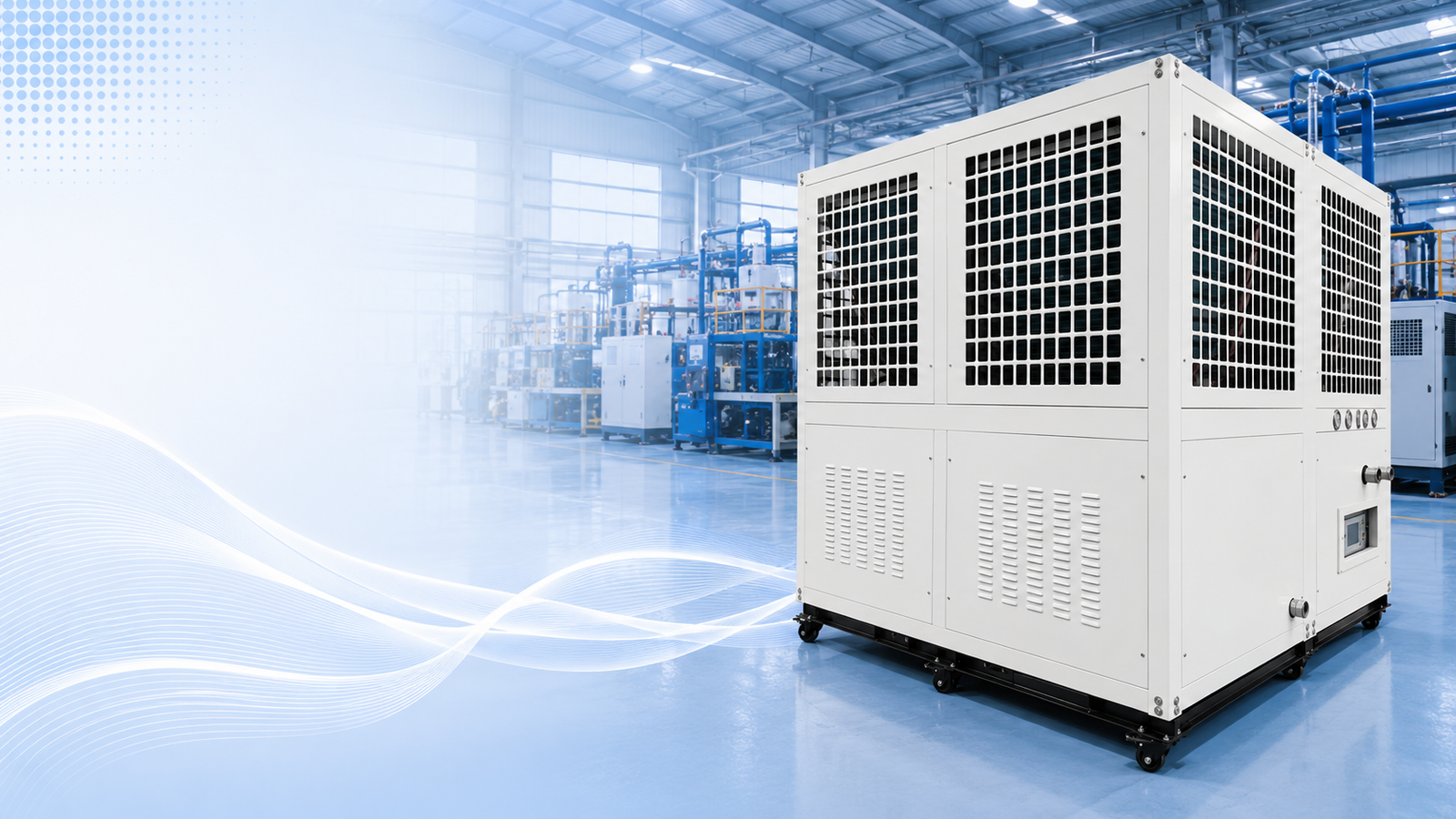
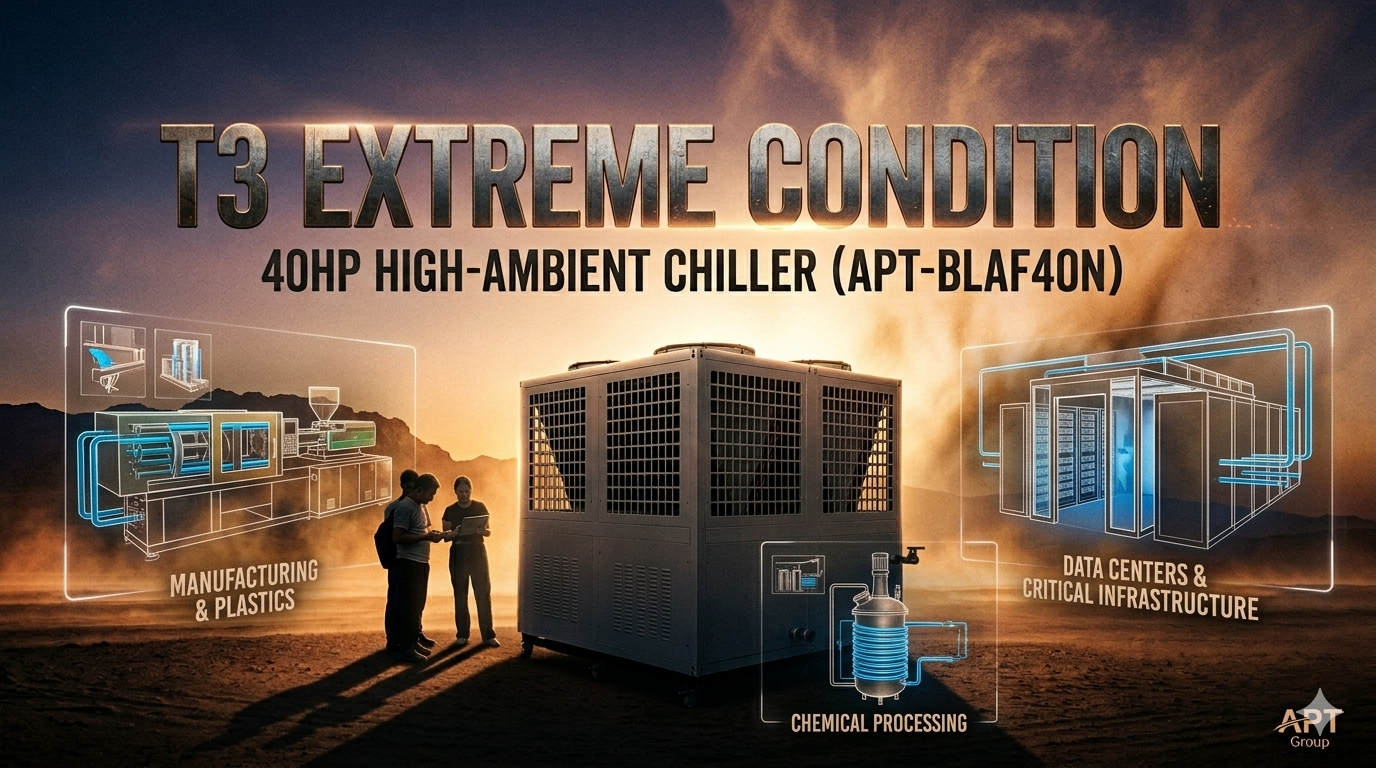
A 40HP T3 high ambient air cooled industrial chiller was reviewed as the preliminary cooling direction for this hot climate factory cooling project. The design direction supports process cooling where high ambient temperature, condenser heat rejection, ventilation clearance, and cabinet protection must be reviewed before final selection.
Project Background
This project direction relates to a factory in a hot climate region where production equipment required reliable process cooling in a workshop operating above standard indoor temperature assumptions. The site preferred an air cooled direction because cooling tower installation was not the first choice for the preliminary engineering path.
Because high ambient temperature directly affects condenser heat rejection and compressor operating margin, a T3 high ambient design was considered instead of treating a standard air cooled chiller as automatically suitable. The factory cooling review focused on maximum ambient temperature, ventilation condition, airflow clearance, cabinet protection, and continuous duty stability.
Cooling Challenge
High Ambient Temperature
Workshop or outdoor-adjacent ambient condition can exceed standard condenser design assumptions.
Heat Rejection Margin
Condenser capacity margin must be reviewed so the chiller can maintain stable operation in hot climate conditions.
Workshop Airflow
Ventilation and hot-air discharge path affect condenser performance and the risk of recirculation.
Cabinet Protection
High temperature, dust, and service environment can influence enclosure and electrical review direction.
Airflow Clearance
Installation spacing must support fresh-air intake and stable condenser exhaust under continuous duty.
Process Heat Load
Equipment heat rejection determines whether 40HP is suitable as a reference direction.
Continuous Operating Hours
Long-hour production requires stable compressor operating margin and reliable protection logic.
Voltage and Service Access
Voltage, frequency, dust exposure, semi-outdoor risk, and maintenance access all affect final selection.
40HP T3 High Ambient Air Cooled Industrial Chiller Solution
A 40HP T3 high ambient air cooled industrial chiller was considered as the preliminary case direction for this hot climate factory cooling project. The direction was reviewed because standard air cooled chillers may lose effective operating margin when ambient temperature, condenser inlet air condition, and ventilation layout move beyond normal indoor assumptions.
The proposed direction includes a T3 high ambient air cooled condenser layout, industrial compressor system, fan and airflow arrangement reviewed for installation condition, pump selected by flow and head, digital temperature controller, and standard protection logic for compressor, pump, flow, pressure, overload, and high-low pressure review.
Final selection depends on maximum ambient temperature, installation airflow, heat load, voltage, and condenser design review. This page should not be interpreted as a promise that one layout works in all hot climates or that derating never occurs.
Engineering Review Matrix
| Engineering Item | Why It Matters | Data to Confirm |
|---|---|---|
| Maximum Ambient Temperature | Defines how much condenser operating margin is required for the hot climate condition. | Peak outdoor or workshop ambient condition by season and operating hour. |
| Process Heat Load | Confirms whether 40HP is suitable as a reference direction. | Total process cooling demand from the factory equipment and duty profile. |
| Target Water Temperature | Defines controller setpoint and process stability requirement. | Required outlet temperature and acceptable fluctuation range. |
| Condenser Margin | Protects heat rejection performance when ambient air is hotter than normal design assumptions. | Condenser sizing direction, expected condensing condition, and project margin review. |
| Airflow Clearance | Helps avoid hot-air recirculation and reduced condenser performance. | Clearance around the chiller, intake path, and discharge direction. |
| Workshop Ventilation | Ventilation condition affects effective condenser inlet air temperature. | Air exchange condition, enclosure effect, and nearby heat source impact. |
| Installation Location | Indoor, semi-outdoor, or outdoor position changes protection and ventilation review requirements. | Actual site layout, surface condition, service access, and shading condition. |
| Dust / Outdoor Exposure | Dust and weather exposure can change condenser cleaning and cabinet protection direction. | Dust level, rain exposure, sun load, and maintenance cleaning access. |
| Flow Rate | Ensures enough circulation through the process cooling loop. | Required L/min or m3/h for the equipment circuit. |
| Pump Pressure | Checks whether the pump can overcome loop resistance. | Pump head, piping length, exchanger loss, elevation change, and filter resistance. |
| Voltage and Frequency | Supports electrical compatibility with destination or export site condition. | Available power supply and final electrical standard. |
| Operating Hours | Influences compressor duty, condenser loading, and reliability review. | Working hours per day and continuous production expectation. |
| Service Access | Maintenance clearance affects long-term operation in hot climate factory conditions. | Front, side, and top access around the cabinet and condenser area. |
Recommended Configuration Table
| Item | Preliminary Direction | Notes |
|---|---|---|
| Cooling Method | T3 high ambient air cooled condenser | Condenser design should be reviewed against the actual hot climate condition. |
| Capacity Direction | 40HP reference | Final size depends on actual process heat load and operating profile. |
| Cooling Circuit | Closed-loop process water | Loop arrangement should follow factory equipment cooling requirement and stability needs. |
| Typical Application | Hot climate factory / production equipment / process cooling | Suitable for projects where cooling tower installation is not preferred. |
| Outlet Temperature | Project-defined, often 7-25 C | Final setpoint follows actual process target and allowable fluctuation. |
| Pump Selection | By required flow and head | Pump choice must match real loop resistance and hydraulic demand. |
| Power Supply | 380-460V, 50/60Hz by destination | Electrical configuration should match the actual plant or export destination. |
| Final Review | Ambient temperature / heat load / condenser margin / airflow / pump head / voltage | Engineering confirmation is required before quotation and final model release. |
Why T3 High Ambient Air Cooled Chiller Was Considered
Standard Air Cooled Chillers May Lose Margin
Standard air cooled chillers may lose effective capacity when condenser inlet air temperature rises in hot climate conditions.
T3 Direction Supports Higher Ambient Review
T3 direction supports hotter climate review for condenser size, airflow, and compressor operating margin.
No Cooling Tower Preferred
This direction supports factory cooling discussion where a cooling tower is not preferred for the preliminary project path.
Final selection depends on maximum ambient temperature, installation airflow, heat load, voltage, and condenser design review. This page should not be interpreted as a promise that one layout works in all hot climates or that derating never occurs.
Project Value
Better Hot Climate Cooling Direction
Improves early-stage discussion for condenser review in high ambient industrial conditions.
Reduced Under-Sized Condenser Risk
Helps avoid using a standard condenser direction where hot climate operating margin may be too low.
Clear Ambient Temperature Path
Creates a disciplined engineering path around maximum ambient, ventilation, and installation data.
Supports No Cooling Tower Discussion
Useful for factories that prefer an air cooled solution instead of adding cooling tower infrastructure.
Better Site Data Preparation
Helps customers prepare heat load, airflow, and installation information for quotation review.
Related Pages
40HP T3 High Ambient Air Cooled Chiller
Review the related product page for this hot climate high ambient cooling direction.
ApplicationHigh Ambient Factory Cooling
Review broader hot workshop and high ambient process cooling requirements.
CategoryAir Cooled Chillers
Compare standard and custom air cooled process cooling directions.
Category20-50HP Large Air Cooled Chiller
Compare nearby large-range air cooled industrial chiller directions.
CustomCustom Industrial Chiller
Review custom process cooling directions when ambient, airflow, voltage, or layout need special support.
GuideChiller Selection Guide
Review supporting engineering topics before final chiller selection and quotation.
GuideAir Cooled vs Water Cooled Chiller
Compare condenser type logic when site utilities and heat rejection conditions differ.
PDFDownload Case PDF
Download the concise PDF reference sheet for this 40HP T3 high ambient factory cooling case.
40HP T3 High Ambient Air Cooled Chiller for Hot Climate Factory Cooling FAQ
What is a T3 high ambient chiller?
A T3 high ambient chiller is a process cooling direction reviewed for hotter climate conditions where condenser heat rejection, compressor operating margin, and airflow design need more attention than standard indoor assumptions.
Why use a T3 air cooled chiller for hot climate factory cooling?
It may be reviewed when the factory operates in high ambient temperature conditions and the project needs better condenser margin without relying on a cooling tower.
Is a 40HP chiller enough for high ambient process cooling?
Not always. A 40HP direction is only a preliminary reference. Final suitability depends on real heat load, target water temperature, ambient condition, and ventilation layout.
What ambient temperature data is required?
Prepare the maximum expected workshop or outdoor temperature, seasonal range, nearby heat source condition, and operating hours during the hottest period.
Does high ambient temperature reduce chiller capacity?
Yes, it can. Higher condenser inlet air temperature may reduce effective cooling margin, which is why condenser design review is important in hot climate projects.
What airflow clearance should be reviewed?
Check the intake and discharge path around the condenser, side and rear clearance, overhead restriction, and whether hot air could recirculate back into the chiller.
Can a T3 chiller replace a cooling tower?
It can support projects where a cooling tower is not preferred, but final suitability depends on ambient temperature, heat load, space, and condenser review.
Can it be installed outdoors?
It may be possible, but outdoor installation should still be reviewed for sun load, dust, rain exposure, ventilation, service access, and cabinet protection.
What data is required before final selection?
Prepare maximum ambient temperature, heat load, target temperature, flow rate, pump head, voltage, installation layout, airflow clearance, and expected operating hours.
Can APT customize condenser, fan, cabinet, pump, voltage, or controls?
Yes. APT can review condenser size, airflow path, cabinet direction, pump arrangement, export voltage, and control logic according to project needs.
Need a Similar Chiller for Hot Climate Factory Cooling?
Share your maximum ambient temperature, process heat load, target water temperature, required flow, pump pressure, installation layout, airflow clearance, operating hours, voltage, and service condition. APT engineers can review whether a similar 40HP T3 high ambient air cooled chiller direction is suitable for your project.