
10HP Mobile Industrial Chiller for Temporary Production Line Cooling
A project-based reference showing how a 10HP mobile industrial chiller can be reviewed for temporary production line cooling, equipment testing, maintenance backup, and flexible machine-side chilled water support.
This remains a case reference and preliminary engineering direction. Final selection depends on cooling load, runtime, flow rate, pump pressure, connection method, power supply, hose length, and site movement conditions.
Quick Answer: What Chiller Was Reviewed for This Temporary Production Cooling Project?
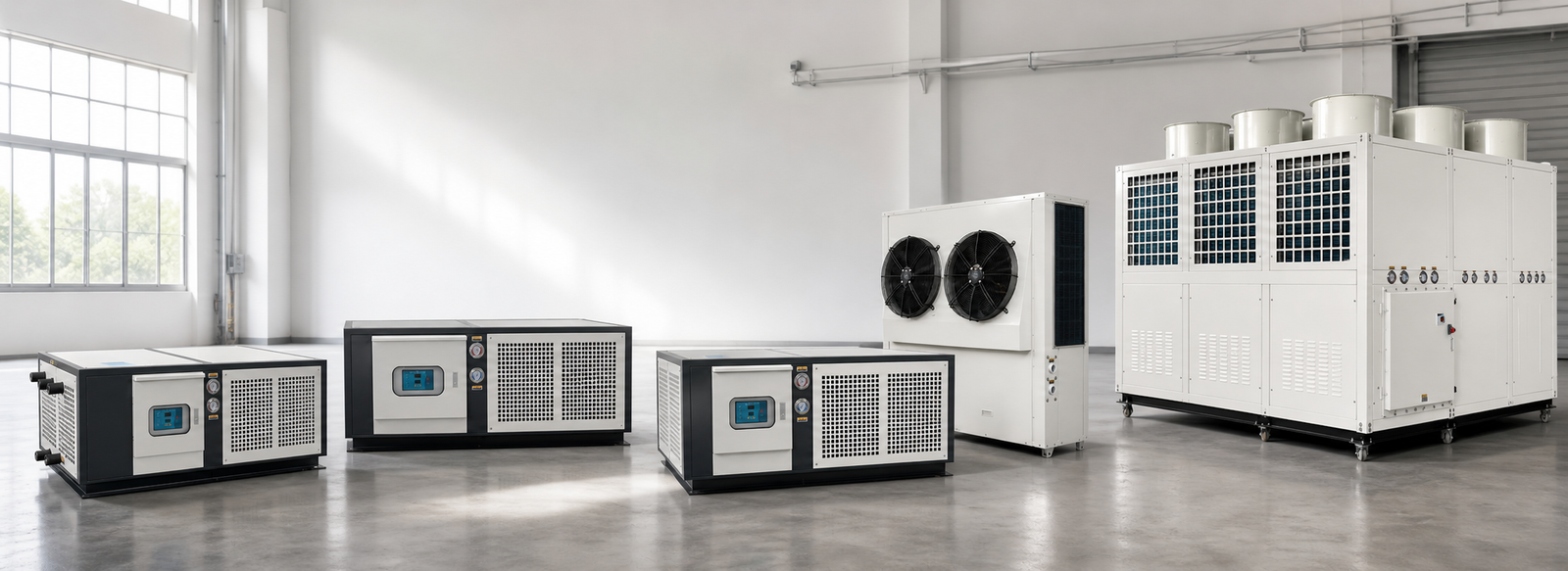
A 10HP mobile industrial chiller was reviewed as the preliminary cooling direction for this temporary production line cooling project. The design direction supports flexible movement, quick hose connection, independent chilled water circulation, and temporary cooling support during equipment testing, process adjustment, or main chiller maintenance.
Project Background
This project direction relates to a manufacturing workshop that required temporary chilled water support for a production line during equipment testing, process adjustment, and scheduled maintenance of the main cooling system. The site needed a practical cooling direction that could move close to the machine side, connect quickly, and operate independently without changing permanent piping.
Because the cooling demand was temporary and the production layout needed flexibility, a 10HP mobile industrial chiller was reviewed as the preliminary direction. The engineering discussion focused on caster-mounted movement, flexible hose connection, independent circulation, available power supply, and whether the pump and tank arrangement could support the existing equipment loop.
Cooling Challenge
Temporary Cooling Load
Actual cooling demand determines whether 10HP is suitable as the preliminary direction.
Runtime Requirement
Planned operating duration affects compressor loading and tank capacity discussion.
Hose Length and Connection Method
Temporary hose route and connection logic affect pressure loss and deployment practicality.
Pump Flow and Pressure
Pump selection must match hose length, filter loss, and existing equipment loop resistance.
Drainage and Water Filling
Temporary cooling often requires practical filling, draining, and restart planning.
Movement Route and Floor Condition
Route width, caster travel, and floor condition affect mobility and safe deployment.
Power Supply Availability
Temporary cooling points may have different available voltage and connection constraints.
Service Access
Panel access, maintenance room, and hose connection space should remain practical in temporary use.
Temperature Stability
Even temporary cooling support may still need stable water temperature for testing or process adjustment.
Existing Equipment Loop Match
The mobile chiller must match the real machine-side loop in connection size, pressure, and flow demand.
10HP Mobile Industrial Chiller Solution
A 10HP mobile industrial chiller was considered as the preliminary direction for this temporary production line cooling project. The design direction was reviewed because the project required flexible cooling support, caster-mounted movement, independent circulation, and practical hose connection during short-term equipment use.
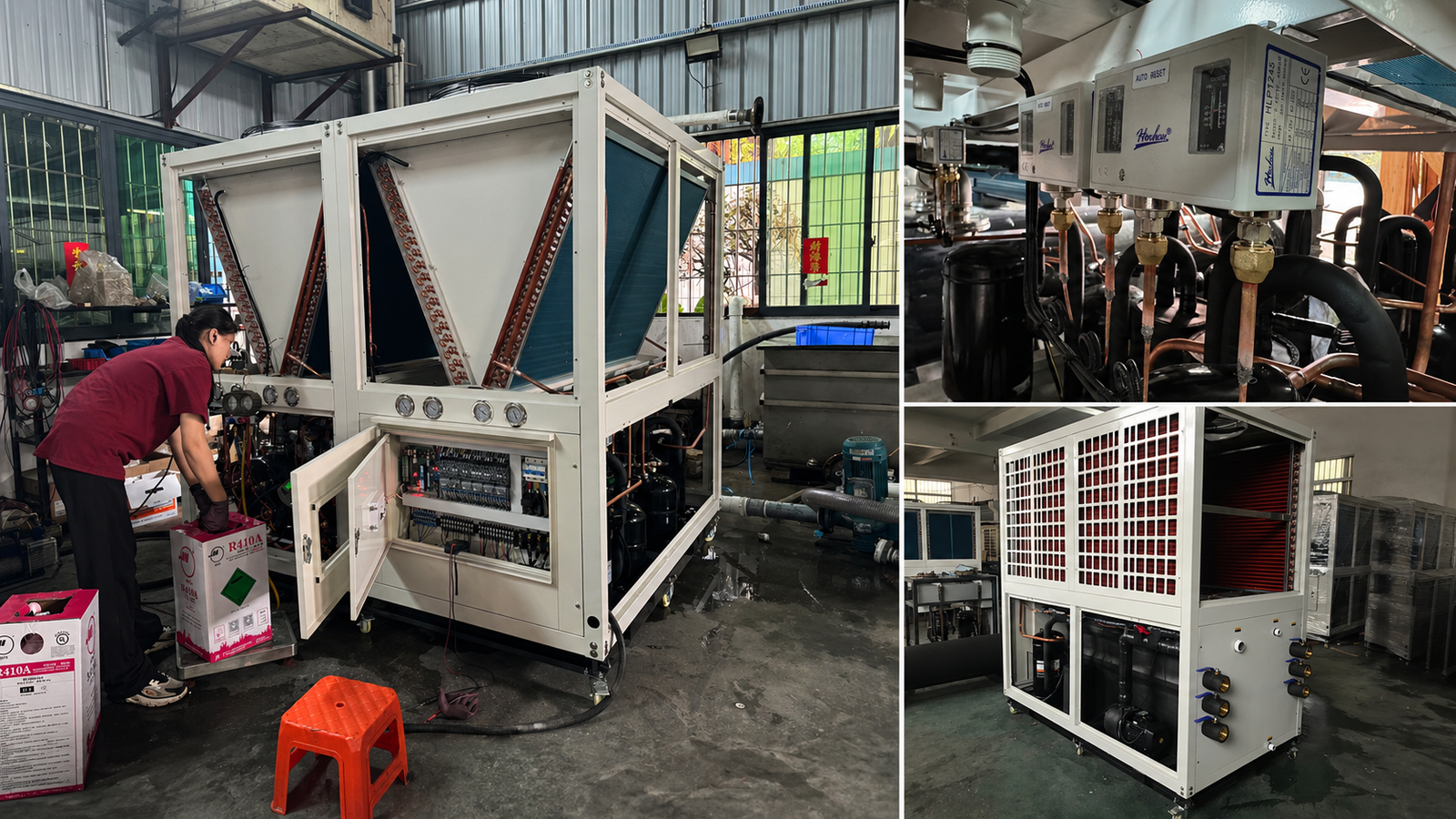
The proposed direction includes an air cooled mobile chiller cabinet, industrial compressor, built-in water tank and circulation pump, flexible hose connection review, digital temperature controller, and standard protection logic for flow, pressure, compressor, pump, and overload monitoring.
This page should not be interpreted as plug-and-play for all equipment or a universal solution that works with any machine loop. Final selection depends on cooling load, runtime, flow rate, pump pressure, connection method, power supply, hose length, and site movement conditions.
Engineering Review Matrix
| Engineering Item | Why It Matters | Data to Confirm |
|---|---|---|
| Temporary Cooling Load | Confirms whether 10HP is suitable as the preliminary cooling direction. | Total heat load from the production line or temporary test loop. |
| Target Water Temperature | Defines controller setpoint and temporary process cooling objective. | Required outlet temperature and acceptable fluctuation. |
| Runtime Requirement | Operating duration affects tank size, compressor duty, and practical deployment logic. | Expected hours per day and whether cooling is intermittent or continuous. |
| Hose Length | Longer hose routes increase pressure loss and affect movement planning. | Total hose run length and routing path. |
| Connection Size | Connection mismatch can prevent direct integration with the machine loop. | Required inlet/outlet connection size and fitting type. |
| Flow Rate | Enough flow is needed to maintain useful temporary cooling support. | Required L/min or m3/h for the connected equipment loop. |
| Pump Pressure | Checks whether the circulation pump can overcome hose and loop resistance. | Pump head, filter loss, exchanger loss, and valve loss. |
| Tank Volume | Tank capacity affects temperature buffering and short-cycle stability. | Required tank size for the temporary cooling duty profile. |
| Drainage / Water Filling | Temporary deployment often needs practical refill and drain handling. | Drain point, water filling method, and restart procedure. |
| Movement Route | Route planning determines whether the mobile unit can reach the cooling point safely. | Door width, aisle width, turning space, and transport path. |
| Floor Condition | Floor level and surface affect caster movement and safe positioning. | Floor flatness, slope, threshold, and load condition. |
| Power Supply | Temporary locations may not have the same electrical condition as fixed equipment areas. | Available voltage, frequency, cable route, and connector type. |
| Operating Hours | Duty cycle affects compressor load and cooling continuity expectations. | Daily runtime, maintenance window, and testing schedule. |
| Equipment Compatibility | The mobile chiller must match existing machine-side cooling conditions. | Loop compatibility, allowable pressure, and connection layout. |
Recommended Configuration Table
| Item | Preliminary Direction | Notes |
|---|---|---|
| Cooling Method | Mobile air cooled chiller | Independent air cooled heat rejection supports practical short-term deployment. |
| Capacity Direction | 10HP reference | Final size depends on actual cooling load and operating schedule. |
| Mobility Direction | Caster-mounted industrial cabinet | Movement route and floor condition should be reviewed before final cabinet release. |
| Cooling Circuit | Closed-loop chilled water | Supports temporary production line, testing loop, and machine-side cooling discussion. |
| Typical Application | Temporary production line / equipment testing / maintenance backup | Suitable for flexible support where fixed piping changes are not preferred. |
| Outlet Temperature | Project-defined, often 7-25 C | Final setpoint should match process requirement and temporary cooling objective. |
| Pump Selection | By required flow, hose length, and pressure | Pump must match actual connection method and loop resistance. |
| Power Supply | 380-460V, 50/60Hz by destination | Electrical configuration should follow the actual temporary installation point. |
| Final Review | Cooling load / runtime / hose / pump head / connection / power supply | Engineering confirmation is required before quotation and final model confirmation. |
Why Mobile Industrial Chiller Was Considered
Flexible Cooling Support Without Fixed Piping Changes
Mobile cooling direction can help support temporary jobs without heavy permanent piping modification.
Useful for Testing or Process Adjustment
It is often considered where temporary chilled water support is needed during testing or short-term process change.
Supports Maintenance Backup Cooling
Mobile units can provide temporary cooling support when the main chiller system is offline for service.
Final selection depends on cooling load, runtime, flow rate, pump pressure, connection method, power supply, hose length, and site movement conditions. This page should not be interpreted as plug-and-play for all equipment or a mobile unit that works with any machine without engineering review.
Project Value
Faster Temporary Cooling Deployment
Supports quicker response when a production line needs short-term chilled water support.
Reduced Downtime During Maintenance or Testing
Provides a practical backup or temporary cooling path during service windows and line adjustment.
Flexible Support for Changing Production Layout
Caster-mounted movement helps respond to changing machine positions and workshop needs.
Clear Engineering Path for Hose and Pump Review
Improves early-stage discussion around hose routing, pump head, and connection arrangement.
Lower Need for Permanent Piping Modification
Supports temporary use cases where permanent chilled-water rework is not preferred.
Related Pages
Mobile Industrial Chiller
Review the related product and application direction for mobile process cooling projects.
Product Reference10HP Air Cooled Chiller
Compare a nearby fixed-installation 10HP air cooled product direction for production cooling review.
CategoryAir Cooled Chillers
Review the broader APT air cooled industrial chiller category and selection range.
GuideChiller Selection Guide
Review supporting engineering topics before final chiller selection and quotation.
GuidePump Flow and Pressure Selection
Review how hose length, connection method, and pump head affect temporary cooling performance.
ApplicationCNC Machine Tool Cooling
Review another machine-side cooling direction where temporary or movable chilled water support may be useful.
PDFDownload Case PDF
Download the concise PDF reference sheet for this 10HP mobile industrial chiller temporary cooling case.
QuoteRequest a Quote
Submit similar temporary production cooling requirements for engineering review.
10HP Mobile Industrial Chiller for Temporary Production Line Cooling FAQ
What is a mobile industrial chiller used for?
A mobile industrial chiller is often used for temporary process cooling, machine-side support, production testing, maintenance backup, or flexible workshop cooling where fixed installation is not preferred.
Is a 10HP mobile chiller enough for temporary production cooling?
It can be a suitable preliminary direction for some temporary cooling projects, but final confirmation depends on real cooling load, runtime, flow, pressure, and connection condition.
Can a mobile chiller support equipment testing?
Yes. Mobile chillers are often reviewed for testing loops where chilled water support is needed before the permanent system is finalized.
Can it be used as backup cooling during maintenance?
Yes. A mobile unit may be considered for short-term backup cooling while the main chiller system is under maintenance or inspection.
What data is needed before final selection?
Prepare cooling load, target temperature, runtime, hose length, connection size, flow rate, pump head, available power supply, and movement route data.
Why are hose length and pump pressure important?
Long hose runs and connection losses increase resistance, so pump head must be reviewed to maintain useful chilled water circulation.
Can the chiller connect to existing machine loops?
Yes, but connection size, allowable pressure, flow requirement, and hose layout must be checked before confirming the final design.
What power supply should be confirmed?
Confirm the actual available voltage, frequency, cable route, and connector condition at the temporary installation point.
Can APT customize caster, tank, pump, hose connection, voltage, or controller?
Yes. APT can review project-specific customization for caster layout, water tank, pump, hose connection, voltage, and controller logic.
What should be reviewed before quotation?
Before quotation, confirm cooling load, runtime, hose route, flow rate, pump pressure, movement path, floor condition, power supply, and machine-loop compatibility.
Need a Similar Mobile Chiller for Temporary Production Cooling?
Share your cooling load, target temperature, runtime, hose length, flow rate, pump pressure, movement route, floor condition, and power supply data. APT engineers can review whether a similar 10HP mobile industrial chiller direction is suitable for your project.