
Common Industrial Chiller Alarms and Troubleshooting Guide
Industrial chiller alarms are designed to protect the compressor, pump, refrigeration circuit, water circuit, and process equipment. This guide explains common alarm types and practical troubleshooting logic without replacing qualified service procedures.
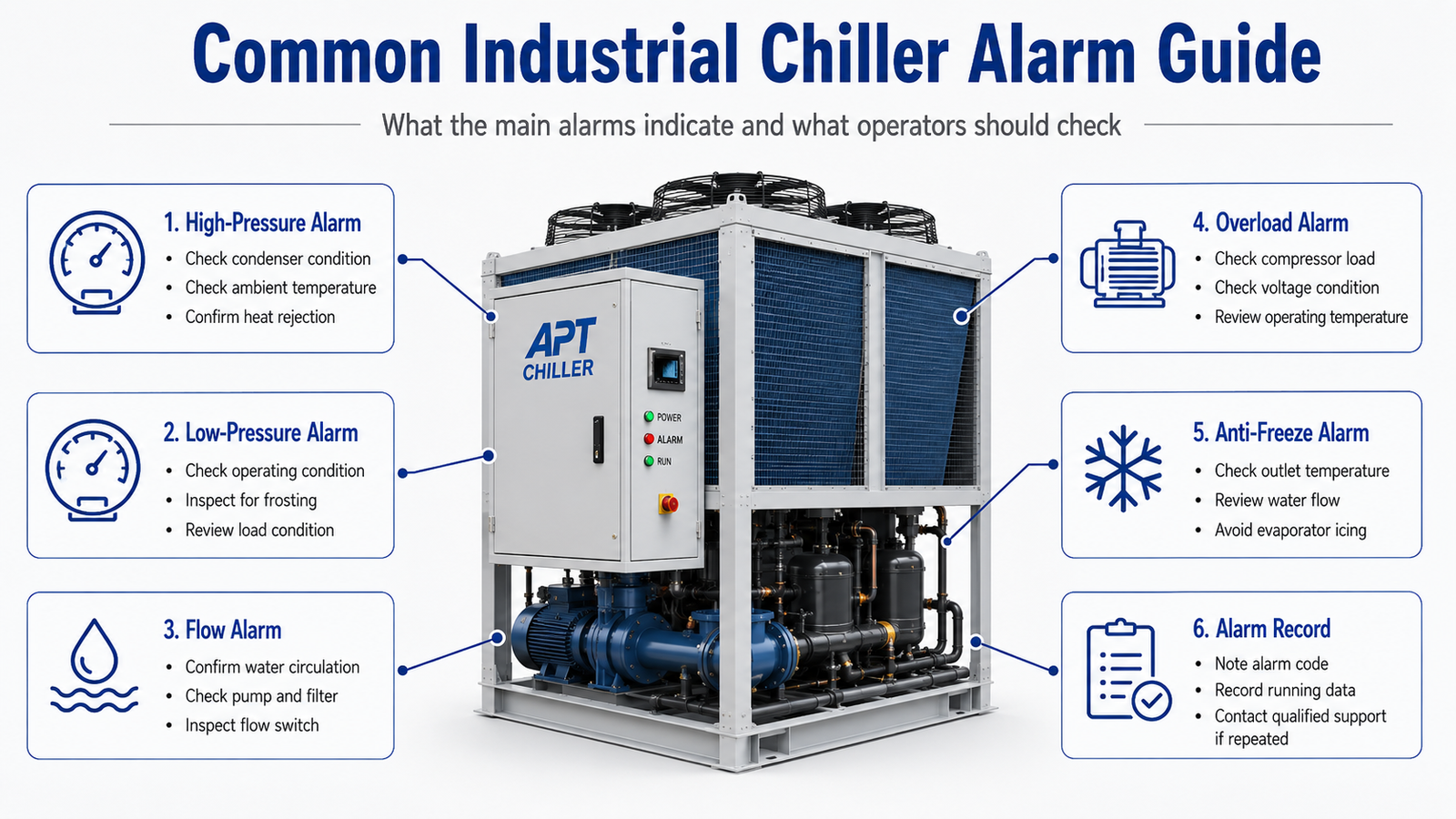
Quick Summary
Main problem
Alarms indicate abnormal operating conditions that may reduce cooling performance or damage equipment if ignored.
What to inspect
Alarm code, operating temperature, pressure readings, water flow, condenser condition, power supply, and recent maintenance history.
Recommended action
Record the alarm and investigate basic operating conditions before restarting repeatedly.
When to contact support
Contact APT when alarms repeat, electrical or refrigeration checks are needed, or the cause is unclear.
Article Overview
For industrial users, chiller maintenance is not a minor background task. It directly affects stable process cooling, equipment protection, product consistency, energy use, and production availability. APT Chiller views maintenance and troubleshooting as part of the complete engineering support cycle, from chiller selection to long-term operation.
This guide is written for engineers, maintenance teams, overseas buyers, OEM equipment manufacturers, plant operators, and project managers who need practical information before contacting technical support or planning preventive chiller maintenance.
The guidance below is general and does not replace qualified electrical or refrigeration service procedures. When the issue involves electrical cabinets, refrigerant circuits, pressure protection, or safety devices, use trained personnel and follow site safety requirements.
Why Industrial Chillers Use Alarm Protection
Industrial chillers operate with refrigeration, hydraulic, electrical, and control systems working together. Alarm protection helps prevent abnormal pressure, overheating, freezing, phase problems, overload, and water circulation failure from damaging the chiller or process equipment.
An alarm should be treated as useful diagnostic information, not only an inconvenience. Repeatedly resetting the chiller without checking the cause can increase downtime and component stress. A clear alarm record helps engineers understand whether the problem is related to heat rejection, water flow, electrical supply, controller settings, sensor condition, or refrigeration circuit behavior.
APT Chiller supports engineering-based technical troubleshooting by reviewing alarm information together with application type, cooling load, ambient temperature, pump flow and pressure, condenser condition, and maintenance history.
High-Pressure Alarm Causes
High-pressure alarms are commonly related to poor heat rejection. Air-cooled chillers may have dirty condenser fins, blocked airflow, fan faults, hot air recirculation, high ambient temperature, or insufficient installation clearance. Water-cooled chillers may have cooling water problems, fouled condenser tubes, poor cooling tower performance, or insufficient cooling water flow.
Overloading can also contribute to high pressure. If the actual heat load is higher than the chiller capacity or if ambient conditions exceed the design range, the refrigeration system operates under higher stress.
Maintenance teams should inspect condenser cleanliness, ventilation, cooling water condition, pressure readings, and operating environment before assuming compressor failure.
Low-Pressure Alarm Causes
Low-pressure alarms may be related to refrigerant shortage, blocked filter components, low heat load, evaporator frosting, abnormal expansion valve operation, low water flow, or low temperature set points. The exact diagnosis should be performed by qualified refrigeration personnel.
From an operator perspective, useful information includes water temperature, set point, flow condition, ambient temperature, recent maintenance, and whether the alarm appears during startup or after running for some time.
Low-pressure protection helps prevent abnormal refrigeration operation. If the alarm repeats, do not continue running the chiller without technical review.
Compressor Overload and Electrical Alarms
Compressor overload may be caused by high operating pressure, voltage problems, phase imbalance, excessive current, poor ventilation, mechanical stress, or repeated start-stop cycles. Phase protection alarms may indicate phase loss, phase sequence problems, or unstable power supply.
Electrical inspection should be performed by qualified personnel. Operators can record supply voltage information if available, check whether other equipment on the same power line has problems, and confirm whether the alarm appears during startup or under heavy load.
Stable power supply is important for export industrial chiller projects because voltage standards, frequency, and site electrical conditions vary by country.
Flow, Anti-Freezing, and Temperature Control Alarms
Flow alarms are connected to water circulation. Common causes include low water level, blocked filter, air in the circuit, pump issue, closed valve, high pipe resistance, or flow switch problem. Anti-freezing alarms protect the evaporator when water temperature or flow condition creates freezing risk.
Temperature control warnings may be caused by excessive heat load, sensor position, controller setting, unstable flow, dirty condenser, or a mismatch between process demand and chiller capacity. These alarms should be reviewed with both process and chiller conditions in mind.
When an alarm involves electrical cabinets, refrigerant circuits, or safety protection devices, maintenance teams should follow qualified service procedures and contact technical support when needed.
Maintenance and Troubleshooting Pain Points
Repeated resets
Restarting without diagnosis can hide the root cause and increase component stress.
Incomplete alarm records
Missing codes, temperatures, and pressure data makes troubleshooting slower.
Assuming one cause
High pressure, low flow, and unstable temperature can each result from several site conditions.
Unsafe repair attempts
Electrical and refrigeration issues require qualified service procedures.
APT Engineering Support Approach
APT supports industrial chiller users with engineering-based technical support, not only product replacement. When reviewing a maintenance or troubleshooting question, APT engineers may ask for cooling capacity, target temperature, inlet and outlet temperature, pump flow and pressure, condenser condition, water quality, heat exchanger material, ambient temperature, voltage, alarm code, photos, and operating history.
This information helps determine whether the issue is related to preventive maintenance, water circuit inspection, condenser heat rejection, pump flow and pressure, heat exchanger protection, high ambient operation, spare parts planning, or original chiller selection. For custom industrial chillers, APT can also review pump configuration, heat exchanger selection, condenser design, control logic, and installation requirements.
Recommended Inspection Table
| Component / Problem | What to check | Possible cause | Recommended action |
|---|---|---|---|
| High-pressure alarm | Condenser, airflow, cooling water, ambient | Poor heat rejection or overloading | Clean condenser, improve ventilation, review cooling water and load. |
| Low-pressure alarm | Water flow, set point, pressure readings | Refrigerant or expansion issue, frosting risk | Record data and contact qualified refrigeration support. |
| Compressor overload | Current, voltage, condenser condition | High load, voltage issue, poor heat rejection | Stop repeated resets and use qualified electrical inspection. |
| Flow alarm | Tank level, pump, filters, valves | Low flow, air, blockage, flow switch issue | Restore water circulation and verify actual flow. |
| Anti-freezing alarm | Outlet temperature, flow, set point | Low flow or too low set point | Check water circulation and temperature settings. |
FAQ
What are the most common industrial chiller alarms?
Common alarms include high pressure, low pressure, compressor overload, phase protection, flow alarm, anti-freezing alarm, sensor fault, and temperature control warning.
What should I do when a chiller alarm appears?
Record the alarm code, operating temperature, pressure readings, water flow condition, ambient temperature, and recent maintenance information. Check basic conditions and contact support if the alarm repeats.
Why does a chiller have a high-pressure alarm?
High-pressure alarms are often caused by dirty condensers, blocked airflow, fan issues, high ambient temperature, cooling water problems, fouling, or excessive heat load.
Is a low-pressure alarm always caused by low refrigerant?
No. Low-pressure alarms may also relate to low heat load, blocked components, evaporator frosting, low water flow, expansion valve issues, or abnormal operating conditions. Qualified diagnosis is recommended.
Can APT help troubleshoot chiller alarms remotely?
APT can review alarm information, operating data, photos, maintenance history, and application conditions to provide engineering-based technical support and next-step guidance.
Need help troubleshooting or maintaining your industrial chiller?
APT engineers can help review cooling capacity, water flow, pump pressure, heat exchanger condition, condenser design, and operating environment. Share your application, alarm information, operating data, photos, and maintenance history so the support discussion can start from practical engineering facts.