
High-Ambient Chiller Projects for Hot Workshops and Outdoor Installations
High-ambient chiller projects require special attention to condenser sizing, airflow, compressor load, electrical protection, dust, and installation layout. APT supports high ambient industrial operation for hot workshops, outdoor installations, and export projects.
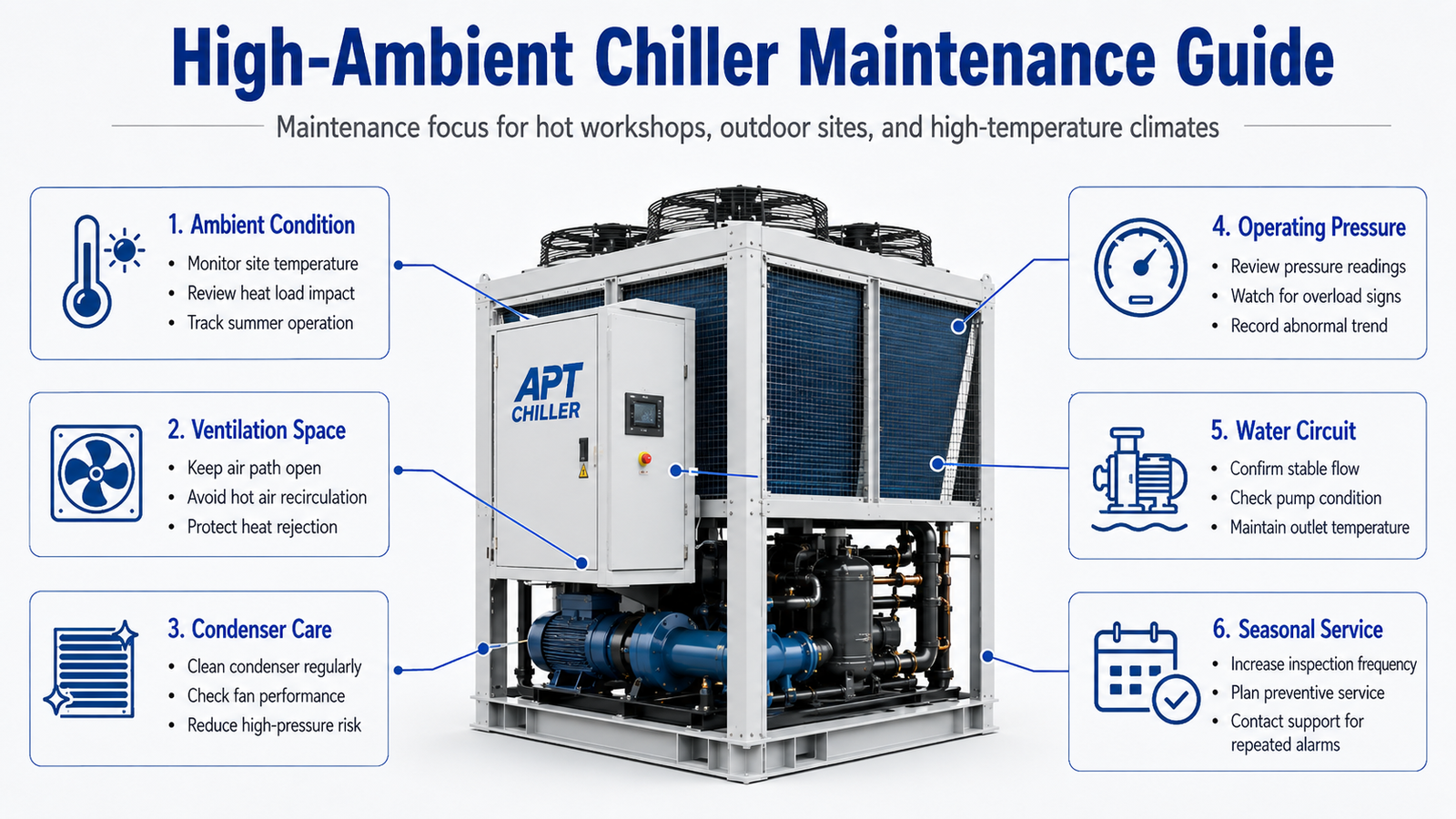
Project Summary
Project type
Cooling for hot workshops, outdoor installations, Middle East environments, die casting plants, thermal spray areas, and heavy-duty production.
Main cooling challenge
High ambient temperature reduces heat rejection margin and increases compressor and electrical stress.
Recommended design direction
T3 or high-ambient chiller configuration with larger condenser, strong airflow planning, suitable compressor protection, and maintenance access.
Typical equipment / industry
Die casting, thermal spray, plastics, chemical process cooling, outdoor process equipment, and export industrial projects.
Project Overview
Industrial chiller projects are rarely solved by selecting a catalog model only. Real project conditions include cooling capacity, inlet and outlet water temperature, ambient temperature, condenser type, pump flow and pressure, tank volume, heat exchanger material, refrigerant circuit design, power supply, control logic, installation environment, and delivery requirements.
APT is an engineering-based industrial chiller manufacturer supporting precision process cooling, custom cooling systems, high ambient industrial operation, corrosion-resistant cooling design, explosion-proof design discussion, OEM integrated cooling, and export-oriented project communication.
The purpose of this project guide is to help engineers, overseas buyers, equipment manufacturers, purchasing teams, and project managers understand what should be reviewed before requesting a chiller quotation. Good project information allows APT to recommend a practical application-specific cooling configuration rather than a generic size.
Typical High-Ambient Chiller Project Scenarios
High-ambient chiller projects appear in hot climate export markets, outdoor installations, poorly ventilated machine rooms, die casting plants, thermal spray workshops, and heavy-duty production sites. The chiller must reject process heat while surrounded by hot air or limited ventilation.
A standard chiller selected for moderate ambient temperature may not deliver stable cooling in a 45°C workshop or an outdoor site exposed to summer heat. Real site temperature can exceed the published weather temperature because machinery, walls, roofs, and process heat create local hot zones.
APT reviews high ambient industrial operation by considering cooling capacity, condenser type, compressor loading, fan design, airflow clearance, dust level, voltage, electrical cabinet environment, and maintenance schedule.
Why Standard Chillers May Fail in Hot Environments
An industrial chiller must reject heat from the process plus compressor work. When ambient temperature is high, the condenser has less ability to remove heat. Refrigerant pressure rises, compressor load increases, and high-pressure alarms become more likely.
Poor installation can make the situation worse. If hot discharge air returns to the condenser inlet, the chiller effectively operates in a higher ambient condition. Dusty condenser fins also reduce heat rejection, especially in workshops with metal powder, oil mist, or process residue.
High ambient projects often require project-based chiller design rather than standard selection. The chiller must be matched to the worst expected operating condition, not only average climate data.
Main Engineering Challenges: Heat Rejection, Airflow, Dust, and Protection
Condenser heat rejection is the first design concern. Air-cooled chillers may need larger condenser surface, stronger fans, appropriate fin spacing, and clear airflow path. Water-cooled chillers require cooling water temperature and tower performance review.
Electrical protection is also important. High ambient temperature affects control cabinets, contactors, overload protection, sensors, and compressor operating range. The electrical configuration should match voltage, phase, frequency, and site reliability.
Maintenance access should be included in the project. If condenser cleaning is difficult, performance will decline over time. APT considers service access as part of long-term reliability.
T3 High-Ambient Chiller Design Considerations
T3 high-ambient design may be discussed for projects operating in hotter climates or demanding workshops. Depending on project requirements, this may involve condenser sizing, compressor selection, fan configuration, refrigerant circuit protection, cabinet ventilation, and control settings.
The final design should be based on confirmed ambient temperature, cooling load, installation layout, and operating schedule. APT can compare air-cooled and water-cooled options where site utilities allow.
Project Challenges to Review
Reduced heat rejection margin
High ambient air makes condenser operation more demanding.
Hot air recirculation
Poor layout can cause the chiller to breathe its own discharge air.
Dusty production sites
Dirty fins increase pressure and reduce cooling capacity.
Electrical stress
High cabinet temperature and unstable voltage can affect reliability.
APT Engineering Solution Approach
APT customizes industrial chillers according to real project conditions. Engineers review cooling capacity, inlet and outlet water temperature, ambient temperature, condenser type, pump flow and pressure, water tank volume, heat exchanger material, refrigerant circuit design, power supply and electrical control, PLC or communication requirements, installation environment, and export packaging needs.
This engineering-based technical support helps match the chiller to the process instead of forcing the process to fit a standard machine. For demanding applications, APT can discuss high-ambient condenser design, corrosion-resistant heat exchangers, explosion-proof design requirements subject to confirmed classification, special voltage, compact layout, OEM integrated cooling, and long-term service access.
Recommended Project Configuration Table
| Project scenario | Cooling requirement | Recommended chiller design | Key engineering note |
|---|---|---|---|
| Outdoor air-cooled project | Reliable cooling in hot climate | High-ambient air-cooled chiller | Confirm maximum ambient temperature and airflow clearance. |
| Hot die casting workshop | High load and dusty air | T3 design with accessible condenser cleaning | Maintenance frequency should match dust level. |
| Indoor limited ventilation | Heat rejection from enclosed space | Water-cooled or ducted/ventilated solution review | Room ventilation must remove condenser heat. |
| Middle East export project | High temperature and voltage confirmation | Custom high-ambient chiller with export configuration | Confirm voltage, climate, packaging, and site layout. |
Project Information Checklist Before Quotation
To help APT engineers prepare a suitable project-based chiller design, provide as much of the following information as possible:
- Process or equipment type
- Estimated heat load, machine power, or required cooling capacity
- Required inlet and outlet water temperature
- Ambient temperature and installation location
- Cooling medium or process fluid
- Required pump flow and pressure
- Power supply, voltage, phase, and frequency
- Heat exchanger material requirement
- Safety, electrical, or site standard requirement
- Photos, drawings, or layout information of the installation site if available
FAQ
What is a high-ambient chiller project?
It is a cooling project where the chiller must operate in hot workshops, outdoor sites, or high-temperature climates that require special condenser, airflow, and protection review.
Why do standard chillers struggle in hot environments?
High ambient temperature reduces condenser heat rejection, increases compressor load, and may cause high-pressure alarms if the chiller is not designed for the condition.
What information is needed for high-ambient chiller selection?
Provide maximum ambient temperature, cooling load, target water temperature, installation layout, airflow space, dust condition, voltage, and operating hours.
Are water-cooled chillers better for high ambient projects?
Water-cooled chillers can be suitable when reliable cooling water is available, but cooling tower performance and water quality must be reviewed. Air-cooled and water-cooled options depend on the site.
Can APT provide T3 high-ambient design?
APT can discuss T3 or high-ambient configuration depending on project requirements, confirmed ambient temperature, cooling load, voltage, and installation conditions.
Need help designing a chiller for your industrial project?
APT engineers can help review your process conditions, cooling capacity, temperature range, pump pressure, condenser type, heat exchanger material, and installation environment. Share your application details, drawings, site conditions, and special requirements to start a practical project discussion.