
Heat Exchanger Maintenance Guide for Industrial Chiller Systems
Heat exchangers are central to industrial chiller performance. Their condition affects heat transfer, pressure drop, temperature stability, corrosion resistance, and long-term process cooling reliability.
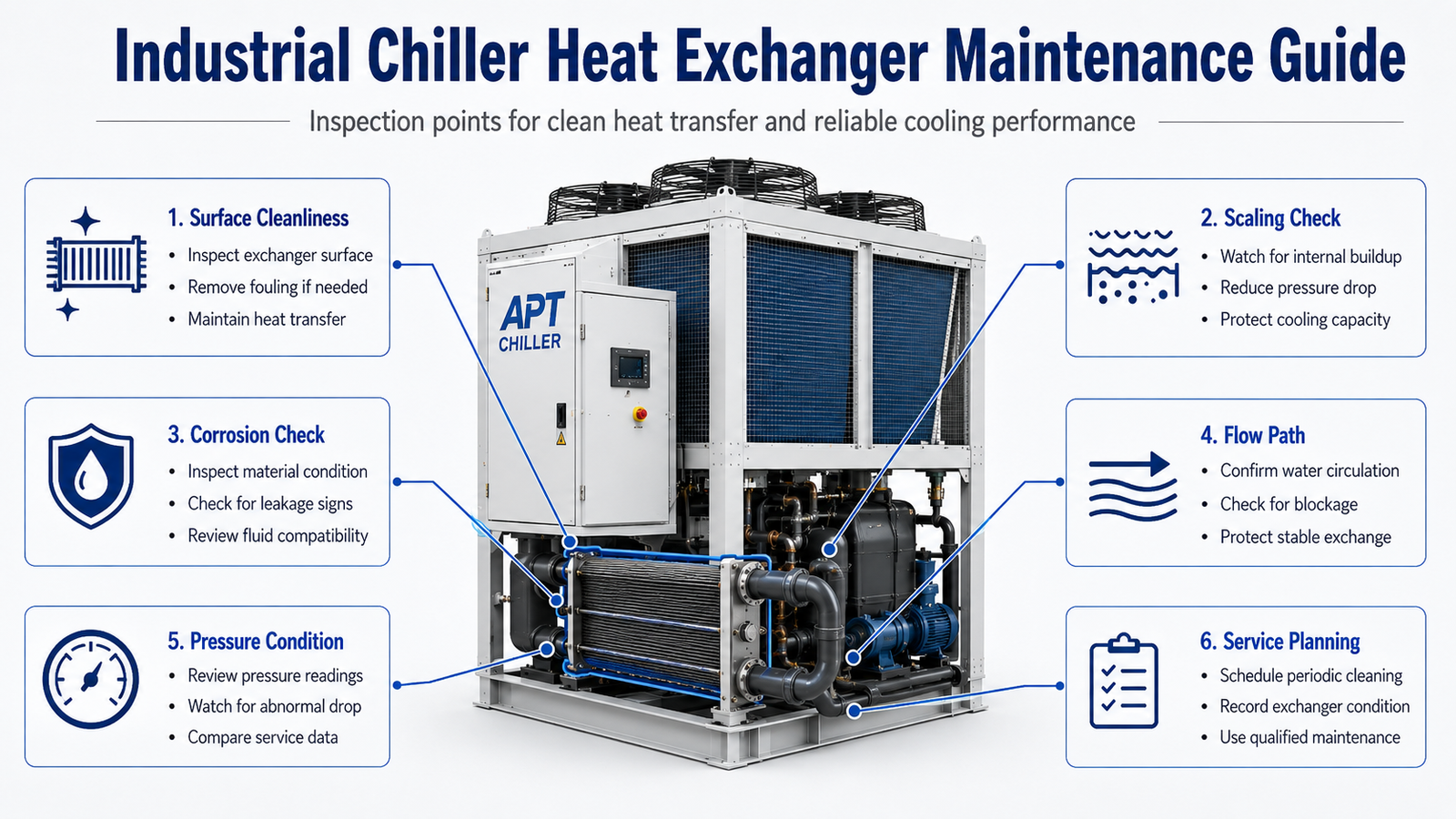
Quick Summary
Main problem
Scaling, fouling, corrosion, and blocked passages reduce heat transfer and may cause unstable cooling.
What to inspect
Temperature difference, pressure drop, water quality, scaling, corrosion signs, filter condition, and material compatibility.
Recommended action
Maintain water quality, clean filters, inspect heat exchanger performance, and choose suitable materials for the process fluid.
When to contact support
Contact APT when heat exchanger cleaning, replacement, material selection, or custom anti-corrosion design is needed.
Article Overview
For industrial users, chiller maintenance is not a minor background task. It directly affects stable process cooling, equipment protection, product consistency, energy use, and production availability. APT Chiller views maintenance and troubleshooting as part of the complete engineering support cycle, from chiller selection to long-term operation.
This guide is written for engineers, maintenance teams, overseas buyers, OEM equipment manufacturers, plant operators, and project managers who need practical information before contacting technical support or planning preventive chiller maintenance.
The guidance below is general and does not replace qualified electrical or refrigeration service procedures. When the issue involves electrical cabinets, refrigerant circuits, pressure protection, or safety devices, use trained personnel and follow site safety requirements.
Why Heat Exchanger Maintenance Matters
The heat exchanger transfers heat between the process water or fluid and the refrigeration system. If the heat transfer surface becomes scaled, fouled, corroded, or blocked, the chiller cannot remove heat efficiently. This can reduce cooling capacity, increase compressor load, and make temperature control unstable.
Industrial chiller heat exchanger maintenance is especially important for chemical processing, electroplating, anodizing, seawater-related applications, thermal spray cooling, injection molding, die casting, and process loops with dirty or mineral-heavy water.
APT Chiller manufactures and supports different heat exchanger options for industrial applications. The correct structure and material depend on cooling capacity, fluid condition, temperature range, corrosion risk, maintenance access, and pressure drop.
Common Heat Exchanger Types in Industrial Chillers
Industrial chillers may use immersion coils, shell-and-tube heat exchangers, coil-in-shell designs, double-pipe heat exchangers, plate-type designs in some systems, or custom process heat exchangers. Each structure has different advantages for heat transfer, cleaning, pressure drop, and material flexibility.
Immersion coils can be suitable for tank cooling and certain corrosive applications when made from compatible materials. Shell-and-tube heat exchangers are widely used for larger water circuits and water-cooled systems. Coil-in-shell designs can provide compact and practical cooling for many industrial chillers.
Selection should consider maintenance. A heat exchanger that performs well in clean water may not be suitable for dirty, corrosive, or scaling-prone fluid unless filtration and cleaning access are planned.
Scaling and Fouling Problems
Scaling occurs when minerals deposit on heat transfer surfaces. Fouling may include sludge, oil, biological growth, rust, or process contamination. Both reduce heat transfer and can narrow water passages, increasing pressure drop and reducing pump flow.
Signs of scaling or fouling include slower cooling response, rising outlet temperature, abnormal temperature difference, higher compressor load, low flow alarms, and frequent filter blockage. These symptoms should be reviewed with water quality and maintenance records.
Prevention is usually easier than restoration. Proper water quality control, filtration, periodic cleaning, tank maintenance, and process separation help protect heat exchangers.
Corrosion and Material Compatibility
Corrosion risk depends on fluid chemistry, temperature, oxygen content, conductivity, pH, chloride concentration, and process contamination. Electroplating, chemical processing, anodizing, seawater, acidic or alkaline solutions, and special coolants may require corrosion-resistant heat exchangers.
Stainless steel, titanium, PVC, and other special materials may be considered depending on the process. Titanium is often discussed for highly corrosive applications, while stainless steel may be suitable for many industrial water circuits. Material choice should be based on actual fluid data rather than assumptions.
APT can review fluid type, concentration, water quality, target temperature, and process contact method before recommending heat exchanger materials.
Cleaning and Inspection Recommendations
Cleaning frequency depends on water quality, operating hours, process contamination, and heat exchanger structure. Operators should monitor pressure drop, flow, cooling response, filter condition, and water appearance. Maintenance should avoid aggressive methods that damage materials or seals.
Qualified cleaning procedures should be used for chemical cleaning, tube cleaning, or replacement. If corrosion is already present, the root cause should be corrected before installing a replacement heat exchanger.
Maintenance and Troubleshooting Pain Points
Reduced heat transfer
Scale and fouling act as insulation and reduce cooling performance.
Pressure drop increase
Blocked passages force the pump to work harder and may trigger flow alarms.
Material mismatch
Wrong material selection can cause corrosion and leakage in chemical processes.
Difficult cleaning access
Maintenance planning should consider how the exchanger will be inspected and serviced.
APT Engineering Support Approach
APT supports industrial chiller users with engineering-based technical support, not only product replacement. When reviewing a maintenance or troubleshooting question, APT engineers may ask for cooling capacity, target temperature, inlet and outlet temperature, pump flow and pressure, condenser condition, water quality, heat exchanger material, ambient temperature, voltage, alarm code, photos, and operating history.
This information helps determine whether the issue is related to preventive maintenance, water circuit inspection, condenser heat rejection, pump flow and pressure, heat exchanger protection, high ambient operation, spare parts planning, or original chiller selection. For custom industrial chillers, APT can also review pump configuration, heat exchanger selection, condenser design, control logic, and installation requirements.
Recommended Inspection Table
| Component / Problem | What to check | Possible cause | Recommended action |
|---|---|---|---|
| Immersion heat exchanger | Surface scale, corrosion, tank water | Dirty or corrosive tank fluid | Clean tank and review material compatibility. |
| Shell-and-tube heat exchanger | Pressure drop, tube fouling, water quality | Scale or suspended solids | Inspect and clean using qualified procedures. |
| Titanium exchanger | Chemical compatibility and deposits | Severe corrosive fluid or fouling | Maintain fluid control and inspect for blockage. |
| Stainless steel exchanger | Corrosion marks, scaling, weld area | Chloride, pH, poor water quality | Review fluid data and maintenance schedule. |
| Flow problem | Temperature difference and pump pressure | Blocked passages or filters | Clean filters and investigate exchanger pressure drop. |
FAQ
Why is heat exchanger maintenance important for chillers?
Heat exchanger maintenance protects heat transfer efficiency, reduces pressure drop, supports stable temperature control, and helps prevent scaling, fouling, and corrosion problems.
What are common signs of heat exchanger scaling?
Common signs include slower cooling, higher outlet temperature, increased pressure drop, low flow alarms, frequent filter blockage, and reduced heat transfer performance.
When should titanium heat exchangers be considered?
Titanium heat exchangers may be considered for corrosive fluids, chemical processes, electroplating, anodizing, seawater, or other applications where standard materials may not be compatible.
Can a blocked heat exchanger cause low flow alarms?
Yes. Blocked passages, scale, or fouling can increase pressure drop and reduce water circulation, which may trigger low flow alarms.
Can APT provide replacement or custom heat exchangers?
Yes. APT supports heat exchanger selection, manufacturing, replacement, and custom material review for industrial chiller applications.
Need help troubleshooting or maintaining your industrial chiller?
APT engineers can help review cooling capacity, water flow, pump pressure, heat exchanger condition, condenser design, and operating environment. Share your application, alarm information, operating data, photos, and maintenance history so the support discussion can start from practical engineering facts.