
Large Water-Cooled Chiller Systems
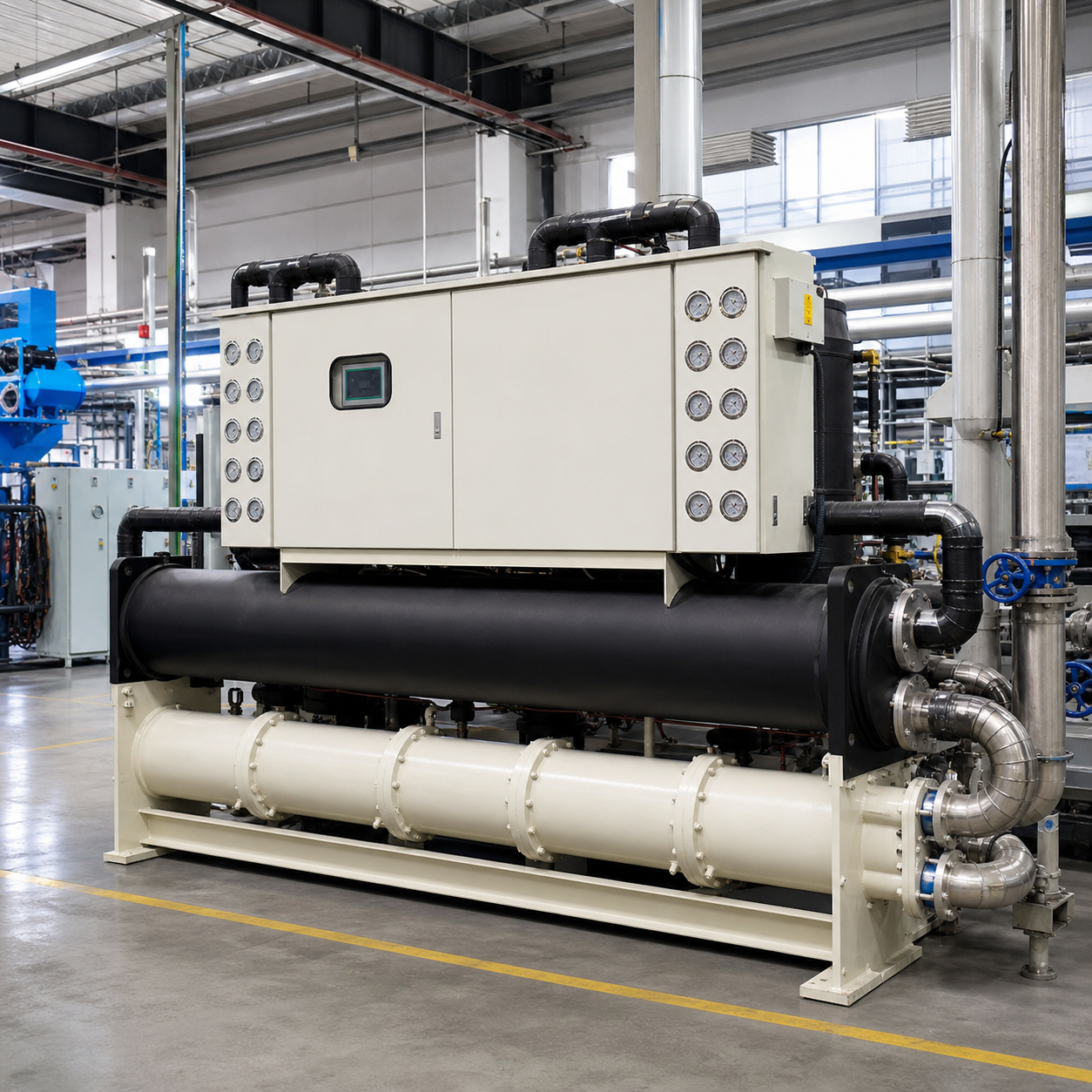
APT large water-cooled chiller systems are configurable industrial process cooling systems for centralized chilled-water loops, production lines, multi-point equipment cooling, plastic processing, die casting, chemical process cooling, thermal spray support, hydraulic systems, and factory equipment. System capacity, compressor configuration, condenser, evaporator, pump station, buffer tank, control system, refrigerant, voltage, water circuit materials, and cooling tower conditions should be reviewed according to actual plant layout and process load.
When Should You Choose a Large Water-Cooled Chiller System?
A large water-cooled chiller system is suitable when a factory needs centralized chilled-water cooling for multiple machines, production lines, process tanks, heat exchangers, hydraulic systems, or plant equipment, and the site has a cooling tower, condenser water loop, or plant cooling water system. It is usually reviewed when 20–50 HP packaged chillers are not enough, or when the customer needs plant-level cooling distribution, external pump stations, buffer tanks, redundancy, and control integration.
Where Large Water-Cooled Systems Fit in the APT Water-Cooled Chiller Range
This page covers 50+ HP and centralized water-cooled chiller systems after the 20–50 HP industrial water-cooled range. It is a system engineering page rather than a simple packaged model page.
Small Water-Cooled Process Chiller
Compact equipment, lab systems, CNC, and point-of-use cooling with available plant water.
View Small Series → Medium Range5–20 HP Medium Water-Cooled Chiller
Configurable medium-duty process cooling for single machines, process tanks, and factory equipment.
View 5–20 HP → Industrial Range20–50 HP Industrial Water-Cooled Chiller
Larger packaged water-cooled process chillers for continuous industrial cooling and heavier heat loads.
View 20–50 HP → Current SystemLarge Water-Cooled Chiller System
50+ HP, centralized chilled-water loops, pump stations, buffer tanks, and plant-level process cooling.
Current Page → CustomCustom Chiller Solutions
Custom engineering for special fluids, corrosion-resistant circuits, safety, voltage, and controls.
Review Custom →System Capacity Direction Matrix
Large water-cooled systems should not be selected only by HP. Total heat load, chilled-water temperature, condenser water temperature, cooling tower performance, process flow, piping distance, pump head, and control requirements must be reviewed.
| System Direction | Reference Cooling Range | Typical Use | Key Engineering Review | Next Step |
|---|---|---|---|---|
| 50+ HP packaged water-cooled system | Above 50 HP direction | Larger production equipment, process tanks, multi-point cooling | Total heat load, cooling tower capacity, pump head, installation space | Request 50+ HP Review → |
| Centralized chilled-water loop | Project-specific | Multiple machines, plant equipment, production line cooling | Pipe network, flow balance, buffer tank, control strategy | Request Centralized Loop Review → |
| Water-cooled chiller + external pump station | Project-specific | Long-distance piping, multi-point equipment cooling | Pump flow, pressure loss, filters, bypass, redundancy | Request Pump Station Review → |
| Water-cooled chiller + buffer tank system | Project-specific | Load fluctuation, process stability, batch cooling | Tank volume, temperature stability, operating cycle | Request Buffer Tank Review → |
| Custom high-capacity process cooling system | Project-specific | Chemical, die casting, thermal spray, special process cooling | Material, safety, redundancy, control, layout | Request Custom System Review → |
Large Water-Cooled Chiller System Architecture
This is a system-level design. The chiller, condenser water loop, chilled-water loop, pump station, tank, piping, valves, filters, sensors, and controls should be reviewed together.
Chiller Module
Compressor configuration, refrigeration circuits, evaporator, condenser, and protection logic are selected by capacity and operating conditions.
Water-Cooled Condenser
Shell-and-tube condenser configuration is reviewed according to cooling tower water, heat rejection, water quality, and maintenance access.
Evaporator / Process Heat Exchanger
Shell-and-tube, plate, or custom heat exchanger options can be reviewed according to fluid, flow, water quality, and maintenance needs.
External Pump Station
Pump flow, head, redundancy, bypass, filters, and branch flow should be matched to the pipe network and equipment resistance.
Buffer Tank / Expansion Tank
System volume, load fluctuation, batch operation, and temperature stability influence tank size and layout.
PLC / Central Control
PLC, HMI, sensors, alarms, flow monitoring, and plant control integration can be reviewed for centralized systems.
Cooling Tower & Condenser Water Requirements
A large water-cooled chiller system requires stable condenser water from a cooling tower or plant condenser water loop. Cooling tower capacity, condenser water inlet and outlet temperature, water flow, water quality, scaling risk, filtration, pipe distance, pressure drop, and maintenance access must be reviewed before final design.
Cooling Tower Capacity
The cooling tower should match condenser heat rejection, local wet-bulb conditions, water flow, and plant operation schedule.
Condenser Water Temperature
Condenser water inlet and outlet temperature directly affect compressor load and system capacity.
Water Quality / Scaling / Treatment
Scaling, fouling, corrosion, filtration, and treatment affect condenser efficiency and maintenance intervals.
Condenser Maintenance Access
Large systems should allow condenser cleaning, valve access, pipe inspection, and water treatment maintenance.
Chilled-Water Loop & Pump Station Requirements
For centralized process cooling, the chilled-water loop is as important as the chiller itself. Pipe network length, height difference, pressure loss, branch flow, filter, bypass, pump redundancy, tank volume, and control strategy should be reviewed.
Flow Rate & Pump Head
Pump selection depends on total process flow, pressure loss, branch resistance, and required pressure at each cooling point.
Pipe Network & Pressure Loss
Pipe distance, height difference, filters, valves, elbows, and equipment heat exchanger resistance affect pump design.
Buffer Tank & System Volume
Tank volume helps stabilize temperature during load changes, batch cooling, and multi-point operation.
Redundancy / Bypass / Filtration
Dual pump, bypass, filters, and standby design can support continuous production reliability.
Configuration Options Matrix
| System Item | Available Options | Selection Logic |
|---|---|---|
| Compressor System | Single / multiple compressors / multiple circuits | Selected by capacity, duty cycle, redundancy, and part-load requirement |
| Condenser | Shell-and-tube water-cooled condenser | Selected by cooling tower condition, water quality, heat rejection, cleaning access |
| Evaporator | Shell-and-tube / plate / custom heat exchanger | Selected by process fluid, flow rate, maintenance, and water quality |
| Chilled-Water Pump | Single / dual / high-flow / high-pressure / external pump station | Selected by pipe distance, pressure loss, equipment resistance, redundancy |
| Buffer Tank | Built-in / external / large buffer tank / expansion tank | Selected by load fluctuation, process stability, and system volume |
| Control System | Digital / PLC / HMI / central control / remote alarm | Selected by plant automation, monitoring, and interlock requirement |
| Voltage | 380V / 3PH / 50Hz or customized | Selected by destination country and plant power supply |
| Refrigerant | R410A / R407C / R134a / project-specific | Selected by temperature range, capacity, and system design |
| Water Circuit | Standard / stainless / corrosion-resistant | Selected by water quality, coolant type, and process requirements |
| Chemical / Special Fluid Review | Secondary loop / special heat exchanger / material review | Required for corrosive, clean, chemical, or process fluid cooling |
| Safety Review | Custom safety / explosion-proof / plant safety integration | Directed to custom chiller solution if required |
Technical Specification Table
| Parameter | Typical Range / Options | Engineering Notes |
|---|---|---|
| Cooling Capacity | 50+ HP direction or project-specific system capacity | Final capacity is selected by total process heat load and operating conditions |
| System Type | Large water-cooled process chiller system | Designed for centralized chilled-water loops and cooling tower systems |
| Cooling Medium | Water / glycol water / DI water / special process fluids | Special fluids require material and pump compatibility review |
| Chilled-Water Temperature | Project-specific process temperature range | Temperature affects compressor, evaporator, tank, and control configuration |
| Condenser Water Requirement | Cooling tower or plant condenser water loop | Condenser water temperature, flow, quality, and maintenance access must be reviewed |
| Compressor Configuration | Multiple compressors or multiple circuit direction by project | Selected by capacity, duty cycle, part-load operation, and redundancy |
| Water-Cooled Condenser | Shell-and-tube condenser direction | Cleaning access and water treatment are important for large systems |
| Evaporator / Heat Exchanger | Shell-and-tube / plate / custom heat exchanger | Selected according to process fluid, flow, water quality, and maintenance requirement |
| Chilled-Water Pump Station | Single / dual / high-flow / high-pressure / external pump station | Pump design depends on pipe distance, pressure loss, and multi-point distribution |
| Buffer Tank | External buffer tank / expansion tank / project-specific tank | Tank volume supports load fluctuation and temperature stability |
| Cooling Tower Coordination | Cooling tower capacity and condenser water conditions by project | Must be matched to system heat rejection and site conditions |
| Control System | Digital / PLC / HMI / central control / remote alarm / communication | Control options support plant monitoring and process integration |
| Voltage | 380V / 3PH / 50Hz or customized export voltage | Confirm plant power supply before quotation |
| Refrigerant | R410A / R407C / R134a / project-specific refrigerant | Selected by system design and temperature range |
| Protection | Pressure / overload / phase / anti-freeze / low flow / pump / temperature / control alarms | Protection logic should match continuous production risks |
| Installation | Plant room / equipment room / skid layout / centralized piping system | Consider service space, pipe routing, drainage, maintenance, and safety access |
| Customization | System capacity / pump station / buffer tank / controls / material / safety / layout | APT can review project-specific large water-cooled chiller systems |
Application Fit Matrix
| Application | Fit Level | Typical Requirement | Engineering Review |
|---|---|---|---|
| Plastic Processing Production Line | High | Multiple machines, extrusion line, molds, hydraulic systems, rollers | Review total heat load, flow balance, pipe network, and cooling tower capacity |
| Die Casting Cooling | High | High heat-load molds, hydraulic cooling, production water loops | Review heat shock, water quality, pump head, and service access |
| Chemical Process Cooling | Medium to High | Reactors, tanks, heat exchangers, process loops | Review corrosion risk, secondary loop, material, and safety requirements |
| Thermal Spray Cooling System | Medium to High | HVOF or plasma systems, spray guns, power supplies, auxiliary loops | Review flow, pressure, redundancy, equipment water quality, and system reliability |
| Hydraulic System Cooling | High | Hydraulic stations, presses, forming machines, oil-to-water heat exchangers | Review oil heat load, heat exchanger size, and operating schedule |
| Centralized Factory Equipment Cooling | High | Multiple machines or production cells connected to a chilled-water loop | Review total load, distribution piping, pump head, and central control |
| Industrial Heat Exchanger Cooling | Medium to High | Heat exchanger loops, testing systems, tank cooling, production water loops | Review fluid compatibility, material, and flow resistance |
| Process Tank Cooling | High | Large tanks, bath cooling, batch process cooling | Review tank volume, heat gain, agitation, and buffer tank strategy |
| Multi-Point Chilled-Water Loop | High | Multiple branches and cooling points in one plant loop | Review branch flow, balancing valves, pipe loss, sensors, and controls |
Suitable vs Not Suitable Conditions
Suitable For
- 50+ HP process cooling direction
- Multiple machines or production lines
- Centralized chilled-water loop
- Factory with cooling tower or condenser water loop
- Long operating hours or continuous-duty process
- External pump station and buffer tank requirement
- Higher efficiency direction than large air-cooled systems
- Plant-level monitoring or PLC integration
- Large process tanks, heat exchangers, die casting, chemical, plastic processing
Not Recommended For
- Small standalone equipment
- Sites without cooling tower or condenser water
- Projects needing simple plug-and-play outdoor installation
- Poor condenser water quality without treatment
- Very corrosive or explosive process without custom design
- Projects requiring fixed catalog parameters without engineering review
- Small equipment better served by 5–20 HP or compact chillers
Large Water-Cooled System vs Packaged Air-Cooled Chiller
| Decision Factor | Large Water-Cooled System | Packaged Air-Cooled Chiller |
|---|---|---|
| Heat Rejection | Through cooling tower or plant condenser water loop | Through ambient air condenser fans |
| Installation | More suitable for centralized plant cooling infrastructure | More suitable for standalone or simpler installation projects |
| Efficiency Direction | Often preferred for continuous plant-level cooling with infrastructure in place | Often preferred when simplicity matters more than central utility integration |
| System Complexity | Higher, because pump station, tank, controls, and pipe network are reviewed together | Lower, because the package is usually more self-contained |
| Maintenance | Requires cooling tower water treatment and system-side maintenance planning | Requires condenser coil airflow and outdoor service review |
| Best For | Centralized chilled-water loops, multi-point cooling, and plant expansion planning | Standalone equipment or simpler packaged process cooling |
| Limitation | Not suitable when condenser water infrastructure is unavailable | May be less suitable for larger centralized cooling networks |
Project-Specific Engineering Options
Custom Capacity Review
System direction is reviewed by total process heat load rather than nominal label only.
Multiple Compressor Circuits
Review part-load performance, redundancy, and staged operation needs.
Shell-and-Tube Condenser
Matched by cooling tower condition, cleaning access, and water quality.
External Pump Station
Configured by pipe distance, pump head, branch count, and redundancy strategy.
Buffer Tank / Expansion Tank
Reviewed for system volume, temperature stability, and batch process behavior.
PLC / HMI / Remote Alarm
Supports plant automation, central monitoring, and alarm interlock logic.
Flow / Pressure / Temperature Sensors
Sensor layout is selected according to monitoring and control strategy.
Stainless / Corrosion-Resistant Circuit
Recommended when fluid compatibility or corrosion risk needs extra review.
Secondary Heat Exchanger Review
Useful when direct process-side fluid contact is not appropriate.
Custom Safety / Explosion-Proof Review
Special environments should be handled as custom engineering projects.
Quote Information Checklist
What APT Needs to Review
Sharing complete process, utility, and distribution information helps APT review large water-cooled system direction more accurately and propose a more realistic system architecture.
- Application or production line
- Total heat load or required cooling capacity
- Number of machines or cooling points
- Chilled-water inlet and outlet temperature
- Chilled-water flow rate
- Pipe distance and height difference
- Pump pressure or pipe network resistance
- Cooling tower capacity
- Condenser water inlet and outlet temperature
- Condenser water flow rate
- Water quality and filtration
- Tank or buffer volume requirement
- Control strategy and alarm requirement
- Redundancy requirement
- Voltage / phase / frequency
- Installation space / plant layout
- Material requirement
- Safety or explosion-proof requirement
- Destination country
- Photos, drawings, existing chiller or cooling tower data
Related Water-Cooled Product Pages
Water-Cooled Chillers
Review the full water-cooled category before choosing a size or system direction.
View Category → Medium Range5–20 HP Medium Water-Cooled Chillers
Configurable medium-duty water-cooled units for single machines and local process cooling.
View 5–20 HP → Industrial Range20–50 HP Industrial Water-Cooled Chillers
Packaged larger water-cooled units before moving into centralized systems.
View 20–50 HP → CustomCustom Chiller Solutions
Review custom design direction for materials, safety, controls, and special applications.
Review Custom →Related Air-Cooled Comparison Pages
Air-Cooled Chillers
Compare standalone air-cooled options when centralized condenser-water infrastructure is unavailable.
View Air-Cooled Category → Packaged Comparison20–50 HP Large Air-Cooled Chillers
Compare packaged air-cooled direction before moving into centralized systems.
View 20–50 HP → CustomCustom Chiller Solutions
Move to custom engineering when process fluid, safety, or layout goes beyond standard comparison.
Review Custom →Related Application Pages
Injection Molding Cooling
Review centralized mold and hydraulic cooling direction for production lines.
View Application → ApplicationDie Casting Cooling
Explore foundry and die casting process cooling with larger heat-load review.
View Application → ApplicationThermal Spray Cooling System
See cooling requirements for HVOF, plasma, and auxiliary spray system loops.
View Application → ApplicationChemical Process Cooling
Review reactor, condenser, and process-loop cooling with fluid compatibility considerations.
View Application → SupportParts & Heat Exchangers
See heat exchanger and component directions used in larger plant cooling systems.
View Support Page → ApplicationElectroplating Cooling
Review plating bath cooling and corrosion-sensitive engineering points.
View Application →Related Resource Pages
Chiller Selection Guides
Selection logic, comparison notes, and engineering buying guidance.
Open Guides → Resource CenterIndustrial Chiller Resources
Broader support content for industrial cooling systems and planning.
Open Resources → DownloadsDownloads
Brochures, documents, and downloadable support materials.
Open Downloads → ToolChiller Selection Tool
Start a structured preliminary selection workflow before engineering review.
Use Tool →Large Water-Cooled Chiller System FAQ
What is a large water-cooled chiller system used for?
It is used for centralized industrial process cooling applications such as production lines, multiple machines, process tanks, plastic processing, die casting, chemical process cooling, thermal spray support, hydraulic systems, and plant chilled-water loops.
Is a large water-cooled chiller system a fixed standard unit?
No. Large water-cooled chiller systems are usually configured according to total heat load, chilled-water temperature, condenser water conditions, cooling tower capacity, pump head, tank volume, pipe network, control strategy, and application requirements.
Does a large water-cooled chiller system need a cooling tower?
Most large water-cooled systems require a cooling tower or plant condenser water loop. Cooling tower capacity, condenser water temperature, condenser water flow, water quality, and maintenance access should be confirmed before design.
When should I choose a large water-cooled system instead of a 20–50 HP packaged chiller?
A large water-cooled system should be reviewed when total heat load is above the practical range of packaged chillers, when multiple machines need centralized cooling, or when external pump stations, buffer tanks, redundancy, and plant-level control are required.
What information is needed to size the pump station?
Pump station design requires chilled-water flow rate, pipe distance, height difference, pressure loss, filter and valve resistance, number of cooling points, required pressure at each machine, and redundancy requirements.
Can APT provide a buffer tank or external water tank?
Yes. Buffer tank, external tank, expansion tank, and system volume can be reviewed according to load fluctuation, temperature stability, operating cycle, and plant layout.
Can the system be used for chemical or electroplating processes?
Yes, but chemical or electroplating processes require review of fluid compatibility, corrosion risk, heat exchanger material, secondary loop design, pump material, and safety requirements.
When should I choose an air-cooled chiller instead?
An air-cooled chiller may be easier when the site has no cooling tower, prefers simpler installation, or needs a packaged standalone system. A water-cooled system is more suitable when condenser water infrastructure exists and centralized continuous cooling is required.
Can the system include PLC, remote alarm, or central control?
Yes. PLC, HMI, remote alarm, communication interface, sensor feedback, flow monitoring, and plant control integration can be reviewed according to the project.
What information is needed for a large water-cooled chiller system quotation?
Please provide total heat load, number of machines, chilled-water temperature, flow rate, pipe distance, pump pressure, cooling tower conditions, condenser water temperature, water quality, control requirements, voltage, plant layout, material requirements, and any safety requirements.
Need a Large Water-Cooled Chiller System Configuration?
Share your total heat load, number of cooling points, chilled-water temperature, condenser water temperature, cooling tower conditions, flow rate, pump head, pipe layout, buffer tank requirement, control strategy, voltage, water quality, material requirements, and application details. APT engineers can review your large water-cooled process cooling project and configure a suitable plant-level chilled-water system.