
Routine Industrial Chiller Maintenance Guide for Stable Process Cooling
Routine industrial chiller maintenance is one of the most effective ways to keep process cooling stable, reduce unplanned downtime, and protect production equipment. This guide explains daily, weekly, monthly, and periodic inspection points for industrial chillers used in manufacturing environments.
Quick Summary
Main problem
Poor maintenance can reduce cooling capacity, trigger alarms, increase energy use, and interrupt continuous production.
What to inspect
Water level, outlet temperature, pressure, filters, condenser surface, pump operation, compressor sound, electrical cabinet, and alarm history.
Recommended action
Build a preventive chiller maintenance routine that matches operating hours, water quality, dust level, and ambient temperature.
When to contact support
Ask APT for technical support when alarms repeat, cooling performance drops, pressure readings are abnormal, or replacement parts are required.
Article Overview
For industrial users, chiller maintenance is not a minor background task. It directly affects stable process cooling, equipment protection, product consistency, energy use, and production availability. APT Chiller views maintenance and troubleshooting as part of the complete engineering support cycle, from chiller selection to long-term operation.
This guide is written for engineers, maintenance teams, overseas buyers, OEM equipment manufacturers, plant operators, and project managers who need practical information before contacting technical support or planning preventive chiller maintenance.
The guidance below is general and does not replace qualified electrical or refrigeration service procedures. When the issue involves electrical cabinets, refrigerant circuits, pressure protection, or safety devices, use trained personnel and follow site safety requirements.
Why Routine Chiller Maintenance Matters
An industrial chiller is often connected directly to production quality. If chilled water temperature becomes unstable, downstream equipment such as molds, heat exchangers, spray guns, laser sources, chemical tanks, or hydraulic systems may lose process control. Maintenance is therefore not only a service activity. It is part of stable process cooling management.
Routine inspection helps operators find small changes before they become shutdown events. A slightly dirty condenser, a partially blocked strainer, low tank level, loose electrical terminal, weak pump flow, or early scaling inside a heat exchanger may not stop the chiller immediately. Over time, these conditions can reduce heat transfer and force the compressor to operate under higher stress.
APT Chiller designs industrial cooling systems for engineering process applications, but long-term reliability still depends on the way the unit is installed, operated, inspected, and maintained at site. A good maintenance plan should be simple enough for operators to follow and detailed enough for maintenance teams to record meaningful data.
Daily Inspection Checklist
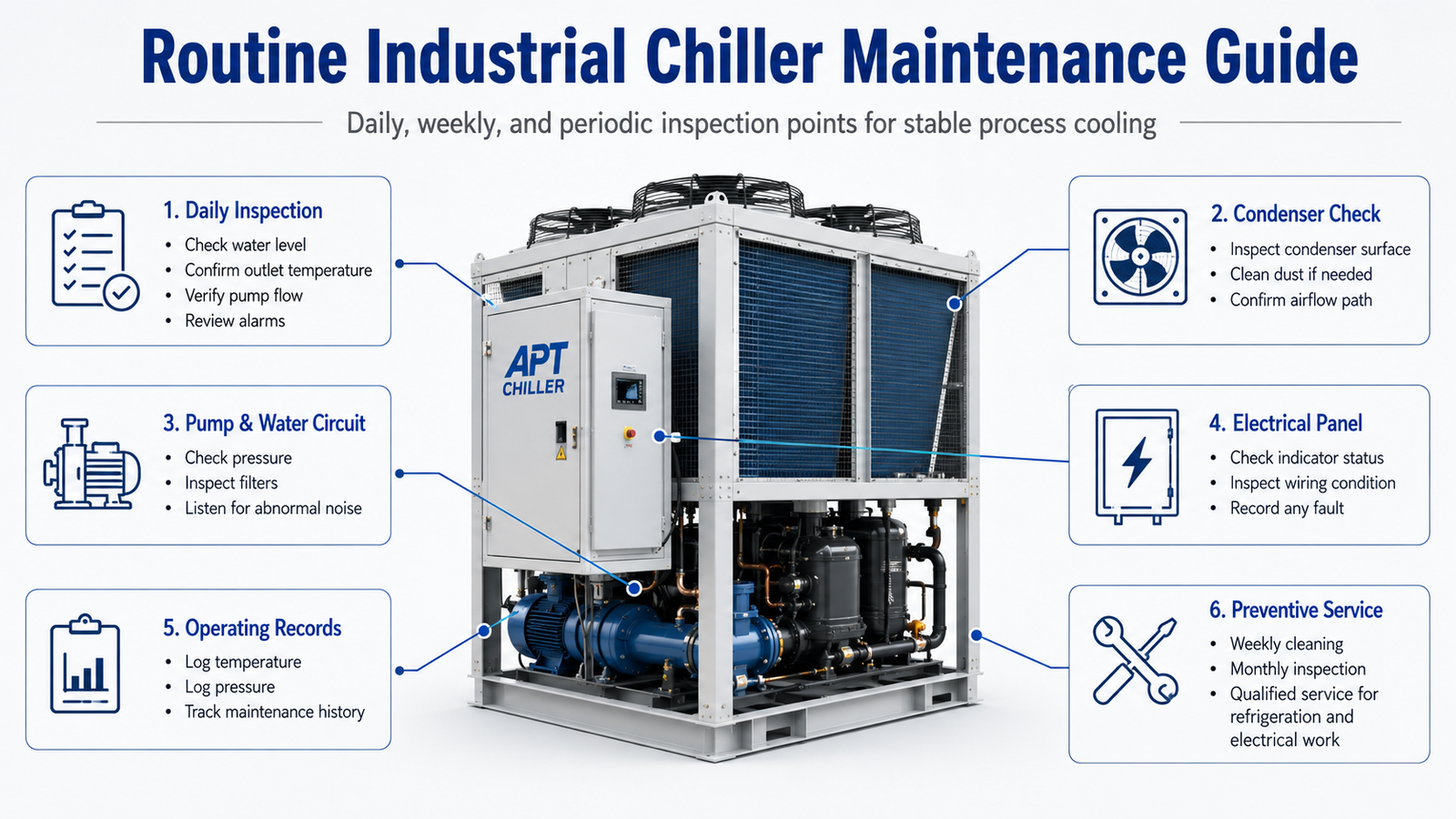
Daily inspection should focus on visible operating condition and basic cooling performance. Operators should confirm that the chiller starts normally, outlet water temperature is close to the set value, water level is sufficient, pump flow is stable, and no unusual vibration, noise, smell, or visible leakage is present.
Record inlet and outlet water temperatures when possible. A stable temperature difference usually shows that the water circuit and heat load are within expected conditions. If the outlet temperature keeps rising while the compressor is running, check for excessive heat load, dirty condenser, insufficient water flow, blocked filter, high ambient temperature, or an abnormal refrigeration circuit condition.
The daily log does not need to be complicated. A clear record of temperature, pressure, alarm status, water level, and operating hours can help APT engineers understand the working history if technical troubleshooting support is needed later.
Weekly and Monthly Maintenance Tasks
Weekly work should include checking and cleaning inlet filters or strainers, confirming fan rotation and airflow path on air-cooled chillers, checking cooling water condition on water-cooled chillers, and visually inspecting electrical cabinet ventilation. If the chiller operates in a dusty workshop, condenser fins may need cleaning more often.
Monthly maintenance should include a more detailed water circuit inspection. Check pump pressure, flow condition, tank cleanliness, piping vibration, valves, filter condition, and any signs of scaling or rust. Review alarm history and compare current operating data with earlier records.
Periodic maintenance may involve qualified inspection of refrigerant pressure, compressor electrical current, contactors, protection devices, controller settings, sensors, and heat exchanger performance. Electrical and refrigeration work should be performed by qualified personnel following site safety procedures.
Key Components to Inspect
The condenser, evaporator or heat exchanger, compressor, pump, tank, water filter, flow switch, controller, pressure protection device, fans, and electrical cabinet all influence chiller reliability. The condenser controls heat rejection; the evaporator transfers heat from the process water; the pump maintains circulation; and the controller protects the machine from abnormal operation.
Many cooling problems are caused by several small issues acting together. For example, a hot workshop plus dirty condenser plus low airflow space can cause high-pressure alarms. A blocked filter plus undersized piping plus air inside the water circuit can cause low flow alarms and unstable temperature.
APT maintenance support normally reviews both refrigeration and hydraulic conditions because cooling capacity alone does not guarantee field performance. Pump flow and pressure, water quality, heat exchanger protection, and installation environment must all be considered.
Common Signs of Poor Maintenance
Warning signs include longer cooling time, frequent high-pressure alarms, increasing outlet water temperature, compressor overload, low flow alarms, unusual pump noise, visible dirt on condenser fins, dirty tank water, pressure fluctuation, and repeated sensor or controller warnings.
If these signs appear, avoid simply lowering the temperature set point or restarting the chiller repeatedly. That may hide the root cause and increase compressor stress. Check basic operating conditions first, then contact technical support if the issue remains.
Maintenance and Troubleshooting Pain Points
Dirty heat rejection surfaces
Dust, oil mist, or fouling on condensers reduces heat rejection and can cause high-pressure alarms.
Weak water circulation
Blocked filters, air pockets, worn pumps, or closed valves can reduce flow and make the process temperature unstable.
Poor records
Without temperature, pressure, and alarm records, troubleshooting becomes slower and less accurate.
Wrong operating environment
Hot, dusty, corrosive, or poorly ventilated locations increase maintenance frequency and may require custom chiller design.
APT Engineering Support Approach
APT supports industrial chiller users with engineering-based technical support, not only product replacement. When reviewing a maintenance or troubleshooting question, APT engineers may ask for cooling capacity, target temperature, inlet and outlet temperature, pump flow and pressure, condenser condition, water quality, heat exchanger material, ambient temperature, voltage, alarm code, photos, and operating history.
This information helps determine whether the issue is related to preventive maintenance, water circuit inspection, condenser heat rejection, pump flow and pressure, heat exchanger protection, high ambient operation, spare parts planning, or original chiller selection. For custom industrial chillers, APT can also review pump configuration, heat exchanger selection, condenser design, control logic, and installation requirements.
Recommended Inspection Table
| Component / Problem | What to check | Possible cause | Recommended action |
|---|---|---|---|
| Water tank and level | Tank level, water clarity, visible dirt | Leakage, evaporation, contamination | Refill with suitable water and inspect the circuit for leaks or contamination. |
| Condenser | Fins, airflow path, fan operation | Dust, blocked ventilation, fan fault | Clean condenser surface and improve ventilation space. |
| Pump and flow | Pressure, flow switch, pump sound | Blocked filter, air in circuit, worn pump | Clean filters, vent air, verify pump operation and piping resistance. |
| Electrical cabinet | Terminals, contactors, heat, alarm history | Loose terminal, overload, poor ventilation | Use qualified electrical inspection and correct abnormal conditions. |
| Refrigeration circuit | High and low pressure readings | Heat rejection issue, refrigerant issue, load mismatch | Have qualified service personnel inspect refrigeration conditions. |
FAQ
How often should industrial chiller maintenance be performed?
Basic inspection should be performed regularly according to operating hours, water quality, dust level, ambient temperature, and application risk. Daily checks are useful for continuous production, while monthly and periodic maintenance should review water circuit, condenser, electrical, and protection conditions.
What is included in a chiller maintenance checklist?
A practical chiller maintenance checklist includes water level, outlet temperature, pressure, water flow, filter condition, condenser cleanliness, compressor operation, pump noise, electrical cabinet condition, alarms, and operating environment.
Can poor maintenance reduce cooling capacity?
Yes. Dirty condensers, blocked filters, heat exchanger scaling, low water flow, high ambient temperature, and abnormal refrigeration conditions can reduce effective cooling capacity even if the chiller was originally sized correctly.
Should operators reset chiller alarms repeatedly?
No. Repeated alarm resets can hide the cause of the problem and may increase equipment risk. Operators should record the alarm, check basic conditions, and contact qualified service support if the alarm continues.
Can APT help with long-term chiller maintenance planning?
Yes. APT can provide engineering-based technical support for preventive chiller maintenance, spare parts planning, water circuit inspection, heat exchanger protection, and troubleshooting communication.
Need help troubleshooting or maintaining your industrial chiller?
APT engineers can help review cooling capacity, water flow, pump pressure, heat exchanger condition, condenser design, and operating environment. Share your application, alarm information, operating data, photos, and maintenance history so the support discussion can start from practical engineering facts.