
Custom Water-Cooled Chiller for Centralized Factory Cooling
Centralized factory cooling projects often require larger cooling capacity, continuous process operation, stable chilled-water supply, and project-specific pump, tank, control, and piping coordination. This case-style guide explains how APT evaluates custom water-cooled chiller systems for factory cooling loops.
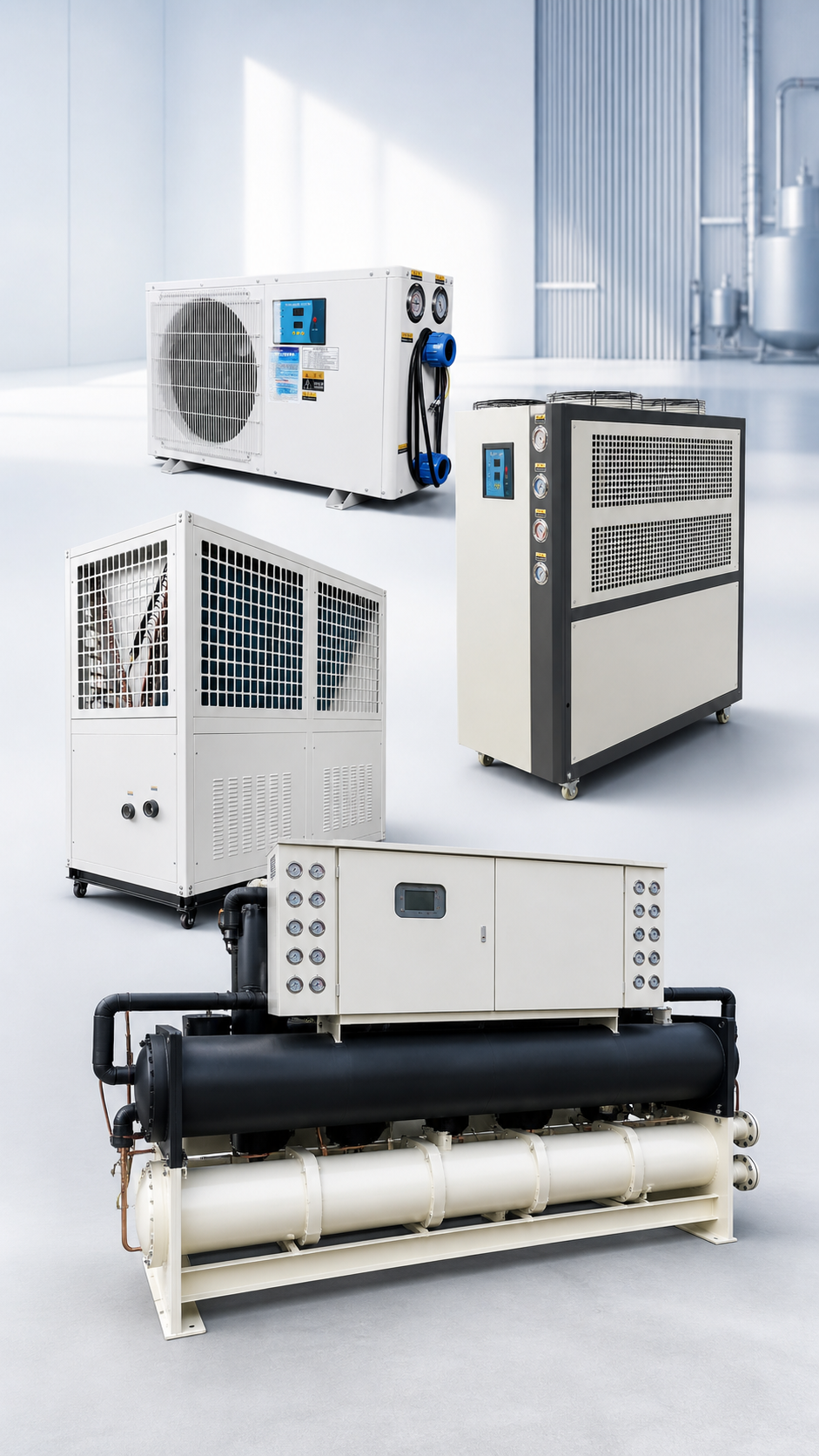
Project Summary
Project type
Custom water-cooled chiller system for centralized factory cooling, process loops, production equipment, and multi-point cooling branches.
Main cooling challenge
Larger cooling capacity, continuous operation, pump pressure demand, water circuit balancing, installation layout, and long-term reliability.
Recommended design direction
Water-cooled industrial chiller with custom pump, tank, evaporator, control logic, safety protection, and project-specific electrical configuration.
Typical users
Factories, OEM equipment lines, production workshops, centralized process cooling systems, and industrial plants with multiple cooling points.
Project Overview
A centralized factory cooling system is different from a small point-of-use chiller. The chiller must supply stable chilled water to one or more production loops, often across longer pipe runs, multiple machines, or process equipment that operates for long shifts.
For this type of project, APT reviews the required cooling capacity, target water temperature, inlet and outlet temperature difference, water flow, pump pressure, cooling tower or condenser water condition, piping layout, operating hours, installation environment, and electrical supply.
The goal is not simply to choose a water-cooled chiller by nominal horsepower. A suitable project design should match the factory's real heat load, hydraulic resistance, control strategy, service access, and future maintenance requirements.
Why Centralized Factory Cooling Needs Custom Configuration
Centralized cooling loops may serve injection molding machines, die casting equipment, chemical process tanks, laser systems, CNC machines, heat exchangers, or other industrial equipment. Each process may have a different flow rate, temperature stability requirement, and pressure drop.
A standard chiller may not provide the correct pump head, tank volume, control interface, or safety logic for a factory-wide cooling circuit. When the loop has long piping, multiple branches, valves, filters, or elevated equipment, hydraulic design becomes as important as cooling capacity.
APT supports custom water-cooled chiller projects by reviewing both refrigeration performance and water-side circulation. This helps reduce low-flow alarms, unstable temperature, insufficient cooling at remote equipment, and unnecessary energy use.
Main Engineering Points for the Cooling Loop
Cooling capacity should be calculated from the process heat load, flow rate, and temperature difference. For larger factory loops, APT also checks whether the chiller needs reserve capacity for future equipment, seasonal ambient conditions, or production expansion.
Pump selection must consider pipe length, pipe diameter, elbows, filters, valves, branch circuits, elevation, and equipment-side pressure drop. A pump selected only by nominal chiller size may not deliver enough water to the farthest cooling point.
Tank design, bypass control, filtration, pressure gauges, temperature sensors, alarm output, phase protection, compressor protection, and PLC or remote control requirements may also be reviewed during project communication.
Project Challenges to Review
Large cooling load
Continuous factory production may require higher cooling capacity and a suitable safety margin.
Long water circuit
Piping distance, branch layout, valves, filters, and elevation affect pump head and flow stability.
Cooling water condition
Water-cooled systems require reliable condenser water, cooling tower condition, water quality, and maintenance access.
Multiple cooling points
Different machines may need different flow rates, temperature ranges, and branch balancing.
Control integration
Factory projects may require alarm output, remote start/stop, PLC communication, or equipment interlock signals.
Maintenance reliability
Filters, pumps, compressors, heat exchangers, and electrical components should be accessible for inspection.
Typical Configuration Direction
A custom water-cooled chiller for centralized factory cooling may include semi-hermetic or scroll compressors, shell-and-tube or plate heat exchangers, high-flow or high-head pumps, stainless steel tank options, water filtration, pressure and temperature monitoring, and industrial control protection.
Depending on the site, APT may recommend a single larger chiller, multiple parallel units, standby design, external pump arrangement, larger buffer tank, or separated process loops. These decisions depend on heat load distribution, uptime requirement, installation space, and maintenance plan.
Information Needed Before Quotation
| Information | Why it matters | Example details |
|---|---|---|
| Cooling capacity or heat load | Determines compressor and heat exchanger sizing. | kW, RT, kcal/h, process heat load, or machine power data. |
| Target water temperature | Defines evaporator and control requirement. | Inlet/outlet temperature, allowed fluctuation, process setpoint. |
| Flow rate and pump pressure | Determines pump model and water circuit design. | Required m3/h, pump head, pipe distance, pipe diameter, branch count. |
| Condenser water condition | Important for water-cooled heat rejection. | Cooling tower water temperature, water quality, condenser water flow. |
| Power supply and controls | Ensures electrical compatibility and factory integration. | Voltage, phase, frequency, remote control, alarm output, PLC needs. |
| Installation environment | Affects layout, ventilation, maintenance, and protection. | Indoor/outdoor, ambient temperature, space limits, dust, corrosion risk. |
FAQ
When should a factory choose a water-cooled chiller?
Water-cooled chillers are often suitable for larger cooling capacity, indoor centralized systems, continuous production, and plants that already have cooling water or cooling tower infrastructure.
Can one custom chiller cool multiple machines?
Yes, if total heat load, flow rate, pump pressure, branch balancing, and control logic are properly designed. APT reviews the full water circuit before recommending a centralized configuration.
What is the main risk in centralized cooling loops?
The main risks are insufficient flow at remote equipment, pressure loss, unstable temperature, poor filtration, water quality problems, and inadequate maintenance access.
Can APT customize pumps, tanks, voltage, and controls?
Yes. APT can discuss custom pump head, flow rate, tank volume, heat exchanger type, voltage, control panel, alarm output, and project-specific industrial chiller requirements.
Need a Custom Water-Cooled Chiller for Factory Cooling?
Share your cooling capacity, target water temperature, flow rate, pump pressure, piping layout, power supply, cooling water condition, and operating schedule. APT engineers can help review a suitable centralized factory cooling configuration.