
Electroplating and Chemical Bath Cooling Projects with Corrosion-Resistant Chillers
Electroplating and chemical bath cooling projects require stable temperature control and careful material compatibility. APT supports corrosion-resistant cooling design for plating tanks, anodizing lines, rectifiers, chemical baths, and surface treatment processes.
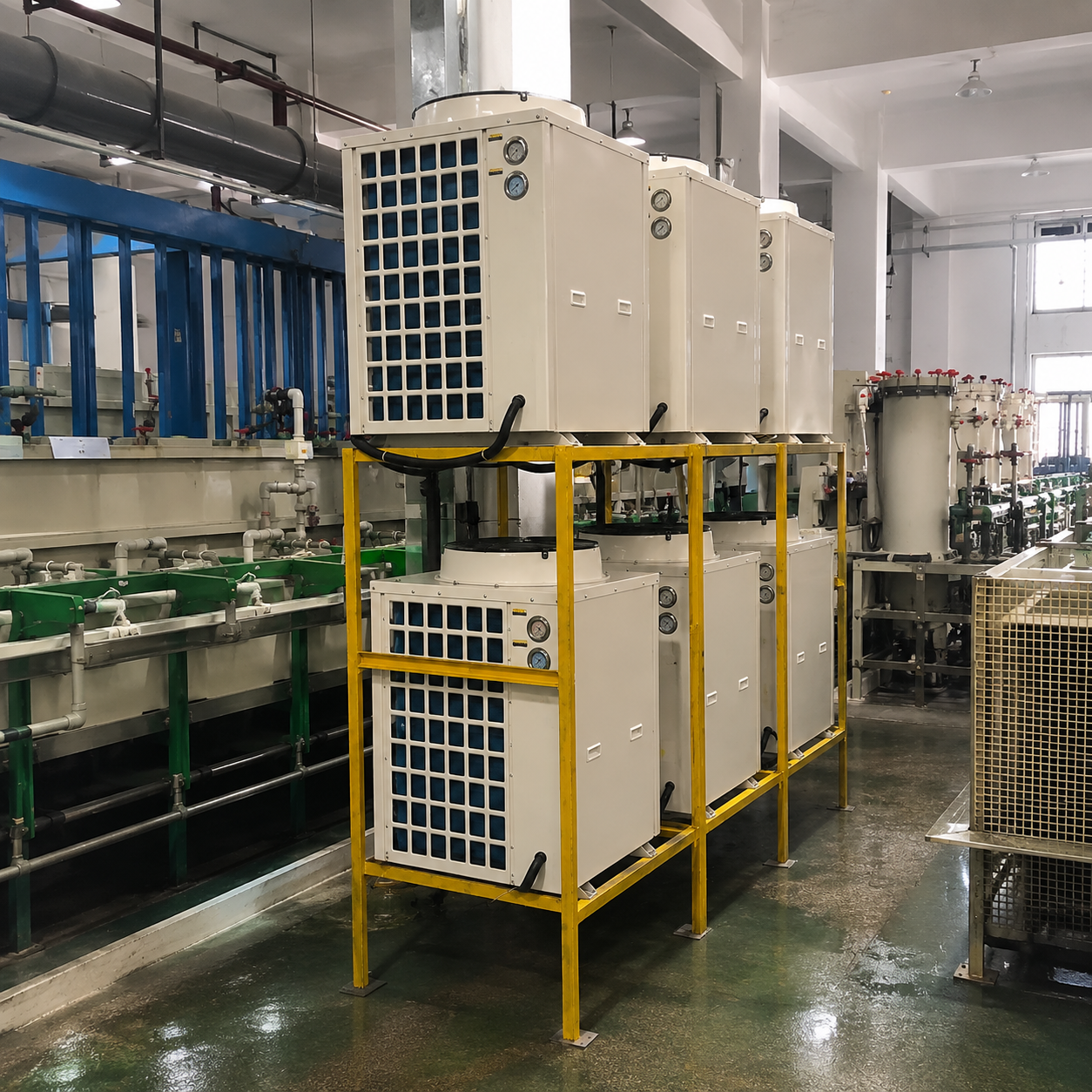
Project Summary
Project type
Cooling for plating tanks, anodizing lines, chemical baths, rectifiers, and surface treatment production lines.
Main cooling challenge
Corrosive environment, acid or alkaline fluids, tank temperature stability, heat exchanger material, and water quality control.
Recommended design direction
Corrosion-resistant chiller with titanium, stainless steel, PVC, or suitable heat exchanger design based on process fluid conditions.
Typical equipment / industry
Electroplating plants, anodizing lines, surface treatment, chemical tanks, rectifiers, and process bath temperature control.
Project Overview
Industrial chiller projects are rarely solved by selecting a catalog model only. Real project conditions include cooling capacity, inlet and outlet water temperature, ambient temperature, condenser type, pump flow and pressure, tank volume, heat exchanger material, refrigerant circuit design, power supply, control logic, installation environment, and delivery requirements.
APT is an engineering-based industrial chiller manufacturer supporting precision process cooling, custom cooling systems, high ambient industrial operation, corrosion-resistant cooling design, explosion-proof design discussion, OEM integrated cooling, and export-oriented project communication.
The purpose of this project guide is to help engineers, overseas buyers, equipment manufacturers, purchasing teams, and project managers understand what should be reviewed before requesting a chiller quotation. Good project information allows APT to recommend a practical application-specific cooling configuration rather than a generic size.
Typical Electroplating and Chemical Bath Cooling Project Scenarios
Electroplating cooling projects may involve one tank, multiple tanks, rectifier cooling, anodizing bath control, chemical process loops, or centralized surface treatment lines. The cooling system must maintain stable bath temperature while resisting corrosion and supporting long operating hours.
The heat load may come from electrical rectifiers, chemical reactions, process agitation, hot workpieces, and ambient workshop conditions. Unlike simple clean-water applications, plating and chemical bath projects must consider whether the chiller fluid contacts corrosive media directly or cools through an intermediate loop.
APT reviews these projects with an engineering mindset: cooling capacity, tank volume, temperature range, pump flow and pressure, heat exchanger material selection, corrosion risk, maintenance access, and site ventilation are all part of the design discussion.
Why Plating and Anodizing Projects Need Corrosion-Resistant Cooling Design
Plating and anodizing processes often involve acidic, alkaline, chloride-containing, or chemically active fluids. If the heat exchanger material is not compatible, corrosion can cause leakage, contamination, downtime, and expensive maintenance.
Corrosion-resistant cooling design may use titanium, stainless steel, PVC, or other materials depending on the fluid. The correct choice depends on chemical concentration, temperature, pH, conductivity, chloride level, and whether the process fluid directly contacts the heat exchanger.
APT avoids assuming one material fits all plating projects. Customers should provide fluid information before quotation so the cooling design can match the actual process.
Main Project Challenges: Tanks, Rectifiers, and Corrosion Risk
Bath temperature stability affects plating quality, coating consistency, chemical reaction rate, and production repeatability. If the bath becomes too warm, the process may become unstable or product defects may increase.
Rectifiers add heat to the production line and may need their own cooling consideration. Multiple tanks can require branch control, flow balancing, and sufficient pump capacity. In addition, corrosive mist around the installation area can affect electrical cabinets and external components.
Water quality and scaling prevention remain important even when corrosion-resistant materials are used. Fouling or blockage can reduce heat transfer and create pump flow problems.
Titanium and Stainless Steel Heat Exchanger Options
Titanium heat exchangers are often considered for aggressive chemical or plating environments, while stainless steel may be suitable for many industrial water or less aggressive fluid conditions. PVC or special anti-corrosion designs may also be reviewed for certain applications.
APT can support heat exchanger selection and manufacturing discussion based on process fluid and project requirements. The goal is to reduce corrosion risk while maintaining heat transfer performance and practical maintenance access.
Project Challenges to Review
Chemical compatibility
Fluid chemistry must be matched with heat exchanger material before final configuration.
Stable bath temperature
Tank temperature affects plating consistency, anodizing quality, and process repeatability.
Corrosive atmosphere
Electrical cabinet and external components may need location and protection review.
Multiple tank layouts
Branch flow, tank volume, and piping resistance can affect cooling performance.
APT Engineering Solution Approach
APT customizes industrial chillers according to real project conditions. Engineers review cooling capacity, inlet and outlet water temperature, ambient temperature, condenser type, pump flow and pressure, water tank volume, heat exchanger material, refrigerant circuit design, power supply and electrical control, PLC or communication requirements, installation environment, and export packaging needs.
This engineering-based technical support helps match the chiller to the process instead of forcing the process to fit a standard machine. For demanding applications, APT can discuss high-ambient condenser design, corrosion-resistant heat exchangers, explosion-proof design requirements subject to confirmed classification, special voltage, compact layout, OEM integrated cooling, and long-term service access.
Recommended Project Configuration Table
| Project scenario | Cooling requirement | Recommended chiller design | Key engineering note |
|---|---|---|---|
| Single plating tank | Stable bath temperature and corrosion resistance | Chiller with compatible immersion or external heat exchanger | Confirm fluid chemistry and direct or indirect cooling method. |
| Anodizing line | Continuous cooling with chemical compatibility | Water-cooled or air-cooled chiller with titanium option | Review tank size, bath temperature, and operating hours. |
| Rectifier cooling | Heat removal from electrical equipment | Closed-loop chiller with clean water circuit | Separate equipment cooling from corrosive bath when needed. |
| Multi-tank surface treatment | Branch flow and tank temperature control | Custom pump, manifold, and heat exchanger arrangement | Provide layout drawings for accurate pump selection. |
Project Information Checklist Before Quotation
To help APT engineers prepare a suitable project-based chiller design, provide as much of the following information as possible:
- Process or equipment type
- Estimated heat load, machine power, or required cooling capacity
- Required inlet and outlet water temperature
- Ambient temperature and installation location
- Cooling medium or process fluid
- Required pump flow and pressure
- Power supply, voltage, phase, and frequency
- Heat exchanger material requirement
- Safety, electrical, or site standard requirement
- Photos, drawings, or layout information of the installation site if available
FAQ
What type of chiller is suitable for electroplating cooling projects?
Electroplating projects often require corrosion-resistant chillers with suitable heat exchanger material, stable temperature control, reliable pump flow, and practical maintenance access.
When is a titanium heat exchanger required?
Titanium may be considered when the process fluid is highly corrosive or when standard materials are not compatible. Final selection depends on confirmed fluid chemistry and operating temperature.
Can one chiller cool multiple plating tanks?
Yes, but pump flow, branch balance, tank volume, temperature range, and control method must be reviewed carefully.
Should the chiller directly cool chemical bath liquid?
Direct or indirect cooling depends on process fluid, corrosion risk, heat exchanger material, cleaning needs, and process safety. APT can discuss both methods with the customer.
What information is needed for a plating chiller project quote?
Provide tank size, fluid chemistry, target temperature, heat load, operating hours, ambient temperature, pump distance, voltage, and any material requirements.
Need help designing a chiller for your industrial project?
APT engineers can help review your process conditions, cooling capacity, temperature range, pump pressure, condenser type, heat exchanger material, and installation environment. Share your application details, drawings, site conditions, and special requirements to start a practical project discussion.