
Mobile Industrial Chillers for Flexible Process Cooling
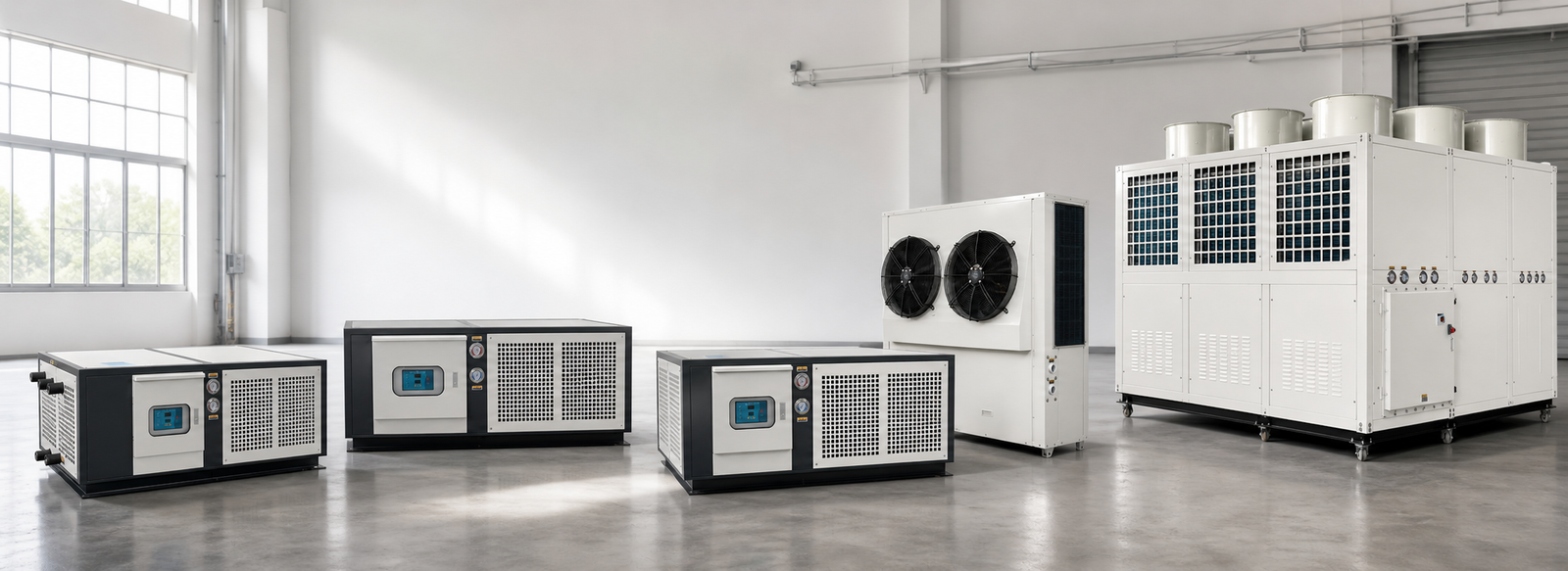
APT mobile industrial chillers are custom process cooling systems designed for temporary cooling, equipment testing, maintenance backup, factory relocation, machine-side cooling, and flexible industrial process cooling applications. The chiller cabinet, caster base, pump, tank, quick water connection, power supply, control panel, protection logic, hose connection, and service access can be configured according to cooling load, process temperature, floor condition, movement frequency, and site layout.
When Should You Choose a Mobile Industrial Chiller?
A mobile industrial chiller should be reviewed when a process cooling system needs to be moved between machines, used for temporary cooling, connected during equipment testing, used as backup cooling during maintenance, or placed near different production equipment at different times. It is commonly used for factory equipment cooling, machine-side cooling, laboratory testing, trial production, maintenance support, and flexible process cooling applications.
Final mobile chiller design should be reviewed according to cooling capacity, caster load, floor condition, water hose length, pump pressure, power connection, drainage, vibration, safety, and movement frequency.
When Do You Need This Custom Direction?
Temporary Cooling Requirement
Temporary cooling is often needed during equipment testing, trial production, process adjustment, emergency support, or replacement of an existing cooling system.
Machine-Side Cooling
A movable chiller can be positioned near CNC machines, laser equipment, laboratory systems, testing equipment, or production machines that require independent cooling.
Maintenance Backup Cooling
Backup cooling may be needed when the main cooling system is under maintenance or when a production line needs short-term cooling continuity.
Flexible Factory Layout
Factories with changing equipment layout may need a chiller that can be relocated with suitable caster base, piping connection, power supply, and service access.
Mobile Chiller Selection Matrix
Use this matrix to identify the right mobile chiller configuration for temporary cooling, machine-side cooling, backup cooling, factory relocation, or testing applications. Each project type requires different information before APT can recommend the correct cooling capacity, pump configuration, connection method, and mobile cabinet design.
| Project Condition | Recommended Design Direction | Typical Use Cases | Key Engineering Review | Next Step |
|---|---|---|---|---|
| Temporary cooling | Mobile process chiller | Trial production, short-term cooling, testing loop, emergency process cooling | Cooling load, required runtime, water connection, drainage method, available power supply | Submit Temporary Cooling Requirements |
| Machine-side cooling | Movable equipment-side chiller | CNC machines, laser systems, laboratory equipment, testing machines | Distance to machine, hose length, pump pressure, water flow, required temperature stability | Submit Machine Cooling Details |
| Maintenance backup | Backup mobile industrial chiller | Main chiller maintenance, factory backup cooling, emergency production support | Existing chiller capacity, connection method, operating hours, compatibility with current cooling loop | Submit Backup Cooling Requirements |
| Factory relocation | Caster-mounted industrial chiller | Flexible factory layout, process line adjustment, movable production support | Caster load, floor condition, vibration, movement frequency, service access, hose routing | Submit Installation Layout |
| Testing and R&D | Mobile testing chiller | Lab test bench, prototype equipment, pilot process, process development | Temperature range, flow control, pump pressure, control interface, test duration | Submit Testing Cooling Requirements |
Not sure which mobile chiller configuration fits your project? Use the Industrial Chiller Selection Tool or submit your cooling requirements for engineering review.
Mobile Chiller Engineering Design Points
Caster Base and Frame Strength
The frame base and caster direction should be reviewed according to equipment weight, floor condition, and expected movement frequency.
Pump and Tank Integration
Pump, tank, and cabinet balance should be arranged to support mobility while maintaining stable process water circulation.
Quick Water Connection
Quick connectors, hose direction, and port layout should be selected according to connection speed, leakage control, and routing safety.
Power Supply and Cable Management
Power inlet, cable route, plug style, and relocation procedure should be reviewed for the actual workshop and testing environment.
Control Panel and Protection Logic
Controller position, alarm logic, remote start-stop, and electrical protection should match temporary or machine-side use conditions.
Floor, Movement, and Service Access Review
Floor flatness, vibration, hose routing, drainage, and maintenance access should be confirmed before defining a mobile layout direction.
Technical Specification Direction
| Parameter | Typical Direction / Options | Engineering Notes |
|---|---|---|
| Cooling Capacity | Project-specific / compact to medium-duty mobile systems | Cooling capacity should be reviewed according to heat load and operating duty. |
| Chiller Type | Mobile air-cooled chiller / movable process chiller / custom cabinet chiller | The final cabinet and mobility direction should match actual use conditions. |
| Cooling Method | Air-cooled / water-cooled / project-specific | Cooling method depends on available utilities and heat rejection condition. |
| Mobility Design | Caster base / forklift base / movable frame / vibration review | Movement method should be selected according to floor condition and relocation frequency. |
| Cooling Medium | Water / glycol / clean water / process fluid by review | Cooling medium affects pump sizing, tank arrangement, and water circuit direction. |
| Pump | Standard / high-flow / high-pressure / stainless / external pump | Pump pressure and flow should match hose length, machine-side loop, and process stability needs. |
| Water Tank | Built-in / stainless / external / buffer tank | Tank size should follow the loop volume, mobility target, and cabinet balance. |
| Connection | Quick water connector / hose connection / threaded connection / custom port | Connection style should be reviewed for relocation speed, leak control, and service convenience. |
| Power Supply | 220V / 380V / 400V / 415V / 460V / 50Hz / 60Hz / custom | Power supply should match the actual factory or test-area electrical source. |
| Control | Digital / PLC / HMI / alarm output / remote start-stop / Modbus | Control logic can be adjusted according to testing or equipment-side integration needs. |
| Protection | High/low pressure, overload, phase, flow, anti-freeze, high temperature alarm | Protection scope should be defined according to process duty and movement risk. |
| Installation | Machine-side / testing area / temporary production / maintenance backup | Final installation direction should be matched to the actual use scenario and access path. |
| Documentation | Layout drawing, connection diagram, wiring diagram, inspection photos | Documentation can be adjusted according to project and delivery requirements. |
Example Direction: Mobile Industrial Chiller for Equipment-Side Cooling
Mobile Industrial Chiller for Flexible Equipment-Side Process Cooling
APT can configure mobile industrial chillers for equipment-side process cooling where the customer needs movable positioning, integrated pump and tank, caster base, quick water connection, stable process cooling, and easy relocation between factory equipment or testing areas. The final configuration should be reviewed according to cooling capacity, floor condition, movement frequency, hose length, pump pressure, and power supply.
Suitable vs Not Recommended Conditions
Suitable For
- Temporary process cooling
- Equipment testing
- Maintenance backup cooling
- Machine-side cooling
- Laboratory test benches
- CNC machine cooling
- Laser equipment cooling
- Small production line cooling
- Flexible factory layout
- Projects requiring quick connection and relocation
Not Recommended For
- Very rough or uneven floors without caster review
- Applications requiring frequent outdoor transport without cabinet protection
- Large-capacity centralized cooling systems
- Sites without stable power supply
- Installations without safe hose routing
- Applications where fixed piping is clearly better
- High ambient outdoor projects without T3 review
- Hazardous areas without explosion-proof safety review
Application Fit Matrix
| Application | Fit Level | Typical Cooling Need | Engineering Review | Related Page |
|---|---|---|---|---|
| Equipment Testing Cooling | High | Temporary cooling loop for testing or commissioning work | Runtime, hose routing, control access, cooling load | View Page |
| CNC Machine Cooling | High | Movable cooling support near machine tools or spindle systems | Distance to machine, pump pressure, service access, hose length | View Page |
| Laser Equipment Cooling | High | Flexible equipment-side chilled-water support | Temperature stability, connection layout, relocation needs | View Page |
| Laboratory Process Cooling | Medium to High | Movable cooling support for test benches and pilot systems | Footprint, noise, power access, temperature range | View Page |
| Maintenance Backup Cooling | High | Short-term support when the main cooling system is unavailable | Capacity matching, temporary connection method, compatibility | View Page |
| Small Production Line Cooling | Medium to High | Flexible cooling for changing production layout | Floor condition, drainage, heat rejection, movement frequency | View Page |
| Machine-Side Process Cooling | High | Local cooling support that can be repositioned as needed | Hose length, pipe routing, caster movement path, power supply | View Page |
| Temporary Factory Cooling | Medium | Short-term production support or relocation cooling | Operating hours, floor path, cable management, backup planning | View Page |
Quote Information Checklist for Mobile Industrial Chillers
What APT Needs to Review
Mobile chiller projects depend on movement conditions as much as cooling duty. Sharing relocation details, hose routing, floor condition, and power access early helps confirm whether a mobile, vertical compact, or other custom direction is more suitable.
- Application or machine type
- Required cooling capacity or heat load
- Temporary or continuous use
- Movement frequency
- Available floor condition
- Required caster or frame design
- Indoor or outdoor use
- Air inlet and air outlet direction
- Water hose length and connection type
- Chilled-water inlet and outlet temperature
- Flow rate and pump pressure
- Coolant type
- Water tank requirement
- Voltage / phase / frequency
- Control requirements: digital controller, PLC, alarm, Modbus
- Noise or indoor installation concerns
- Maintenance access requirement
- Photos, layout drawings, machine drawings, existing chiller data
- Destination country
Related Custom Chiller Pages
Mobile Industrial Chiller FAQ
What is a mobile industrial chiller?
A mobile industrial chiller is a custom process cooling system designed for movable or flexible-use scenarios where the chiller may need to be positioned near different machines, testing areas, or temporary process locations.
When do I need a mobile chiller instead of a fixed chiller?
You may need a mobile chiller when cooling is temporary, machine-side position changes over time, backup support is needed during maintenance, or the process layout requires relocation between different use points.
Can a mobile chiller be used for temporary process cooling?
Yes. Mobile chillers are commonly reviewed for temporary process cooling, but the final design should still be matched to cooling load, runtime, connection method, and power availability.
Can APT customize chillers with casters or movable frames?
Yes. APT can review caster base, movable frame, forklift handling direction, cabinet layout, and connection arrangement according to the actual relocation requirement.
What should be checked before moving an industrial chiller between machines?
Floor condition, caster load, vibration risk, hose routing, cable length, water connection, drainage, and service access should all be reviewed before planning repeated movement.
Can mobile chillers be used for equipment testing?
Yes. Mobile chillers are often reviewed for equipment testing, pilot systems, commissioning work, and prototype process cooling where flexible positioning is useful.
Can a mobile chiller be used as backup cooling during maintenance?
Yes. A mobile chiller can be suitable as backup cooling during maintenance when required capacity, connection compatibility, and operating duration are reviewed for the actual system.
What information is needed before designing a mobile chiller?
APT should review the application, heat load, movement frequency, floor condition, hose length, chilled-water temperature, pump pressure, power supply, connection type, and equipment layout before recommending a final mobile chiller direction.
Is a mobile chiller suitable for outdoor use?
It can be suitable for some outdoor or semi-outdoor use cases, but cabinet protection, ambient temperature, floor condition, rain or dust exposure, and electrical safety should be reviewed first.
When should I choose a fixed chiller instead?
A fixed chiller may be more suitable when the installation point is permanent, fixed piping is clearly better, large-capacity duty is required, or movement would add unnecessary hose, ventilation, or safety complexity.
Need a Mobile Industrial Chiller for Flexible Process Cooling?
Share your application, cooling capacity, movement frequency, floor condition, hose length, pump pressure, water temperature, voltage, power connection, installation layout, and equipment photos. APT engineers can review whether a mobile industrial chiller, vertical compact chiller, or another custom chiller direction is more suitable for your project.