
T3 High Ambient Industrial Chillers for Hot Climate Process Cooling
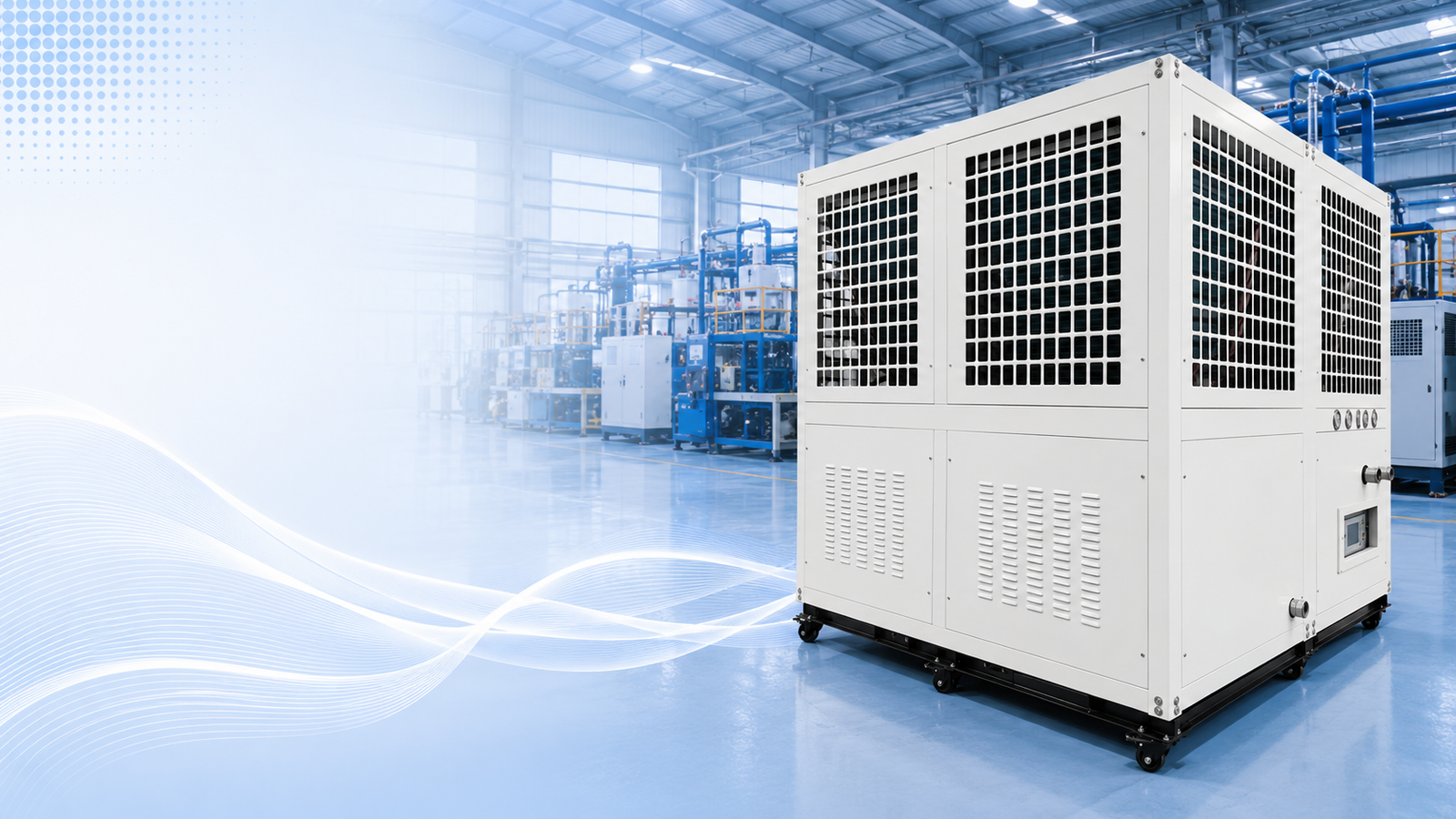
APT T3 high ambient industrial chillers are custom air-cooled process cooling systems designed for hot climate regions, Middle East factories, outdoor installation, high-temperature workshops, and continuous industrial operation. The refrigeration system, condenser size, airflow path, compressor margin, electrical protection, pump, tank, voltage, and control logic can be configured according to ambient temperature, cooling load, installation layout, and process requirements.
When Should You Choose a T3 High Ambient Industrial Chiller?
A T3 high ambient industrial chiller is suitable when the chiller must operate in hot climate regions, outdoor installation areas, high-temperature workshops, or factory environments where standard air-cooled chillers may lose performance due to high condenser air temperature. It is commonly reviewed for Middle East projects, injection molding factories, die casting plants, chemical process cooling, outdoor process cooling, and continuous industrial production where stable cooling performance is required under high ambient conditions.
When Do You Need This Custom Direction?
High Ambient Temperature
When outdoor or workshop temperature may reach 40°C, 45°C, or higher, condenser capacity and compressor operating margin must be reviewed.
Outdoor Installation
Outdoor installation requires airflow clearance, cabinet protection, electrical protection, service access, and heat rejection review.
Continuous Industrial Operation
Long-hour operation needs stable refrigeration design, suitable compressor selection, reliable condenser performance, and safety protection.
Hot Climate Export Projects
Middle East, tropical, and high-temperature regions require voltage, ambient temperature, cooling margin, and installation condition review before quotation.
T3 High Ambient Chiller Selection Matrix
| Project Condition | Recommended Design Direction | Typical Use Cases | Key Engineering Review | Next Step |
|---|---|---|---|---|
| High ambient factory | T3 high ambient air-cooled chiller | Middle East factory, hot workshop, outdoor equipment area | Ambient temperature, condenser size, compressor margin, airflow clearance | Request High Ambient Review |
| Outdoor process cooling | Outdoor custom air-cooled chiller | Outdoor process water cooling, factory utility area, equipment yard | Cabinet protection, ventilation, dust, rain protection, service access | Submit Outdoor Layout |
| Continuous production | Heavy-duty industrial process chiller | Injection molding, die casting, chemical process cooling, production lines | Operating hours, heat load fluctuation, pump flow, water temperature stability | Request Process Review |
| Large heat rejection | Enlarged condenser / high airflow design | Hot climate air-cooled chiller projects | Condenser surface area, fan arrangement, airflow direction, ambient temperature | Review Condenser Design |
| Export voltage / site power | Custom electrical configuration | Middle East, Southeast Asia, Africa, Latin America export projects | Voltage, phase, frequency, electrical protection, control cabinet | Confirm Voltage |
High Ambient Engineering Design Points
Enlarged Air-Cooled Condenser
Condenser surface area is typically reviewed against local maximum ambient temperature, project cooling load, and operating duty rather than a fixed standard layout.
Compressor Operating Margin
Compressor selection should be checked for high ambient condensing pressure, operating hours, and expected process water stability under hot climate conditions.
High Airflow Condenser Fan Design
Fan quantity, arrangement, airflow path, and condenser discharge direction should be reviewed according to outdoor or workshop installation conditions.
Outdoor Cabinet and Service Access
Outdoor projects often require cabinet protection, service clearance, ventilation planning, and easier access for maintenance in hot or dusty environments.
Electrical Protection and Control Logic
Voltage, frequency, electrical margin, high temperature alarm, and control logic should be matched to destination country and working condition.
Pump, Tank, and Process Loop Matching
Pump flow, water tank size, coolant type, and loop resistance should be reviewed according to process temperature stability and production duty.
Technical Specification Direction
| Parameter | Typical Direction / Options | Engineering Notes |
|---|---|---|
| Cooling Capacity | Project-specific / example 40 HP direction | Capacity should be reviewed according to actual heat load and ambient temperature. |
| Chiller Type | T3 high ambient custom air-cooled industrial chiller | Final direction depends on installation and operating conditions. |
| Ambient Temperature | 40°C / 45°C+ project review | High ambient design should be reviewed by actual site maximum condition. |
| Cooling Medium | Water / glycol / process fluid by review | Coolant compatibility may affect evaporator and pump direction. |
| Leaving Water Temperature | Project-specific, commonly reviewed by process requirement | Do not treat leaving water temperature as a fixed standard for all projects. |
| Compressor | Scroll / semi-hermetic / project-specific | Compressor margin should be checked for high ambient operation. |
| Condenser | Enlarged air-cooled condenser / high airflow design | Condenser size and airflow direction should be matched to ambient condition. |
| Evaporator | Plate / shell-and-tube / tank coil / stainless or special material options | Evaporator direction depends on fluid, maintenance, and process loop design. |
| Pump | Standard / high-flow / high-pressure / external pump | Pump selection should be reviewed by flow, pressure, and circuit resistance. |
| Water Tank | Built-in / external / buffer tank | Tank arrangement should be matched to system volume and operating stability. |
| Voltage | 380V / 400V / 415V / 460V / 50Hz / 60Hz / custom | Export voltage and protection should be confirmed before quotation. |
| Control | Digital / PLC / HMI / remote alarm / Modbus | Control logic may be adjusted by project monitoring and integration needs. |
| Protection | High/low pressure, overload, phase, flow, anti-freeze, high temperature alarm | Protection direction should reflect operating environment and risk review. |
| Installation | Outdoor / indoor high-temperature workshop / utility area | Layout, ventilation, and service access should be checked before final design. |
| Customization | Condenser, airflow, cabinet, voltage, pump, tank, controls, materials | T3 high ambient design should be treated as a project-specific engineering direction. |
Example Case: 40HP High Ambient Air-Cooled Chiller
40HP T3 High Ambient Air-Cooled Chiller for Hot Climate Industrial Cooling
APT configured a 40HP high ambient air-cooled chiller for hot climate industrial process cooling. The project required stable operation in demanding ambient temperature conditions, enlarged condenser design, reliable refrigeration protection, industrial water circulation, export voltage review, and continuous factory cooling support.
Suitable vs Not Suitable Conditions
Suitable For
- Hot climate regions
- Middle East industrial cooling
- Outdoor process cooling
- High-temperature workshops
- Injection molding factories
- Die casting production
- Chemical process cooling
- Continuous industrial production
- Sites without cooling tower water
- Projects requiring custom condenser margin
Not Recommended For
- Sites with insufficient condenser airflow clearance
- Indoor rooms without ventilation
- Applications where water-cooled systems are clearly more suitable
- Explosion-proof areas without safety redesign
- Corrosive air environments without cabinet and material review
- Very low-temperature applications without special refrigeration review
Application Fit Matrix
| Application | Fit Level | Typical Cooling Need | Engineering Review |
|---|---|---|---|
| Middle East Factory Cooling | High | High ambient factory process cooling under long-hour operation | Ambient temperature, condenser margin, export voltage, airflow clearance |
| Outdoor Industrial Cooling | High | Outdoor process water cooling with weather and dust exposure | Cabinet protection, service access, airflow path, operating condition |
| Injection Molding Cooling | High | Mold cooling, hydraulic support, stable chilled-water control | Operating hours, heat fluctuation, water temperature stability, pump flow |
| Die Casting Cooling | High | Continuous duty cooling for foundry and hot workshop equipment | Ambient temperature, heavy heat load, condenser margin, outdoor layout |
| Chemical Process Cooling | Medium to High | Process loop temperature control with hot climate exposure | Fluid compatibility, control logic, ambient temperature, service access |
| Thermal Spray Auxiliary Cooling | Medium to High | Auxiliary equipment and closed-loop process cooling | Duty cycle, ambient temperature, dust, airflow, water temperature stability |
| Laser / Equipment Cooling | Medium | Precision equipment cooling in hot workshop or utility area | Temperature control accuracy, airflow, ambient condition, layout |
| Production Line Process Cooling | High | Continuous industrial production cooling support | Operating hours, redundancy review, process temperature stability, ambient heat rejection |
Quote Information Checklist for T3 High Ambient Chillers
What APT Needs to Review
Hot climate chiller projects require both normal process data and ambient-condition review. Sharing site temperature, installation layout, and operating duty helps APT determine whether a T3 high ambient custom air-cooled chiller is the right direction.
- Application or machine type
- Required cooling capacity or process heat load
- Ambient temperature: normal, maximum, and design condition
- Indoor or outdoor installation
- Available airflow clearance around condenser
- Chilled-water inlet and outlet temperature
- Flow rate and pump pressure
- Coolant type
- Operating hours and duty cycle
- Voltage / phase / frequency
- Installation space and service access
- Dust, rain, corrosion, or outdoor exposure conditions
- Control requirements: digital controller, PLC, remote alarm, Modbus
- Photos, layout drawings, existing chiller data
- Destination country
Related Custom Chiller Pages
T3 High Ambient Industrial Chiller FAQ
What is a T3 high ambient industrial chiller?
A T3 high ambient industrial chiller is a custom industrial chiller direction reviewed for operation in hot climate regions, high-temperature workshops, or outdoor installation conditions where standard air-cooled chiller performance may need additional condenser and operating margin review.
When do I need a high ambient chiller?
You should review a high ambient chiller when local ambient temperature, installation layout, or continuous production duty could reduce the performance or reliability margin of a standard air-cooled chiller.
Can a high ambient chiller operate in 45°C ambient temperature?
It may be suitable, but 45°C ambient operation should be reviewed according to condenser size, compressor selection, airflow path, chilled-water temperature, and actual project duty conditions rather than assumed by default.
Is this chiller suitable for Middle East projects?
Yes, T3 high ambient chillers are commonly reviewed for Middle East and other hot climate export projects, especially when outdoor installation, high workshop temperature, and export voltage requirements are involved.
What is different between a standard air-cooled chiller and a T3 high ambient chiller?
A T3 high ambient chiller usually requires additional review of condenser capacity, airflow design, compressor operating margin, cabinet layout, electrical protection, and site condition to support hot climate operation more reliably.
What information is needed before designing a high ambient chiller?
APT should review the application, heat load, leaving water temperature, flow rate, maximum ambient temperature, indoor or outdoor installation, airflow clearance, operating hours, voltage, and site layout before recommending a final design direction.
Can APT customize the condenser and airflow design?
Yes. Condenser size, fan arrangement, airflow direction, cabinet ventilation, and service access can be reviewed according to ambient temperature and installation layout.
Can APT customize voltage and control systems for export projects?
Yes. Voltage, frequency, protection logic, digital controller, PLC, HMI, remote alarm, and communication options can be reviewed for export and project-specific requirements.
Is a high ambient chiller suitable for outdoor installation?
It can be suitable when outdoor layout, cabinet protection, service access, ventilation, dust exposure, rain protection, and condenser airflow clearance are reviewed as part of the project design.
When should I choose a water-cooled chiller instead?
A water-cooled chiller may be more suitable when the site already has stable cooling tower water, centralized utility infrastructure, or operating conditions that clearly favor water-cooled heat rejection over air-cooled outdoor installation.
Need a T3 High Ambient Chiller for Hot Climate Operation?
Share your ambient temperature, application, cooling capacity, chilled-water temperature, flow rate, pump pressure, installation layout, voltage, operating hours, and site conditions. APT engineers can review whether a T3 high ambient industrial chiller or another custom chiller direction is more suitable for your project.